

Oct-2021 Google Professional-Data-Engineer Actual Questions and Braindumps
Professional-Data-Engineer Dumps To Pass Google Exam in 24 Hours - Prep4King
Who is the Professional Data Engineer Exam Intended for?
This exam is designed for individuals who are experts in designing, building, securing, and monitoring data processing systems with a particular emphasis on compliance and security. The candidate who wants to take the Professional Data Engineer exam should have the ability to deploy, leverage, and training pre-existing machine learning models. Moreover, every applicant should have experience of more than 3 years including 1-year experience in designing and handling solutions utilizing GCP.
The benefit of obtaining the Google Professional Data Engineer Exam Certification
A Professional Data Engineer enables data-driven decision making by collecting, transforming, and publishing data. A data engineer should be able to design, build, operationalize, secure, and monitor data processing systems with a particular emphasis on security and compliance; scalability and efficiency; reliability and fidelity; and flexibility and portability. A data engineer should also be able to leverage, deploy, and continuously train pre-existing machine learning models.
NEW QUESTION 93
You need to move 2 PB of historical data from an on-premises storage appliance to Cloud Storage within six months, and your outbound network capacity is constrained to 20 Mb/sec. How should you migrate this data to Cloud Storage?
- A. Use Transfer Appliance to copy the data to Cloud Storage
- B. Create a private URL for the historical data, and then use Storage Transfer Service to copy the data to Cloud Storage
- C. Use gsutil cp -Jto compress the content being uploaded to Cloud Storage
- D. Use trickle or ionice along with gsutil cp to limit the amount of bandwidth gsutil utilizes to less than 20 Mb/ sec so it does not interfere with the production traffic
Answer: A
Explanation:
Explanation/Reference:
NEW QUESTION 94
You want to use a BigQuery table as a data sink. In which writing mode(s) can you use BigQuery as a sink?
- A. Only batch
- B. Both batch and streaming
- C. Only streaming
- D. BigQuery cannot be used as a sink
Answer: B
Explanation:
When you apply a BigQueryIO.Write transform in batch mode to write to a single table, Dataflow invokes a BigQuery load job. When you apply a BigQueryIO.Write transform in streaming mode or in batch mode using a function to specify the destination table, Dataflow uses BigQuery's streaming inserts Reference: https://cloud.google.com/dataflow/model/bigquery-io
NEW QUESTION 95
After migrating ETL jobs to run on BigQuery, you need to verify that the output of the migrated jobs is the same as the output of the original. You've loaded a table containing the output of the original job and want to compare the contents with output from the migrated job to show that they are identical. The tables do not contain a primary key column that would enable you to join them together for comparison.
What should you do?
- A. Create stratified random samples using the OVER() function and compare equivalent samples from each table.
- B. Use a Dataproc cluster and the BigQuery Hadoop connector to read the data from each table and calculate a hash from non-timestamp columns of the table after sorting. Compare the hashes of each table.
- C. Select random samples from the tables using the RAND() function and compare the samples.
- D. Select random samples from the tables using the HASH() function and compare the samples.
Answer: B
Explanation:
Full comparison with this option, rest are comparison on sample which doesn't ensure all the data will be ok.
NEW QUESTION 96
Which of these is not a supported method of putting data into a partitioned table?
- A. Run a query to get the records for a specific day from an existing table and for the destination table, specify a partitioned table ending with the day in the format "$YYYYMMDD".
- B. Create a partitioned table and stream new records to it every day.
- C. If you have existing data in a separate file for each day, then create a partitioned table and upload each file into the appropriate partition.
- D. Use ORDER BY to put a table's rows into chronological order and then change the table's type to "Partitioned".
Answer: D
Explanation:
You cannot change an existing table into a partitioned table. You must create a partitioned table from scratch. Then you can either stream data into it every day and the data will automatically be put in the right partition, or you can load data into a specific partition by using "$YYYYMMDD" at the end of the table name.
Reference: https://cloud.google.com/bigquery/docs/partitioned-tables
NEW QUESTION 97
What is the HBase Shell for Cloud Bigtable?
- A. The HBase shell is a command-line tool that performs administrative tasks, such as creating and deleting tables.
- B. The HBase shell is a GUI based interface that performs administrative tasks, such as creating and deleting tables.
- C. The HBase shell is a command-line tool that performs only user account management functions to grant access to Cloud Bigtable instances.
- D. The HBase shell is a hypervisor based shell that performs administrative tasks, such as creating and deleting new virtualized instances.
Answer: A
Explanation:
Explanation
The HBase shell is a command-line tool that performs administrative tasks, such as creating and deleting tables. The Cloud Bigtable HBase client for Java makes it possible to use the HBase shell to connect to Cloud Bigtable.
Reference: https://cloud.google.com/bigtable/docs/installing-hbase-shell
NEW QUESTION 98
You have spent a few days loading data from comma-separated values (CSV) files into the Google BigQuery table CLICK_STREAM. The column DT stores the epoch time of click events. For convenience, you chose a simple schema where every field is treated as the STRING type. Now, you want to compute web session durations of users who visit your site, and you want to change its data type to the TIMESTAMP. You want to minimize the migration effort without making future queries computationally expensive. What should you do?
- A. Add a column TS of the TIMESTAMP type to the table CLICK_STREAM, and populate the numeric values from the column TS for each row. Reference the column TS instead of the column DT from now on.
- B. Construct a query to return every row of the table CLICK_STREAM, while using the built-in function to cast strings from the column DT into TIMESTAMP values. Run the query into a destination table NEW_CLICK_STREAM, in which the column TS is the TIMESTAMP type. Reference the table NEW_CLICK_STREAM instead of the table CLICK_STREAM from now on. In the future, new data is loaded into the table NEW_CLICK_STREAM.
- C. Delete the table CLICK_STREAM, and then re-create it such that the column DT is of the TIMESTAMP type. Reload the data.
- D. Add two columns to the table CLICK STREAM: TS of the TIMESTAMP type and IS_NEW of the BOOLEAN type. Reload all data in append mode. For each appended row, set the value of IS_NEW to true. For future queries, reference the column TS instead of the column DT, with the WHERE clause ensuring that the value of IS_NEW must be true.
- E. Create a view CLICK_STREAM_V, where strings from the column DT are cast into TIMESTAMP values. Reference the view CLICK_STREAM_V instead of the table CLICK_STREAM from now on.
Answer: D
Explanation:
Topic 1, Flowlogistic Case Study
Company Overview
Flowlogistic is a leading logistics and supply chain provider. They help businesses throughout the world manage their resources and transport them to their final destination. The company has grown rapidly, expanding their offerings to include rail, truck, aircraft, and oceanic shipping.
Company Background
The company started as a regional trucking company, and then expanded into other logistics market. Because they have not updated their infrastructure, managing and tracking orders and shipments has become a bottleneck. To improve operations, Flowlogistic developed proprietary technology for tracking shipments in real time at the parcel level. However, they are unable to deploy it because their technology stack, based on Apache Kafka, cannot support the processing volume. In addition, Flowlogistic wants to further analyze their orders and shipments to determine how best to deploy their resources.
Solution Concept
Flowlogistic wants to implement two concepts using the cloud:
* Use their proprietary technology in a real-time inventory-tracking system that indicates the location of their loads
* Perform analytics on all their orders and shipment logs, which contain both structured and unstructured data, to determine how best to deploy resources, which markets to expand info. They also want to use predictive analytics to learn earlier when a shipment will be delayed.
Existing Technical Environment
Flowlogistic architecture resides in a single data center:
* Databases
* 8 physical servers in 2 clusters
* SQL Server - user data, inventory, static data
* 3 physical servers
* Cassandra - metadata, tracking messages
10 Kafka servers - tracking message aggregation and batch insert
* Application servers - customer front end, middleware for order/customs
* 60 virtual machines across 20 physical servers
* Tomcat - Java services
* Nginx - static content
* Batch servers
Storage appliances
* iSCSI for virtual machine (VM) hosts
* Fibre Channel storage area network (FC SAN) - SQL server storage
* Network-attached storage (NAS) image storage, logs, backups
* Apache Hadoop /Spark servers
* Core Data Lake
* Data analysis workloads
* 20 miscellaneous servers
* Jenkins, monitoring, bastion hosts,
Business Requirements
* Build a reliable and reproducible environment with scaled panty of production.
* Aggregate data in a centralized Data Lake for analysis
* Use historical data to perform predictive analytics on future shipments
* Accurately track every shipment worldwide using proprietary technology
* Improve business agility and speed of innovation through rapid provisioning of new resources
* Analyze and optimize architecture for performance in the cloud
* Migrate fully to the cloud if all other requirements are met
Technical Requirements
* Handle both streaming and batch data
* Migrate existing Hadoop workloads
* Ensure architecture is scalable and elastic to meet the changing demands of the company.
* Use managed services whenever possible
* Encrypt data flight and at rest
* Connect a VPN between the production data center and cloud environment SEO Statement We have grown so quickly that our inability to upgrade our infrastructure is really hampering further growth and efficiency. We are efficient at moving shipments around the world, but we are inefficient at moving data around.
We need to organize our information so we can more easily understand where our customers are and what they are shipping.
CTO Statement
IT has never been a priority for us, so as our data has grown, we have not invested enough in our technology. I have a good staff to manage IT, but they are so busy managing our infrastructure that I cannot get them to do the things that really matter, such as organizing our data, building the analytics, and figuring out how to implement the CFO' s tracking technology.
CFO Statement
Part of our competitive advantage is that we penalize ourselves for late shipments and deliveries. Knowing where out shipments are at all times has a direct correlation to our bottom line and profitability. Additionally, I don't want to commit capital to building out a server environment.
NEW QUESTION 99
When a Cloud Bigtable node fails, ____ is lost.
- A. the last transaction
- B. no data
- C. the time dimension
- D. all data
Answer: B
Explanation:
A Cloud Bigtable table is sharded into blocks of contiguous rows, called tablets, to help balance the workload of queries. Tablets are stored on Colossus, Google's file system, in SSTable format. Each tablet is associated with a specific Cloud Bigtable node.
Data is never stored in Cloud Bigtable nodes themselves; each node has pointers to a set of tablets that are stored on Colossus. As a result:
Rebalancing tablets from one node to another is very fast, because the actual data is not copied. Cloud Bigtable simply updates the pointers for each node.
Recovery from the failure of a Cloud Bigtable node is very fast, because only metadata needs to be migrated to the replacement node.
When a Cloud Bigtable node fails, no data is lost
Reference: https://cloud.google.com/bigtable/docs/overview
NEW QUESTION 100
Cloud Dataproc charges you only for what you really use with _____ billing.
- A. hour-by-hour
- B. month-by-month
- C. week-by-week
- D. minute-by-minute
Answer: D
Explanation:
One of the advantages of Cloud Dataproc is its low cost. Dataproc charges for what you really use with minute-by-minute billing and a low, ten-minute-minimum billing period.
Reference: https://cloud.google.com/dataproc/docs/concepts/overview
NEW QUESTION 101
You want to build a managed Hadoop system as your data lake. The data transformation process is composed of a series of Hadoop jobs executed in sequence. To accomplish the design of separating storage from compute, you decided to use the Cloud Storage connector to store all input data, output data, and intermediary data. However, you noticed that one Hadoop job runs very slowly with Cloud Dataproc, when compared with the on-premises bare-metal Hadoop environment (8-core nodes with 100-GB RAM).
Analysis shows that this particular Hadoop job is disk I/O intensive. You want to resolve the issue. What should you do?
- A. Allocate sufficient persistent disk space to the Hadoop cluster, and store the intermediate data of that particular Hadoop job on native HDFS
- B. Allocate additional network interface card (NIC), and configure link aggregation in the operating system to use the combined throughput when working with Cloud Storage
- C. Allocate more CPU cores of the virtual machine instances of the Hadoop cluster so that the networking bandwidth for each instance can scale up
- D. Allocate sufficient memory to the Hadoop cluster, so that the intermediary data of that particular Hadoop job can be held in memory
Answer: A
Explanation:
Its google recommended approach to use LocalDisk/HDFS to store Intermediate result and use Cloud Storage for initial and final results.
NEW QUESTION 102
You are operating a Cloud Dataflow streaming pipeline. The pipeline aggregates events from a Cloud Pub/ Sub subscription source, within a window, and sinks the resulting aggregation to a Cloud Storage bucket.
The source has consistent throughput. You want to monitor an alert on behavior of the pipeline with Cloud Stackdriver to ensure that it is processing data. Which Stackdriver alerts should you create?
- A. An alert based on a decrease of instance/storage/used_bytes for the source and a rate of change increase of subscription/num_undelivered_messages for the destination
- B. An alert based on a decrease of subscription/num_undelivered_messages for the source and a rate of change increase of instance/storage/used_bytes for the destination
- C. An alert based on an increase of subscription/num_undelivered_messages for the source and a rate of change decrease of instance/storage/used_bytes for the destination
- D. An alert based on an increase of instance/storage/used_bytes for the source and a rate of change decrease of subscription/num_undelivered_messages for the destination
Answer: C
Explanation:
Increase in number of undelivered messages shows that the messages are not getting subscribed.
NEW QUESTION 103
Your company is migrating their 30-node Apache Hadoop cluster to the cloud. They want to re-use
Hadoop jobs they have already created and minimize the management of the cluster as much as possible.
They also want to be able to persist data beyond the life of the cluster. What should you do?
- A. Create a Cloud Dataproc cluster that uses the Google Cloud Storage connector.
- B. Create a Hadoop cluster on Google Compute Engine that uses Local SSD disks.
- C. Create a Hadoop cluster on Google Compute Engine that uses persistent disks.
- D. Create a Google Cloud Dataflow job to process the data.
- E. Create a Google Cloud Dataproc cluster that uses persistent disks for HDFS.
Answer: D
NEW QUESTION 104
You have several Spark jobs that run on a Cloud Dataproc cluster on a schedule. Some of the jobs run in sequence, and some of the jobs run concurrently. You need to automate this process. What should you do?
- A. Create a Directed Acyclic Graph in Cloud Composer
- B. Create a Cloud Dataproc Workflow Template
- C. Create an initialization action to execute the jobs
- D. Create a Bash script that uses the Cloud SDK to create a cluster, execute jobs, and then tear down the cluster
Answer: B
NEW QUESTION 105
You are deploying a new storage system for your mobile application, which is a media streaming service. You decide the best fit is Google Cloud Datastore. You have entities with multiple properties, some of which can take on multiple values. For example, in the entity 'Movie' the property 'actors' and the property 'tags' have multiple values but the property 'date released' does not. A typical query would ask for all movies with actor=<actorname> ordered by date_released or all movies with tag=Comedy ordered by date_released. How should you avoid a combinatorial explosion in the number of indexes?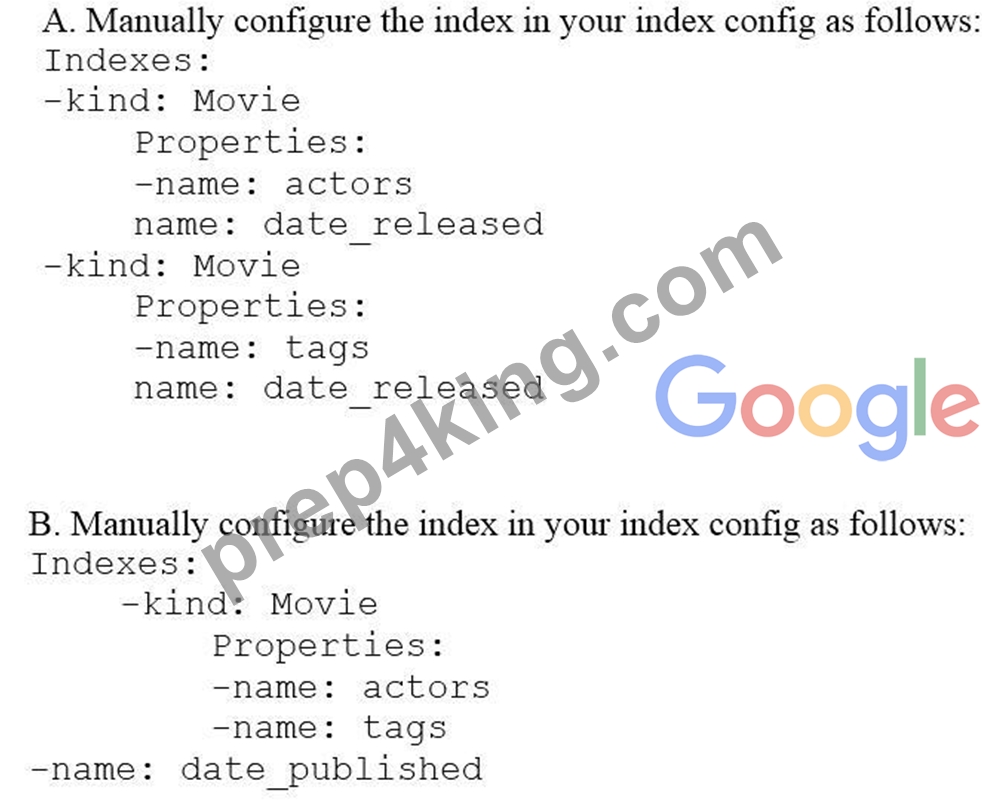

- A. Option C
- B. Option A
- C. Option B.
- D. Option D
Answer: B
NEW QUESTION 106
You have spent a few days loading data from comma-separated values (CSV) files into the Google BigQuery table CLICK_STREAM. The column DT stores the epoch time of click events. For convenience, you chose a simple schema where every field is treated as the STRING type. Now, you want to compute web session durations of users who visit your site, and you want to change its data type to the TIMESTAMP. You want to minimize the migration effort without making future queries computationally expensive. What should you do?
- A. Construct a query to return every row of the table CLICK_STREAM, while using the built-in function to cast strings from the column DT into TIMESTAMP values. Run the query into a destination table NEW_CLICK_STREAM, in which the column TS is the TIMESTAMP type. the table NEW_CLICK_STREAM instead of the table CLICK_STREAM from now on. In the future, new data is loaded into the table NEW_CLICK_STREAM.
- B. Delete the table CLICK_STREAM, and then re-create it such that the column DT is of the TIMESTAMP type. Reload the data.
- C. Add two columns to the table CLICK STREAM: TS of the TIMESTAMP type and IS_NEW of the BOOLEAN type. Reload all data in append mode. For each appended row, set the value of IS_NEW to true. For future queries, the column TS instead of the column DT, with the WHERE clause ensuring that the value of IS_NEW must be true.
- D. Add a column TS of the TIMESTAMP type to the table CLICK_STREAM, and populate the numeric values from the column TS for each row. the column TS instead of the column DT from now on.
- E. Create a view CLICK_STREAM_V, where strings from the column DT are cast into TIMESTAMP values. the view CLICK_STREAM_V instead of the table CLICK_STREAM from now on.
Answer: C
NEW QUESTION 107
You have a data pipeline that writes data to Cloud Bigtable using well-designed row keys. You want to monitor your pipeline to determine when to increase the size of you Cloud Bigtable cluster. Which two actions can you take to accomplish this? (Choose two.)
- A. Review Key Visualizer metrics. Increase the size of the Cloud Bigtable cluster when the Read pressure index is above 100.
- B. Review Key Visualizer metrics. Increase the size of the Cloud Bigtable cluster when the Write pressure index is above 100.
- C. Monitor latency of read operations. Increase the size of the Cloud Bigtable cluster of read operations take longer than 100 ms.
- D. Monitor the latency of write operations. Increase the size of the Cloud Bigtable cluster when there is a sustained increase in write latency.
- E. Monitor storage utilization. Increase the size of the Cloud Bigtable cluster when utilization increases above
70% of max capacity.
Answer: A,D
NEW QUESTION 108
Which Java SDK class can you use to run your Dataflow programs locally?
- A. LocalPipelineRunner
- B. DirectPipelineRunner
- C. LocalRunner
- D. MachineRunner
Answer: B
Explanation:
Explanation
DirectPipelineRunner allows you to execute operations in the pipeline directly, without any optimization.
Useful for small local execution and tests
Reference:
https://cloud.google.com/dataflow/java-sdk/JavaDoc/com/google/cloud/dataflow/sdk/runners/DirectPipelineRun
NEW QUESTION 109
......
Download the Latest Professional-Data-Engineer Dump - 2021 Professional-Data-Engineer Exam Question Bank: https://www.prep4king.com/Professional-Data-Engineer-exam-prep-material.html
Buy Latest Professional-Data-Engineer Exam Q&A PDF - One Year Free Update: https://drive.google.com/open?id=1OpghITphAFvTOG-iBqy7BcbORZ90NRKc
