

Download PCCP Exam Dumps Questions to get 100% Success in Palo Alto Networks
100% Accurate Answers! PCCP Actual Real Exam Questions
NEW QUESTION # 93
Which type of system collects data and uses correlation rules to trigger alarms?
- A. SOAR
- B. SIEM
- C. UEBA
- D. SIM
Answer: B
Explanation:
A Security Information and Event Management (SIEM) system collects data from various sources (logs, events, etc.) and uses correlation rules to analyze this data and trigger alarms when suspicious or predefined patterns are detected.
NEW QUESTION # 94
Which technology helps Security Operations Center (SOC) teams identify heap spray attacks on company-owned laptops?
- A. CVVP
- B. ASM
- C. CSPM
- D. EDR
Answer: D
Explanation:
Heap spray attacks exploit memory management vulnerabilities by injecting malicious code into a program's heap to manipulate execution flow. Endpoint Detection and Response (EDR) platforms monitor memory and process behavior on endpoints, enabling the detection of such memory-based exploits through anomaly and behavior analysis. Palo Alto Networks' Cortex XDR equips SOC teams with the tools to detect, analyze, and respond to heap spray and other in-memory attacks on company laptops in real time. EDR's endpoint-centric visibility is crucial since heap spray attacks operate below network layers and often bypass traditional perimeter defenses.
NEW QUESTION # 95
Which network analysis tool can be used to record packet captures?
- A. Netman
- B. Angry IP Scanner
- C. Smart IP Scanner
- D. Wireshark
Answer: D
Explanation:
Wireshark is a network analysis tool that can capture packets from various network interfaces and protocols.
It can display the captured packets in a human-readable format, as well as filter, analyze, and export them. Wireshark is widely used for network troubleshooting, security testing, and education purposes12. References: Wireshark Go Deep, How to Use Wireshark to Capture, Filter and Inspect Packets, Palo Alto Networks Certified Cybersecurity Entry-level Technician
NEW QUESTION # 96
Which type of malware replicates itself to spread rapidly through a computer network?
- A. worm
- B. Trojan horse
- C. ransomware
- D. virus
Answer: A
Explanation:
A worm is a type of malware that replicates itself to spread rapidly through a computer network. Unlike a virus, a worm does not need a host program or human interaction to infect other devices. A worm can consume network bandwidth, slow down the system performance, or deliver a malicious payload, such as ransomware or a backdoor123. References: Types of Malware & Malware Examples - Kaspersky, 10 types of malware + how to prevent malware from the start, Computer worm - Wikipedia A worm replicates through the network while a virus replicates, not necessarily to spread through the network.
NEW QUESTION # 97
Which endpoint tool or agent can enact behavior-based protection?
- A. AutoFocus
- B. MineMeld
- C. DNS Security
- D. Cortex XDR
Answer: D
Explanation:
Cortex XDR is an endpoint tool or agent that can enact behavior-based protection. Behavior-based protection is a method of detecting and blocking malicious activities based on the actions or potential actions of an object, such as a file, a process, or a network connection. Behavior-based protection can identify and stop threats that are unknown or evade traditional signature-based detection, by analyzing the object's behavior for suspicious or abnormal patterns. Cortex XDR is a comprehensive solution that provides behavior-based protection for endpoints, networks, and cloud environments. Cortex XDR uses artificial intelligence and machine learning to continuously monitor and analyze data from multiple sources, such as logs, events, alerts, and telemetry. Cortex XDR can detect and prevent advanced attacks, such as ransomware, fileless malware, zero-day exploits, and lateral movement, by applying behavioral blocking and containment rules. Cortex XDR can also perform root cause analysis, threat hunting, and incident response, to help organizations reduce the impact and duration of security incidents. References:
* Cortex XDR - Palo Alto Networks
* Behavioral blocking and containment | Microsoft Learn
* Behaviour Based Endpoint Protection | Signature-Based Security - Xcitium
* The 12 Best Endpoint Security Software Solutions and Tools [2024]
NEW QUESTION # 98
Which Palo Alto Networks product provides playbooks with 300+ multivendor integrations that help solve any security use case?
- A. AutoFocus
- B. Cortex XSOAR
- C. Cortex XDR
- D. Prisma Cloud
Answer: B
Explanation:
SOAR tools ingest aggregated alerts from detection sources (such as SIEMs, network security tools, and mailboxes) before executing automatable, process-driven playbooks to enrich and respond to these alerts.
https://www.paloaltonetworks.com/cortex/security-operations-automation
NEW QUESTION # 99
If an endpoint does not know how to reach its destination, what path will it take to get there?
- A. The endpoint will broadcast to all connected network devices.
- B. The endpoint will forward data to another endpoint to send instead.
- C. The endpoint will not send the traffic until a path is clarified.
- D. The endpoint will send data to the specified default gateway.
Answer: D
Explanation:
If an endpoint does not know how to reach its destination, it will send data to the specified default gateway.
A default gateway is a device that routes traffic from a local network to other networks or the internet. The endpoint will use the default gateway's IP address as the next hop for packets that are destined for unknown or remote networks. The default gateway will then forward the packets to the appropriate destination or another gateway, based on its routing table. References:
* Fundamentals of Network Security, Module 2: Networking Concepts, Lesson 2: IP Addressing and Routing1
* PCCET Study Guide, Section 2.2: Describe IP Addressing and Routing2
NEW QUESTION # 100
Why is it important to protect East-West traffic within a private cloud?
- A. All traffic contains threats, so enterprises must protect against threats across the entire network
- B. East-West traffic uses IPv6 which is less secure than IPv4
- C. East-West traffic contains more session-oriented traffic than other traffic
- D. East-West traffic contains more threats than other traffic
Answer: A
Explanation:
East-West traffic is the lateral movement of data packets between servers within a data center, or across private and public clouds1. This type of traffic has grown substantially with the proliferation of data centers and cloud adoption, and it now surpasses the conventional North-South traffic that goes in or out of the network2. Therefore, it is important to protect East-West traffic from potential malicious actors and breaches, as threats can arise internally and move laterally without ever touching the traditional network perimeter12. By inspecting and monitoring all East-West traffic, organizations can effectively block the lateral movement of threat actors, increase network visibility, protect vital applications and data, and lower costs and risks for distributed operations23. References:
* East-West Traffic: Everything You Need to Know | Gigamon Blog
* What is East-West Security? | VMware Glossary
* How to Harness East-West Visibility for a Stronger Defensive Security ...
NEW QUESTION # 101
Which Palo Alto Networks tools enable a proactive, prevention-based approach to network automation that accelerates security analysis?
- A. AutoFocus
- B. MineMeld
- C. Cortex XDR
- D. WildFire
Answer: C
Explanation:
Cortex XDR is a security analytics platform that converges logs from network, identity, endpoint, application, and other security relevant sources to generate high-fidelity behavioral alerts and facilitate rapid incident analysis, investigation, and response1. Cortex XDR uses machine learning algorithms to automate data analysis and apply modeling in real time, helping organizations to reduce analyst workloads and improve security1. Cortex XDR also integrates with Palo Alto Networks next-generation firewalls and other security tools to streamline and speed network security response2. References: Security Analytics - Palo Alto Networks, Network Security Automation - Palo Alto Networks
NEW QUESTION # 102
What are two limitations of signature-based anti-malware software? (Choose two.)
- A. It uses a static file for comparing potential threats.
- B. It requires samples lo be buffered
- C. It is unable to detect polymorphic malware.
- D. It only uses packet header information.
Answer: A,C
Explanation:
Signature-based systems struggle with polymorphic or obfuscated malware, which changes its code to avoid detection. Signature-based detection relies on static databases of known threat signatures, limiting its ability to identify new or unknown threats.
NEW QUESTION # 103
Match the Identity and Access Management (IAM) security control with the appropriate definition.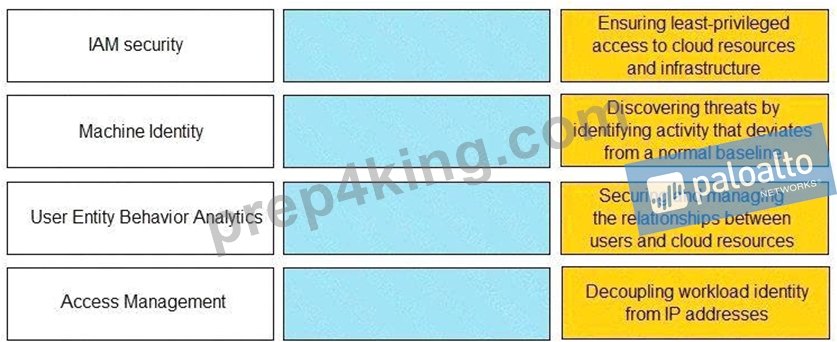
Answer:
Explanation: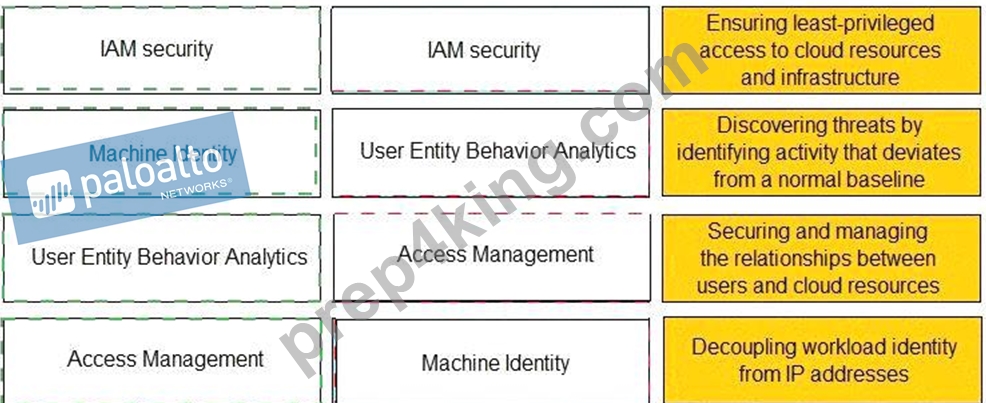
NEW QUESTION # 104
Which NGFW feature is used to provide continuous identification, categorization, and control of known and previously unknown SaaS applications?
- A. User-ID
- B. App-ID
- C. Content-ID
- D. Device-ID
Answer: B
Explanation:
App-ID™ technology leverages the power of the broad global community to provide continuous identification, categorization, and granular risk-based control of known and previously unknown SaaS applications, ensuring new applications are discovered automatically as they become popular.
NEW QUESTION # 105
What are two advantages of security orchestration, automation, and response (SOAR)? (Choose two.)
- A. Consistent incident handling
- B. Completely isolated system
- C. Long-term retention of logs
- D. Scripting of manual tasks
Answer: A,D
Explanation:
Scripting of manual tasks - SOAR platforms automate repetitive, manual security tasks through playbooks and scripting, improving response time and efficiency.
Consistent incident handling - SOAR ensures that incidents are managed in a standardized and repeatable manner, reducing errors and improving compliance.
Isolated system and log retention are not core advantages of SOAR.
NEW QUESTION # 106
What are two capabilities of identity threat detection and response (ITDR)? (Choose two.)
- A. Matching risks to signatures
- B. Securing individual devices
- C. Scanning for excessive logins
- D. Analyzing access management logs
Answer: C,D
Explanation:
Scanning for excessive logins - ITDR identifies suspicious patterns such as unusual or excessive login attempts, which may indicate credential abuse.
Analyzing access management logs - ITDR tools analyze identity-related logs, including authentication and authorization events, to detect threats tied to user behavior and access anomalies.
Device security and signature matching are not core functions of ITDR; they fall under endpoint protection and traditional threat detection respectively.
NEW QUESTION # 107
In the attached network diagram, which device is the switch?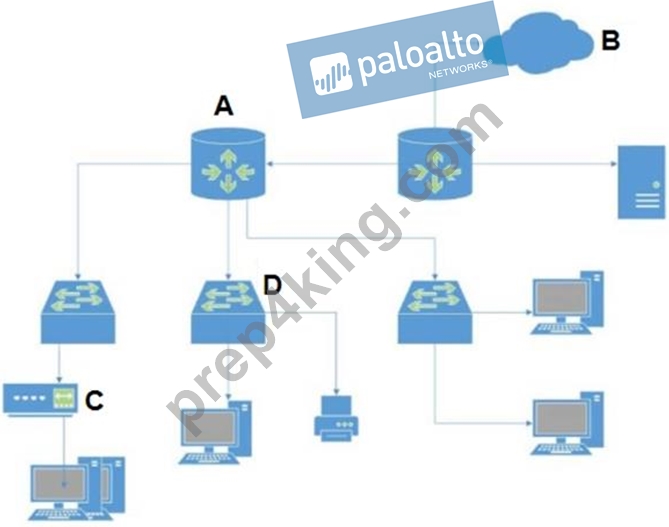
- A. Select B
- B. Select D
- C. Select C
- D. Select A
Answer: B
Explanation:
A switch is a network device that connects multiple devices on a local area network (LAN) and forwards data packets between them. A switch can be identified by its icon, which is a rectangle with four curved lines on each side. In the attached network diagram, device D is the switch, as it matches the icon and connects three computers to device A, which is another network device. References:
* [What is a Network Switch and How Does it Work?]
* [Network Diagram Symbols and Icons | Lucidchart]
NEW QUESTION # 108
Which type of attack obscures its presence while attempting to spread to multiple hosts in a network?
- A. Advanced malware
- B. Reconnaissance
- C. Denial of service
- D. Smishing
Answer: A
Explanation:
Advanced malware is designed to evade detection and persist within a system, often using stealthy techniques to spread laterally across multiple hosts in a network without triggering alerts, making it especially dangerous and difficult to remove.
NEW QUESTION # 109
How can local systems eliminate vulnerabilities?
- A. Create preventative memory-corruption techniques.
- B. Perform an attack on local systems.
- C. Test and deploy patches on a focused set of systems.
- D. Patch systems and software effectively and continuously.
Answer: D
Explanation:
Local systems can eliminate vulnerabilities by patching systems and software effectively and continuously.
Patching is the process of applying updates or fixes to software or hardware components that have known vulnerabilities or bugs. Patching can prevent attackers from exploiting these vulnerabilities and compromising the security or functionality of the systems. Patching should be done regularly and promptly, as new vulnerabilities are constantly discovered and exploited by cybercriminals. Patching should also be done effectively, meaning that the patches are tested and verified before deployment, and that they do not introduce new vulnerabilities or issues. Patching should also be done continuously, meaning that the systems are monitored for new vulnerabilities and patches are applied as soon as they are available. Continuous patching can reduce the window of opportunity for attackers to exploit unpatched vulnerabilities and cause damage or data breaches. References:
*1: What is Patch Management? | Palo Alto Networks
*2: Patch Management Best Practices: How to Keep Your Systems Secure | Snyk
*3: Vulnerability Remediation Process - 4 Steps to Remediation | Snyk
NEW QUESTION # 110
Which model would a customer choose if they want full control over the operating system(s) running on their cloud computing platform?
- A. PaaS
- B. SaaS
- C. IaaS
- D. DaaS
Answer: C
Explanation:
IaaS (Infrastructure as a Service) is a cloud computing model that delivers on-demand infrastructure resources to organizations via the cloud, such as compute, storage, networking, and virtualization1. Customers do not have to manage, maintain, or update their own data center infrastructure, but are responsible for the operating system, middleware, virtual machines, and any apps or data1. Therefore, IaaS gives customers full control over the operating system(s) running on their cloud computing platform, as well as the flexibility to customize and configure their infrastructure according to their needs2. References: What are the different types of cloud computing? | Google Cloud, PaaS vs IaaS vs SaaS: What's the difference? | Google Cloud
NEW QUESTION # 111
Which type of attack involves sending data packets disguised as queries to a remote server, which then sends the data back to the attacker?
- A. DNS tunneling
- B. Port evasion
- C. DDoS
- D. Command-and-control (C2)
Answer: A
Explanation:
DNS tunneling is an attack technique where data packets are disguised as DNS queries and sent to a remote server. That server, often under the attacker's control, responds with additional data or instructions, effectively creating a covert command-and-control (C2) channel over DNS.
NEW QUESTION # 112
Which endpoint product from Palo Alto Networks can help with SOC visibility?
- A. STIX
- B. AutoFocus
- C. Cortex XDR
- D. WildFire
Answer: C
Explanation:
Cortex XDR is an endpoint product from Palo Alto Networks that can help with SOC visibility by allowing you to rapidly detect and respond to threats across your networks, endpoints, and clouds. It assists SOC analysts by allowing them to view all the alerts from all Palo Alto Networks products in one place, and to perform root cause analysis and automated response actions. Cortex XDR also integrates with other Palo Alto Networks products, such as WildFire, AutoFocus, and Cortex Data Lake, to provide comprehensive threat intelligence and data enrichment12. References:
* SOC Services - Palo Alto Networks
* Endpoint Protection - Palo Alto Networks
* Security Operations | Palo Alto Networks
* Cortex - Palo Alto Networks
NEW QUESTION # 113
Which Palo Alto Networks subscription service complements App-ID by enabling you to configure the next- generation firewall to identify and control access to websites and to protect your organization from websites hosting malware and phishing pages?
- A. URL Filtering
- B. DNS Security
- C. WildFire
- D. Threat Prevention
Answer: A
Explanation:
The URL Filtering service complements App-ID by enabling you to configure the next-generation firewall to identify and control access to websites and to protect your organization from websites that host malware and phishing pages.
NEW QUESTION # 114
Which statement describes a host-based intrusion prevention system (HIPS)?
- A. It is installed on an endpoint and inspects the device.
- B. It is placed as a sensor to monitor all network traffic and scan for threats.
- C. It scans a Wi-Fi network for unauthorized access and removes unauthorized devices.
- D. It analyzes network traffic to detect unusual traffic flows and new malware.
Answer: A
Explanation:
A Host-Based Intrusion Prevention System (HIPS) is installed directly on an endpoint device (such as a server or workstation) and monitors local system activity, including processes, file access, and system calls, to detect and prevent malicious behavior.
NEW QUESTION # 115
......
Palo Alto Networks PCCP Exam Syllabus Topics:
| Topic | Details |
|---|---|
| Topic 1 |
|
| Topic 2 |
|
| Topic 3 |
|
| Topic 4 |
|
| Topic 5 |
|
Best Value Available! Realistic Verified Free PCCP Exam Questions: https://www.prep4king.com/PCCP-exam-prep-material.html
Pass Your Exam Easily! PCCP Real Question Answers Updated: https://drive.google.com/open?id=146_Nn5rNX3oOlWsklnQ7btlkUNbas35m
