

[Sep-2026] Updated Microsoft Certified: Fabric Data Engineer Associate DP-700 Exam Questions BUNDLE PACK
Master The Microsoft Content DP-700 EXAM DUMPS WITH GUARANTEED SUCCESS!
NEW QUESTION # 28
You have a Fabric workspace that contains a lakehouse named Lakehouse1.
In an external data source, you have data files that are 500 GB each. A new file is added every day.
You need to ingest the data into Lakehouse1 without applying any transformations. The solution must meet the following requirements Trigger the process when a new file is added.
Provide the highest throughput.
Which type of item should you use to ingest the data?
- A. Event stream
- B. Streaming dataset
- C. Data pipeline
- D. Dataflow Gen2
Answer: C
NEW QUESTION # 29
You have a Fabric workspace that contains a warehouse named Warehouse1.
You have an on-premises Microsoft SQL Server database named Database1 that is accessed by using an on- premises data gateway.
You need to copy data from Database1 to Warehouse1.
Which item should you use?
- A. a notebook
- B. a Dataflow Gen1 dataflow
- C. a data pipeline
- D. a KQL queryset
Answer: C
Explanation:
To copy data from an on-premises Microsoft SQL Server database (Database1) to a warehouse (Warehouse1) in Microsoft Fabric, the best option is to use a data pipeline. A data pipeline in Fabric allows for the orchestration of data movement, from source to destination, using connectors, transformations, and scheduled workflows. Since the data is being transferred from an on-premises database and requires the use of a data gateway, a data pipeline provides the appropriate framework to facilitate this data movement efficiently and reliably.
NEW QUESTION # 30
You have two Fabric workspaces named Workspace1 and Workspace2.
You have a Fabric deployment pipeline named deployPipeline1 that deploys items from Workspace1 to Workspace2. DeployPipeline1 contains all the items in Workspace1.
You recently modified the items in Workspaces1.
The workspaces currently contain the items shown in the following table.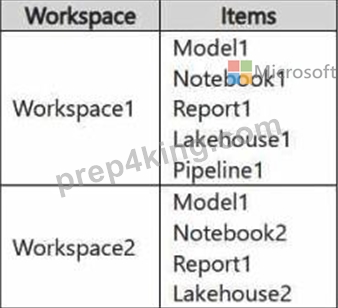
Items in Workspace1 that have the same name as items in Workspace2 are currently paired.
You need to ensure that the items in Workspace1 overwrite the corresponding items in Workspace2. The solution must minimize effort.
What should you do?
- A. Delete all the items in Workspace2, and then run deployPipeline1.
- B. Run deployPipeline1 without modifying the items in Workspace2.
- C. Rename each item in Workspace2 to have the same name as the items in Workspace1.
- D. Back up the items in Workspace2, and then run deployPipeline1.
Answer: B
Explanation:
When running a deployment pipeline in Fabric, if the items in Workspace1 are paired with the corresponding items in Workspace2 (based on the same name), the deployment pipeline will automatically overwrite the existing items in Workspace2 with the modified items from Workspace1. There's no need to delete, rename, or back up items manually unless you need to keep versions. By simply running deployPipeline1, the pipeline will handle overwriting the existing items in Workspace2 based on the pairing, ensuring the latest version of the items is deployed with minimal effort.
NEW QUESTION # 31
You plan to process the following three datasets by using Fabric:
* Dataset1: This dataset will be added to Fabric and will have a unique primary key between the source and the destination. The unique primary key will be an integer and will start from 1 and have an increment of 1.
* Dataset2: This dataset contains semi-structured data that uses bulk data transfer. The dataset must be handled in one process between the source and the destination. The data transformation process will include the use of custom visuals to understand and work with the dataset in development mode.
* Dataset3. This dataset is in a takehouse. The data will be bulk loaded. The data transformation process will include row-based windowing functions during the loading process.
You need to identify which type of item to use for the datasets. The solution must minimize development effort and use built-in functionality, when possible. What should you identify for each dataset? To answer, select the appropriate options in the answer area.
NOTE: Each correct selection is worth one point.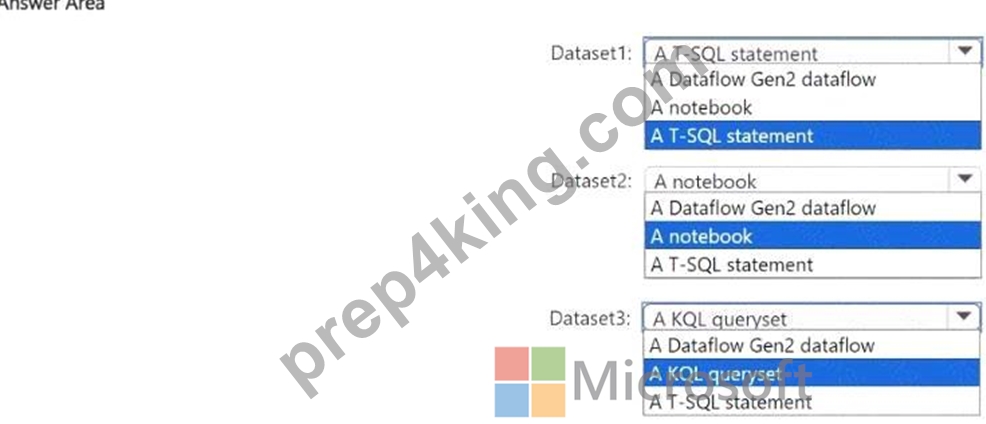
Answer:
Explanation: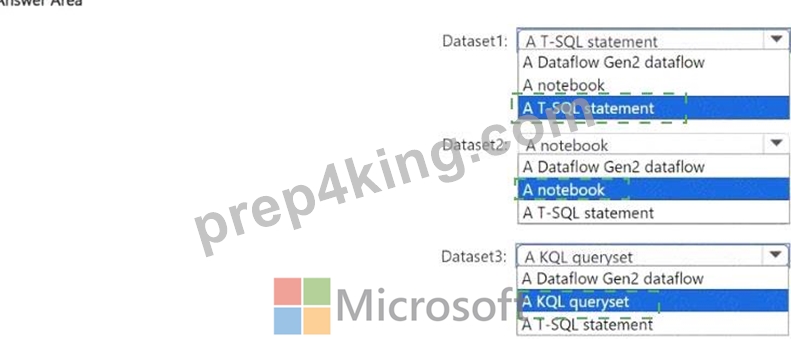
Explanation: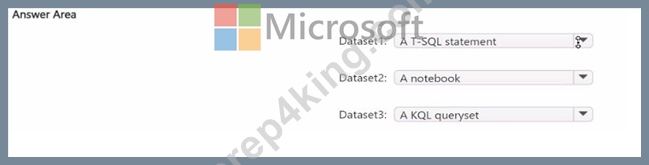
NEW QUESTION # 32
You have a Fabric data warehouse that contains the following tables.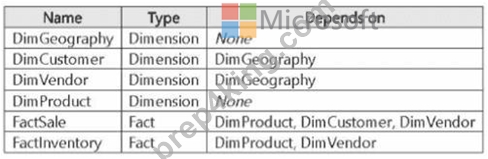
You need to refresh the tables by using an automated pipeline. The solution must ensure that table updates occur in the correct order to maintain referential integrity.
Which two tables should you refresh first? Each correct answer presents part of the solution.
NOTE: Each correct selection is worth one point.
- A. Factlnventory
- B. Dim Product
- C. FactSale
- D. DimCustomer
- E. DimGeography
Answer: B,E
NEW QUESTION # 33
Note: This question is part of a series of questions that present the same scenario. Each question in the series contains a unique solution that might meet the stated goals. Some question sets might have more than one correct solution, while others might not have a correct solution.
After you answer a question in this section, you will NOT be able to return to it. As a result, these questions will not appear in the review screen.
You have a KQL database that contains two tables named Stream and Reference. Stream contains streaming data in the following format.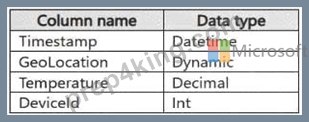
Reference contains reference data in the following format.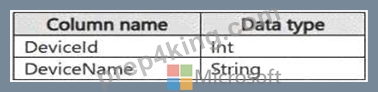
Both tables contain millions of rows.
You have the following KQL queryset.
You need to reduce how long it takes to run the KQL queryset.
Solution: You move the filter to line 02.
Does this meet the goal?
- A. No
- B. Yes
Answer: B
Explanation:
Moving the filter to line 02: Filtering the Stream table before performing the join operation reduces the number of rows that need to be processed during the join. This is an effective optimization technique for queries involving large datasets.
NEW QUESTION # 34
You have a Fabric workspace named Workspace1 that uses version control. Workspace! and Azure DevOps are integrated.
In Azure DevOps. developers create a branch named Branch1 to test extract, transform, and load (ETL) updates.
You need to connect Workspace1 to Branch1. The solution must ensure that all the existing content in Branch1 is available in Workspace1.
What should you do?
- A. From Azure DevOps, merge the contents of the main branch into Branch1.
- B. From Workspace1. select Source control, select Current branch, select Branch1, and then select Commit
- C. From Workspace1. select Source control, and then select Sync
- D. From Workspace1, select Source control, and then select Branch out to new workspace
Answer: C
NEW QUESTION # 35
You have a Fabric deployment pipeline that uses three workspaces named Dev, Test, and Prod.
You need to deploy an eventhouse as part of the deployment process.
What should you use to add the eventhouse to the deployment process?
- A. a deployment pipeline
- B. an Azure DevOps pipeline
- C. GitHub Actions
Answer: A
Explanation:
A deployment pipeline in Fabric is designed to automate the process of deploying assets (such as reports, datasets, eventhouses, and other objects) between environments like Dev, Test, and Prod. Since you need to deploy an eventhouse as part of the deployment process, a deployment pipeline is the appropriate tool to move this asset through the different stages of your environment.
NEW QUESTION # 36
HOTSPOT
You have a Fabric workspace named Workspace1_DEV that contains the following items:
10 reports
Four notebooks
Three lakehouses
Two data pipelines
Two Dataflow Gen1 dataflows
Three Dataflow Gen2 dataflows
Five semantic models that each has a scheduled refresh policy
You create a deployment pipeline named Pipeline1 to move items from Workspace1_DEV to a new workspace named Workspace1_TEST.
You deploy all the items from Workspace1_DEV to Workspace1_TEST.
For each of the following statements, select Yes if the statement is true. Otherwise, select No.
NOTE: Each correct selection is worth one point.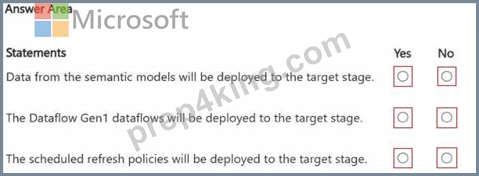
Answer:
Explanation: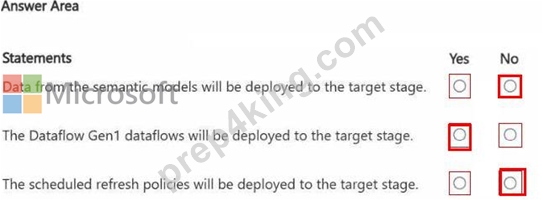
NEW QUESTION # 37
You have a Fabric workspace that contains a warehouse named Warehouse1.
You have an on-premises Microsoft SQL Server database named Database1 that is accessed by using an on-premises data gateway.
You need to copy data from Database1 to Warehouse1.
Which item should you use?
- A. a notebook
- B. a Dataflow Gen1 dataflow
- C. a data pipeline
- D. a KQL queryset
Answer: C
Explanation:
To copy data from an on-premises Microsoft SQL Server database (Database1) to a warehouse (Warehouse1) in Microsoft Fabric, the best option is to use a data pipeline. A data pipeline in Fabric allows for the orchestration of data movement, from source to destination, using connectors, transformations, and scheduled workflows. Since the data is being transferred from an on-premises database and requires the use of a data gateway, a data pipeline provides the appropriate framework to facilitate this data movement efficiently and reliably.
NEW QUESTION # 38
You have a Fabric workspace that contains a lakehouse named Lakehouse1.
In an external data source, you have data files that are 500 GB each. A new file is added every day.
You need to ingest the data into Lakehouse1 without applying any transformations. The solution must meet the following requirements Trigger the process when a new file is added.
Provide the highest throughput.
Which type of item should you use to ingest the data?
- A. Streaming dataset
- B. Dataflow Gen2
- C. Data pipeline
- D. Event stream
Answer: D
Explanation:
To ingest large files (500 GB each) from an external data source into Lakehouse1 with high throughput and to trigger the process when a new file is added, an Eventstream is the best solution.
An Eventstream in Fabric is designed for handling real-time data streams and can efficiently ingest large files as soon as they are added to an external source. It is optimized for high throughput and can be configured to trigger upon detecting new files, allowing for fast and continuous ingestion of data with minimal delay.
NEW QUESTION # 39
HOTSPOT
You have a Fabric workspace.
You are debugging a statement and discover the following issues:
Sometimes, the statement fails to return all the expected rows.
The PurchaseDate output column is NOT in the expected format of mmm dd, yy.
You need to resolve the issues. The solution must ensure that the data types of the results are retained. The results can contain blank cells.
How should you complete the statement? To answer, select the appropriate options in the answer area.
NOTE: Each correct selection is worth one point.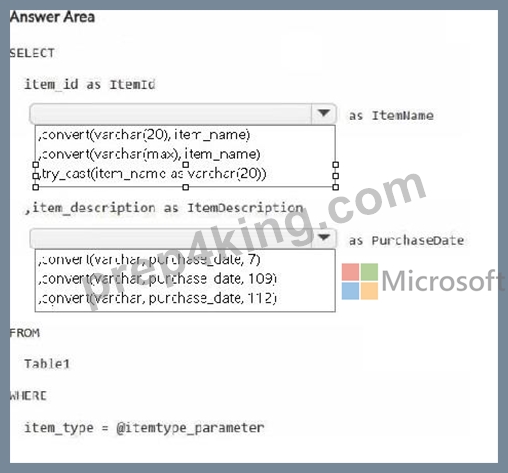
Answer:
Explanation: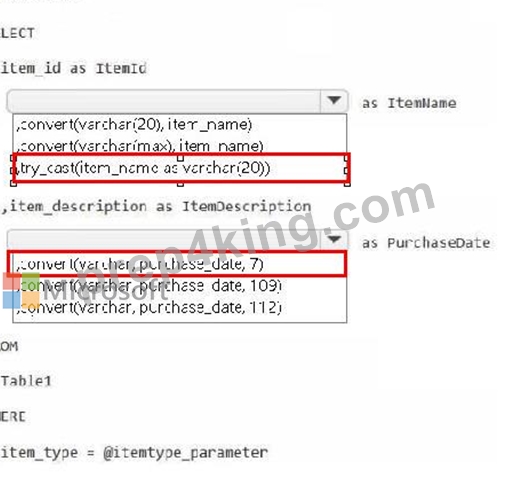
NEW QUESTION # 40
You are building a data loading pattern by using a Fabric data pipeline. The source is an Azure SQL database that contains 25 tables. The destination is a lakehouse.
In a warehouse, you create a control table named Control.Object as shown in the exhibit. (Click the Exhibit tab.) You need to build a data pipeline that will support the dynamic ingestion of the tables listed in the control table by using a single execution.
Which three actions should you perform in sequence? To answer, move the appropriate actions from the list of actions to the answer area and arrange them in the correct order.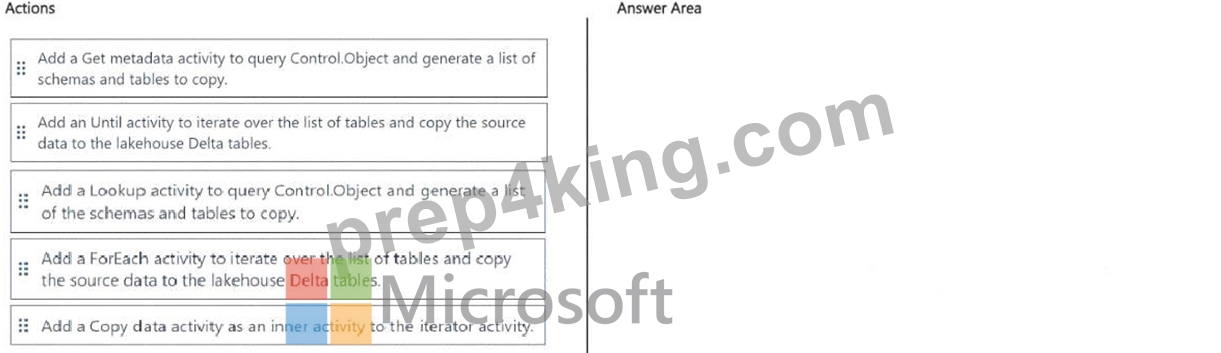
Answer:
Explanation: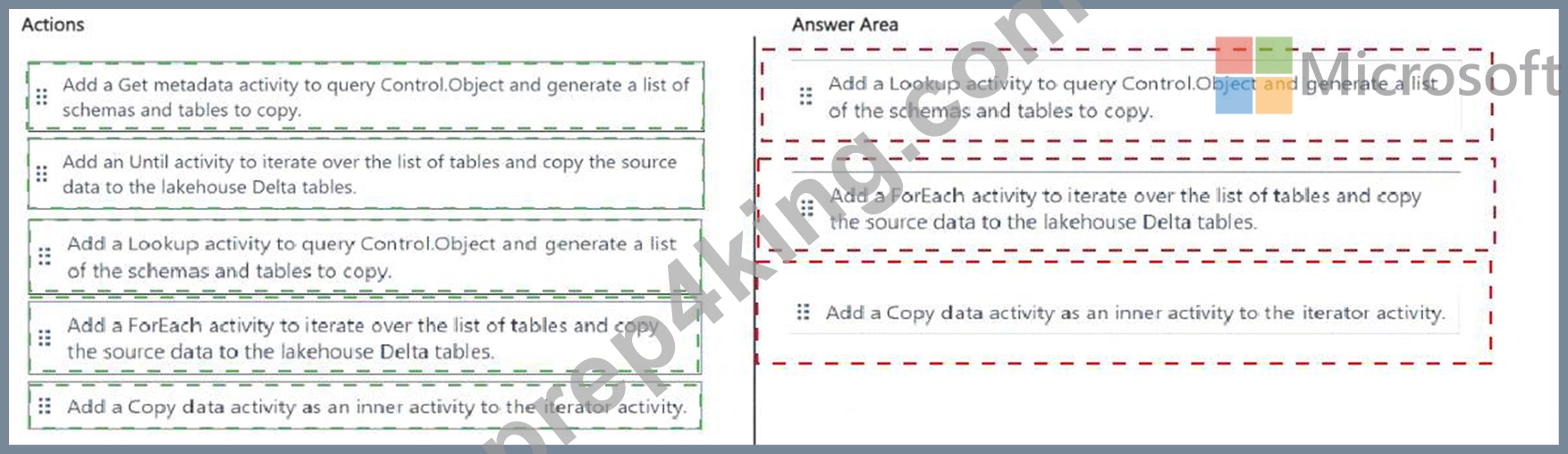
Explanation: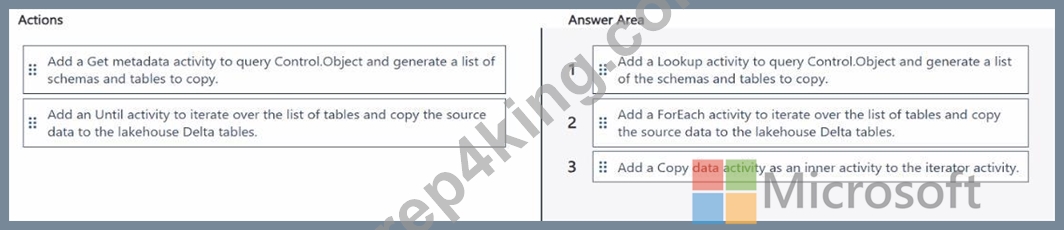
NEW QUESTION # 41
You have a Fabric workspace that contains a Real-Time Intelligence solution and an eventhouse.
Users report that from OneLake file explorer, they cannot see the data from the eventhouse.
You enable OneLake availability for the eventhouse.
What will be copied to OneLake?
- A. no data
- B. both new data and existing data in the eventhouse
- C. only new data added to the eventhouse
- D. only data added to new databases that are added to the eventhouse
- E. only the existing data in the eventhouse
Answer: C
NEW QUESTION # 42
Note: This question is part of a series of questions that present the same scenario. Each question in the series contains a unique solution that might meet the stated goals. Some question sets might have more than one correct solution, while others might not have a correct solution.
After you answer a question in this section, you will NOT be able to return to it. As a result, these questions will not appear in the review screen.
You have a KQL database that contains two tables named Stream and Reference. Stream contains streaming data in the following format.
Reference contains reference data in the following format.
Both tables contain millions of rows.
You have the following KQL queryset.
You need to reduce how long it takes to run the KQL queryset.
Solution: You add the make_list() function to the output columns.
Does this meet the goal?
- A. No
- B. Yes
Answer: A
Explanation:
Adding an aggregation like make_list() would require additional processing and memory, which could make the query slower.
NEW QUESTION # 43
You need to create the product dimension.
How should you complete the Apache Spark SQL code? To answer, select the appropriate options in the answer area.
NOTE: Each correct selection is worth one point.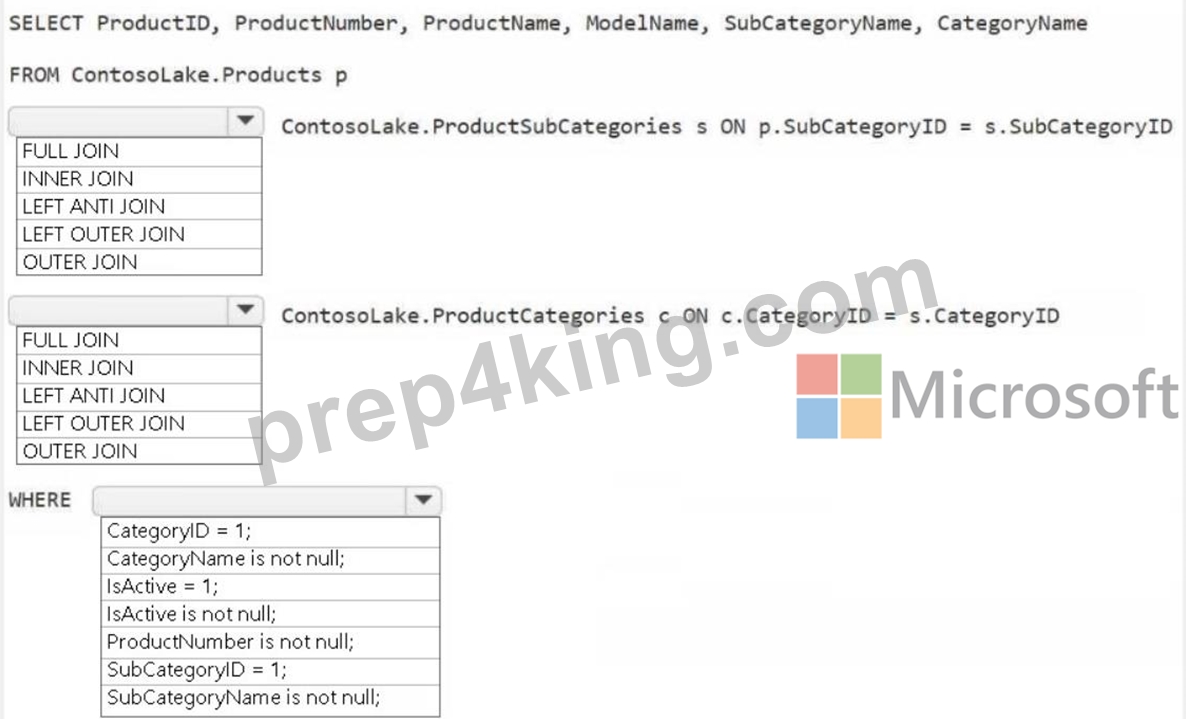
Answer:
Explanation: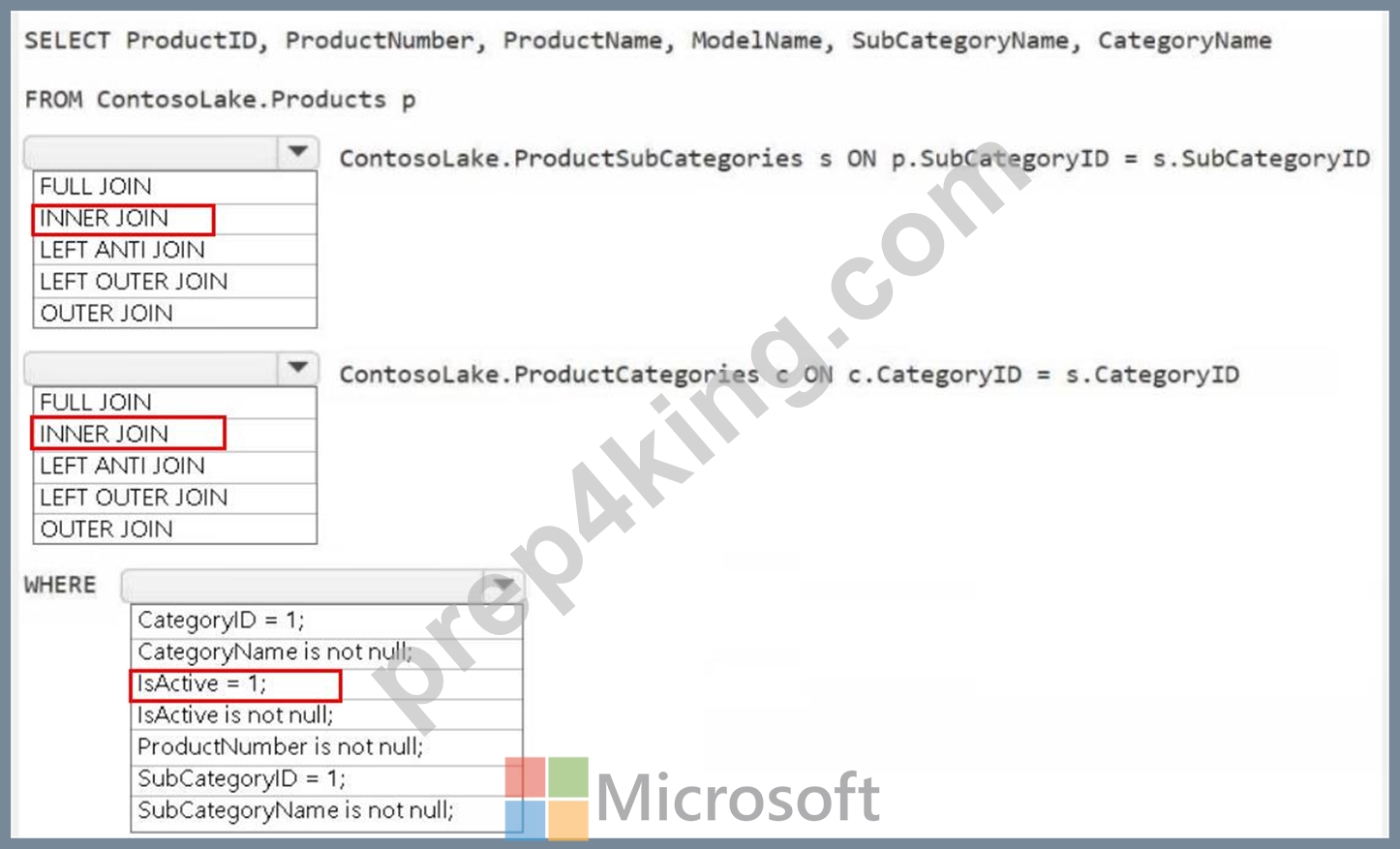
NEW QUESTION # 44
Note: This question is part of a series of questions that present the same scenario. Each question in the series contains a unique solution that might meet the stated goals. Some question sets might have more than one correct solution, while others might not have a correct solution.
After you answer a question in this section, you will NOT be able to return to it. As a result, these questions will not appear in the review screen.
You have a KQL database that contains two tables named Stream and Reference. Stream contains streaming data in the following format.
Reference contains reference data in the following format.
Both tables contain millions of rows.
You have the following KQL queryset.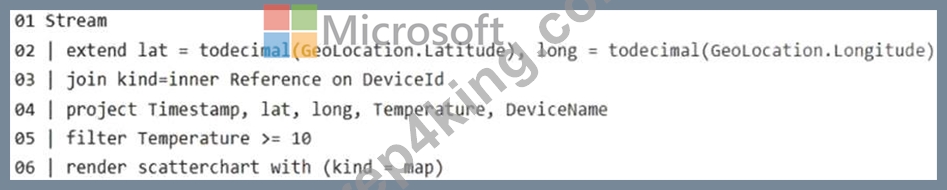
You need to reduce how long it takes to run the KQL queryset.
Solution: You change project to extend.
Does this meet the goal?
- A. No
- B. Yes
Answer: A
Explanation:
Using extend retains all columns in the table, potentially increasing the size of the output unnecessarily.
project is more efficient because it selects only the required columns.
NEW QUESTION # 45
You have a Fabric workspace that contains a warehouse named Warehouse1. Data is loaded daily into Warehouse1 by using data pipelines and stored procedures.
You discover that the daily data load takes longer than expected.
You need to monitor Warehouse1 to identify the names of users that are actively running queries.
Which view should you use?
- A. sys.dm_exec_connections
- B. queryinsights.frequently_run_queries
- C. sys.dm_exec_sessions
- D. queryinsights.long_running_queries
- E. sys.dm_exec_requests
Answer: C
Explanation:
sys.dm_exec_sessions provides real-time information about all active sessions, including the user, session ID, and status of the session. You can filter on session status to see users actively running queries.
NEW QUESTION # 46
You have two Fabric notebooks named Load_Salesperson and Load_Orders that read data from Parquet files in a lakehouse. Load_Salesperson writes to a Delta table named dim_salesperson. Load.Orders writes to a Delta table named fact_orders and is dependent on the successful execution of Load_Salesperson.
You need to implement a pattern to dynamically execute Load_Salesperson and Load_Orders in the appropriate order by using a notebook.
How should you complete the code? To answer, drag the appropriate values the correct targets. Each value may be used once, more than once, or not at all. You may need to drag the split bar between panes or scroll to view content.
NOTE: Each correct selection is worth one point.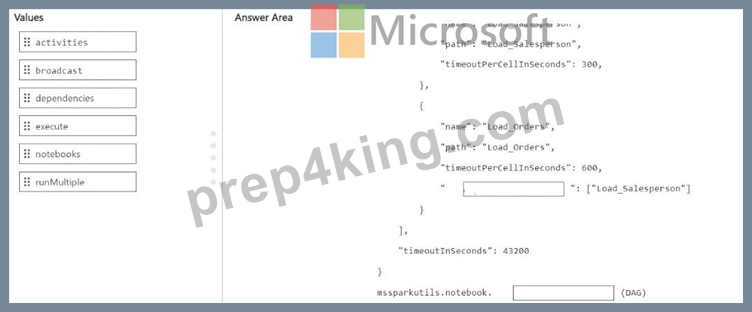
Answer:
Explanation: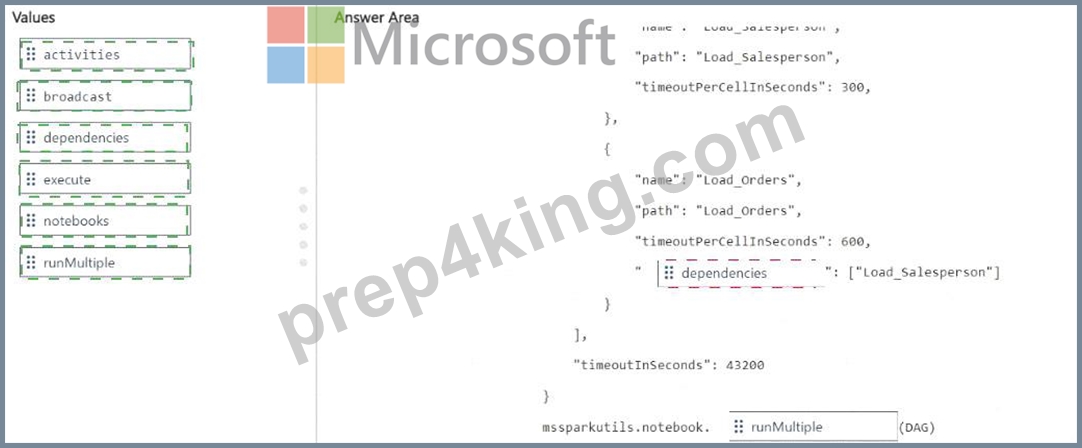
Explanation: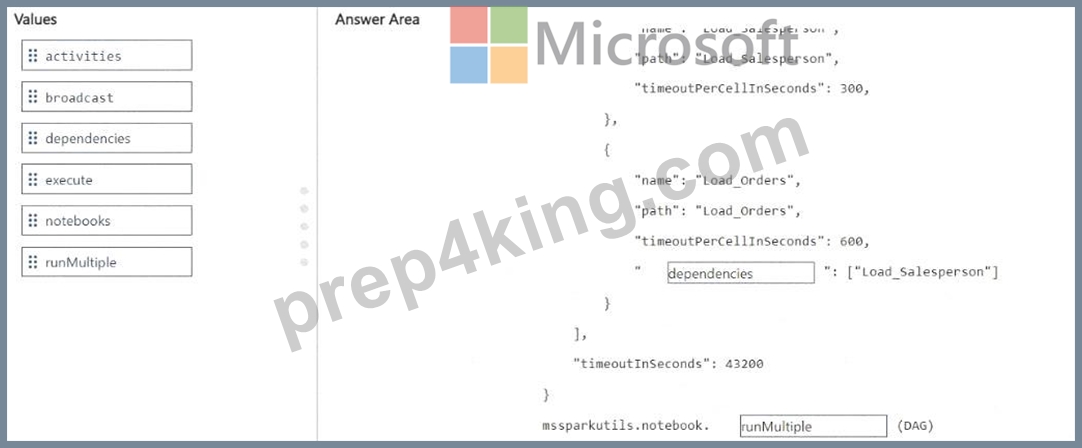
NEW QUESTION # 47
Exhibit.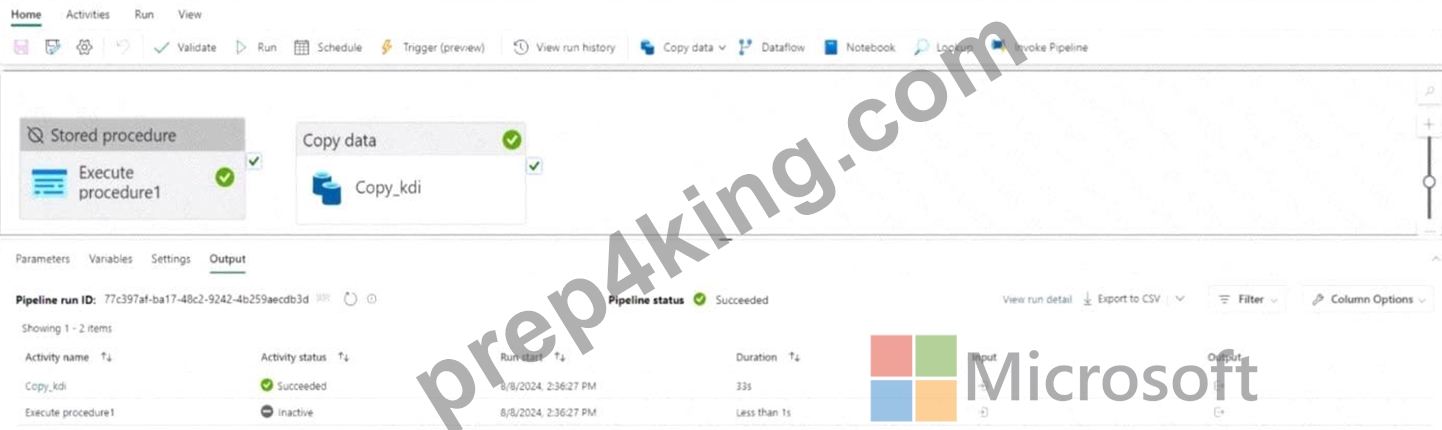
You have a Fabric workspace that contains a write-intensive warehouse named DW1. DW1 stores staging tables that are used to load a dimensional model. The tables are often read once, dropped, and then recreated to process new data.
You need to minimize the load time of DW1.
What should you do?
- A. Create statistics.
- B. Disable V-Order.
- C. Drop statistics.
- D. Enable V-O-der.
Answer: B
NEW QUESTION # 48
You have a Fabric workspace that contains a warehouse named DW1. DW1 is loaded by using a notebook named Notebook1.
You need to identify which version of Delta was used when Notebook1 was executed.
What should you use?
- A. OneLake data hub
- B. Real-Time hub
- C. the Admin monitoring workspace
- D. Fabric Monitor
- E. the Microsoft Fabric Capacity Metrics app
Answer: D
Explanation:
To identify the version of Delta used when Notebook1 was executed, you should use the Admin monitoring workspace. The Admin monitoring workspace allows you to track and monitor detailed information about the execution of notebooks and jobs, including the underlying versions of Delta or other technologies used. It provides insights into execution details, including versions and configurations used during job runs, making it the most appropriate choice for identifying the Delta version used during the execution of Notebook1.
NEW QUESTION # 49
You have a Fabric workspace that contains a warehouse named Warehouse!. Warehousel contains a table named DimCustomers. DimCustomers contains the following columns:
* CustomerName
* CustomerlD
* BirthDate
* Email
You need to configure security to meet the following requirements:
* BirthDate in DimCustomer must be masked and display 1900-01-01.
* Email in DimCustomer must be masked and display only the first leading character and the last five characters.
How should you complete the statement? To answer, select the appropriate options in the answer area. NOTE:
Each correct selection is worth one point.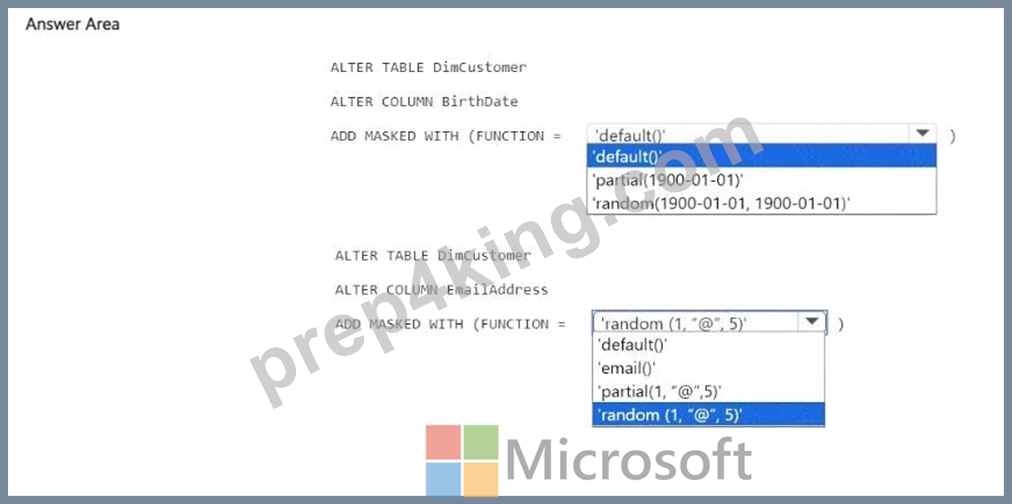
Answer:
Explanation: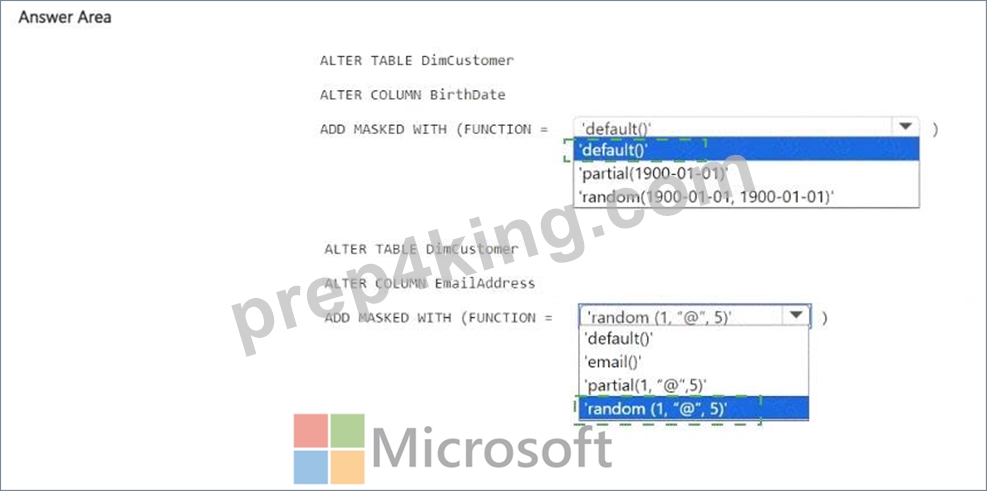
Explanation: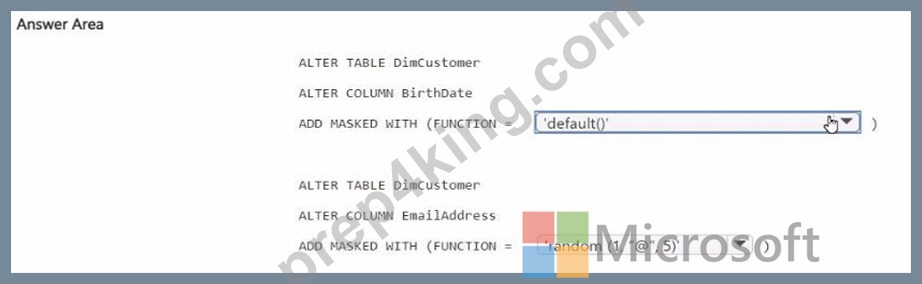
NEW QUESTION # 50
......
Microsoft DP-700 Exam Syllabus Topics:
| Topic | Details |
|---|---|
| Topic 1 |
|
| Topic 2 |
|
| Topic 3 |
|
Pass Microsoft DP-700 Exam – Experts Are Here To Help You: https://www.prep4king.com/DP-700-exam-prep-material.html
Get Latest Microsoft Certified: Fabric Data Engineer Associate DP-700 Practice Test For Quick Preparation: https://drive.google.com/open?id=1Zyz5GqmGGe0lZxWEAqDNA41sSUk9XwNs
