

Free Scripting-and-Programming-Foundations Exam Files Downloaded Instantly UPDATED [2025]
100% Pass Guaranteed Free Scripting-and-Programming-Foundations Exam Dumps
NEW QUESTION # 73
A software engineer has written a program that uses a large number of interacting custom data types information hiding, data abstraction encapsulation polymorphism, and inheritance Variables do not need to receive their types ahead of time, and this program can run on a variety of operating systems without having to re-compile the program into machine code.
Which type of language is being used? Choose 3 terms that accurately describe the language.
- A. Interpreted
- B. Static
- C. Object-oriented
- D. Markup
- E. Procedural
- F. Dynamic
Answer: A,C,F
Explanation:
The language described in the question exhibits characteristics of an interpreted, object-oriented, and dynamic language. Here's why these terms apply:
* Interpreted: The program can run on various operating systems without re-compilation, which is a trait of interpreted languages. Interpreted languages are executed line by line by an interpreter at runtime, rather than being compiled into machine code beforehand123.
* Object-oriented: The use of concepts like information hiding, data abstraction, encapsulation, polymorphism, and inheritance are hallmarks of object-oriented programming (OOP). OOP languages are designed around objects and classes, which allow for modular, reusable, and organized code456.
* Dynamic: Variables in the program do not need to have their types declared ahead of time, indicating dynamic typing. In dynamically typed languages, type checking is performed at runtime, and variables can be assigned to different types of data over their lifetime7891011.
References:
* Interpreted languages123.
* Object-oriented programming characteristics456.
* Dynamic typing in programming7891011.
NEW QUESTION # 74
A programming team is using the Waterfall design approach to create an application. Which deliverable would be produced during the design phase?
- A. The programming paradigm to be used
- B. A report of customer satisfaction
- C. A list of additional features to be added during revision
- D. A written description of the goals for the project
Answer: A
Explanation:
Comprehensive and Detailed Explanation From Exact Extract:
The Waterfall methodology is a linear, sequential approach to software development, with distinct phases:
requirements analysis, design, implementation, testing, and maintenance. According to foundational programming principles (e.g., Certiport Scripting and Programming Foundations Study Guide), the design phase in Waterfall produces technical specifications, including architectural decisions like the programming paradigm.
* Waterfall Design Phase:
* Translates requirements into a detailed blueprint for implementation.
* Deliverables include system architecture, data models, programming paradigm (e.g., object- oriented, procedural), and module specifications.
* Option A: "The programming paradigm to be used." This is correct. During the design phase, the team decides on the programming paradigm (e.g., object-oriented for Java, procedural for C) to structure the application, as this guides implementation. This is a key deliverable.
* Option B: "A list of additional features to be added during revision." This is incorrect. Additional features are identified during requirements analysis or later maintenance phases, not design.
* Option C: "A report of customer satisfaction." This is incorrect. Customer satisfaction reports are generated during or after deployment (maintenance phase), not design.
* Option D: "A written description of the goals for the project." This is incorrect. Project goals are defined during the requirements analysis phase, not design.
Certiport Scripting and Programming Foundations Study Guide (Section on Waterfall Methodology).
Sommerville, I., Software Engineering, 10th Edition (Chapter 2: Waterfall Model).
Pressman, R.S., Software Engineering: A Practitioner's Approach, 8th Edition (Waterfall Design Phase).
NEW QUESTION # 75
Which language has extensive support for object-oriented programming?
- A. C
- B. C++
- C. Markup
- D. HTML
Answer: B
Explanation:
C++ is a programming language that provides extensive support for object-oriented programming (OOP).
OOP is a programming paradigm based on the concept of "objects", which can contain data in the form of fields, often known as attributes, and code, in the form of procedures, often known as methods. C++ offers features such as classes, inheritance, polymorphism, encapsulation, and abstraction which are fundamental to OOP. This makes C++ a powerful tool for developing complex software systems that require a modular and scalable approach.
The information provided is based on standard programming principles and the foundational knowledge of scripting and programming, which includes understanding the capabilities and applications of various programming languages1.
NEW QUESTION # 76
An algorithm should output "OK" if a number is between 98.3 and 98.9, else the output is "Not OK." Which test is a valid test of the algorithm?
- A. Input 98.6. Ensure output is "OK."
- B. Input 98.6. Ensure output is "Not OK."
- C. Input 99.9. Ensure output is "OK."
- D. Input 99.9. Ensure output is "98.9."
Answer: A
Explanation:
Comprehensive and Detailed Explanation From Exact Extract:
A valid test checks if the algorithm produces the expected output for a given input, according to its specification. The algorithm outputs "OK" for numbers in the range [98.3, 98.9] (inclusive or exclusive bounds not specified, but typically inclusive in such problems) and "Not OK" otherwise. According to foundational programming principles, we evaluate each test case.
* Specification:
* Input in [98.3, 98.9] # Output: "OK".
* Input outside [98.3, 98.9] # Output: "Not OK".
* Option A: "Input 98.6. Ensure output is 'Not OK.'" Incorrect. Since 98.6 is between 98.3 and 98.9 (98.3
# 98.6 # 98.9), the output should be "OK", not "Not OK". This test is invalid.
* Option B: "Input 98.6. Ensure output is 'OK.'" Correct. 98.6 is within the range, and the expected output is "OK", making this a valid test.
* Option C: "Input 99.9. Ensure output is 'OK.'" Incorrect. 99.9 is outside the range (99.9 > 98.9), so the output should be "Not OK", not "OK". This test is invalid.
* Option D: "Input 99.9. Ensure output is '98.9.'" Incorrect. The algorithm outputs either "OK" or "Not OK", not a numerical value like "98.9". This test is invalid.
Certiport Scripting and Programming Foundations Study Guide (Section on Algorithm Testing).
General Programming Principles: Testing and Validation.
W3Schools: "Python Conditions" (https://www.w3schools.com/python/python_conditions.asp).
NEW QUESTION # 77
What is an argument?
- A. A declared piece of information within a function
- B. A piece of information assigned to a function's output
- C. An input named in the definition of a function
- D. A piece of information provided in a function call
Answer: D
Explanation:
In programming, an argument is a value that is passed to a function when it is called. The function can then use that information within its scope as it runs. Arguments are often used interchangeably with parameters, but they refer to the actual values provided to the function, while parameters are the variable names listed in the function's definition that receive the argument values12.
For example, consider a function calculateSum that takes two arguments, a and b:
Python
def calculateSum(a, b):
return a + b
# Here, 5 and 3 are arguments provided in the function call.
result = calculateSum(5, 3)
AI-generated code. Review and use carefully. More info on FAQ.
In this case, 5 and 3 are the arguments provided in the function call to calculateSum. They are not declared within the function (option B), not assigned to the function's output (option C), nor are they inputs named in the definition of the function (option D). Instead, they are pieces of information provided during the function call, which aligns with option A.
References:
* iD Tech's explanation of arguments in programming1.
* Programming Fundamentals' discussion on parameters and arguments2.
NEW QUESTION # 78
A function should determine the average of x and y. What should be the function's parameters and return value (s)?
- A. Parameters: noneReturn values: x, y
- B. Parameters: x, yReturn value: average
- C. Parameters: averageReturn values: x, y
- D. Parameters: x, y, averageReturn value: none
Answer: B
Explanation:
Comprehensive and Detailed Explanation From Exact Extract:
A function that calculates the average of two numbers (x and y) needs to take those numbers as inputs (parameters) and return their average as the output. According to foundational programming principles (e.g., Certiport Scripting and Programming Foundations Study Guide), functions should accept necessary inputs and return computed results, avoiding unnecessary parameters or outputs.
* Option A: "Parameters: x, y, average; Return value: none." This is incorrect. Including average as a parameter is unnecessary since it is the result to be computed. A function with no return value (void in C) would not provide the average to the caller, which defeats the purpose.
* Option B: "Parameters: x, y; Return value: average." This is correct. The function needs x and y as inputs to compute (x + y) / 2. The average is returned to the caller. For example, in Python: def average (x, y): return (x + y) / 2.
* Option C: "Parameters: none; Return values: x, y." This is incorrect. Without parameters, the function cannot access x and y to compute the average. Returning x and y is irrelevant to the task.
* Option D: "Parameters: average; Return values: x, y." This is incorrect. average is the output, not an input, and returning x and y does not provide the computed average.
Certiport Scripting and Programming Foundations Study Guide (Section on Functions).
Python Documentation: "Defining Functions" (https://docs.python.org/3/tutorial/controlflow.html#defining- functions).
W3Schools: "C Functions" (https://www.w3schools.com/c/c_functions.php).
NEW QUESTION # 79
A program calculates the average miles per gallon given miles traveled and gas consumed. How should the item that holds the miles per gallon be declared?
- A. Variable float milesTraveled
- B. Constant float milesPerGallon
- C. Variable float milesPerGallon
- D. Constant float milesTraveled
Answer: C
Explanation:
Comprehensive and Detailed Explanation From Exact Extract:
Miles per gallon (MPG) is calculated as miles traveled divided by gallons consumed, typically resulting in a decimal value (e.g., 25.5 MPG). According to foundational programming principles, MPG should be a variable (as it is computed and may change) and a floating-point type to handle decimals.
* Option A: "Variable float milesTraveled." This is incorrect. While miles traveled may be a float variable, the question asks for the declaration of MPG, not miles traveled.
* Option B: "Constant float milesPerGallon." This is incorrect. MPG is calculated and may vary with different inputs, so it should be a variable, not a constant (const).
* Option C: "Constant float milesTraveled." This is incorrect. The question focuses on MPG, not miles traveled, and constants are inappropriate for computed values.
* Option D: "Variable float milesPerGallon." This is correct. MPG requires a float to store decimal values (e.g., 22.7) and a variable to allow updates based on new calculations. For example, in C: float milesPerGallon = miles / gallons;.
Certiport Scripting and Programming Foundations Study Guide (Section on Variables and Data Types).
Python Documentation: "Floating Point Arithmetic" (https://docs.python.org/3/tutorial/floatingpoint.html).
W3Schools: "C Data Types" (https://www.w3schools.com/c/c_data_types.php).
NEW QUESTION # 80
What does the following algorithm determine?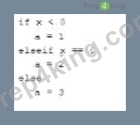
- A. Whether x is evenly divisible by 2 or 3
- B. Whether x r> negative. 0, <x positive
- C. Whether x is even
- D. Whether x is odd
Answer: D
Explanation:
The algorithm provided in the image performs a modulo operation with 2 (x % 2) and checks if the result is 1.
In programming, the modulo operation gives the remainder of the division of two numbers. For any integer x, if x % 2 equals 1, it means that x is odd because it has a remainder of 1 when divided by 2. Even numbers, when divided by 2, have no remainder and thus would return 0 in a modulo 2 operation.
References: The explanation is based on the standard definition and behavior of the modulo operation in programming and mathematics. For more information on algorithms and their applications, you can refer to resources such as GeeksforGeeks1 and Built In2.
NEW QUESTION # 81
Which operator is helpful in determining if an integer is a multiple of another integer?
- A. /
- B. +
- C. %
- D. ||
Answer: C
Explanation:
Comprehensive and Detailed Explanation From Exact Extract:
To determine if one integer is a multiple of another, the modulo operator (%) is used. According to foundational programming principles, the modulo operator returns the remainder of division, and if the remainder is zero, the first integer is a multiple of the second.
* Option A: "/." This is incorrect. The division operator (/) returns the quotient of division, which may include a decimal (e.g., 7 / 2 = 3.5). It does not directly indicate if one number is a multiple of another.
* Option B: "||." This is incorrect. The logical OR operator (||) is used for boolean operations (e.g., in conditional statements) and is unrelated to checking multiples.
* Option C: "+." This is incorrect. The addition operator (+) adds two numbers and is not used to check if one is a multiple of another.
* Option D: "%." This is correct. The modulo operator (%) returns the remainder after division. If a % b
== 0, then a is a multiple of b (e.g., 10 % 5 == 0, so 10 is a multiple of 5).
Certiport Scripting and Programming Foundations Study Guide (Section on Operators).
C Programming Language Standard (ISO/IEC 9899:2011, Section on Arithmetic Operators).
W3Schools: "Python Operators" (https://www.w3schools.com/python/python_operators.asp).
NEW QUESTION # 82
Which type of language requires variables to be declared ahead of time and prohibits their types from changing while the program runs?
- A. Scripted (interpreted)
- B. Static
- C. Compiled
- D. Procedural
Answer: B
Explanation:
The type of language that requires variables to be declared ahead of time and prohibits their types from changing while the program runs is known as a statically typed language. In statically typed languages, the type of a variable is determined at compile-time and cannot be changed during runtime. This means that the compiler must know the exact data types of all variables used in the program, and these types must remain consistent throughout the execution of the program. Statically typed languages require developers to declare the type of each variable before using it, which can help catch type errors during the compilation process, potentially preventing runtime errors and bugs.
NEW QUESTION # 83
Which output results from the given algorithm?
i = 61
d = 6
c = 0
while i >= d
c = c + 1
i = i - d
Put c to output
- A. 0
- B. 1
- C. 2
- D. 3
Answer: D
Explanation:
Comprehensive and Detailed Explanation From Exact Extract:
The algorithm counts how many times d can be subtracted from i until i is less than d, effectively computing the integer division i / d. According to foundational programming principles, we trace the loop execution.
* Initial State:
* i = 61, d = 6, c = 0.
* Loop Execution:
* While i >= d (i.e., 61 >= 6):
* c = c + 1 (increment counter).
* i = i - d (subtract d from i).
* Iterations:
* 1: i = 61, c = 0 + 1 = 1, i = 61 - 6 = 55.
* 2: i = 55, c = 1 + 1 = 2, i = 55 - 6 = 49.
* 3: i = 49, c = 2 + 1 = 3, i = 49 - 6 = 43.
* 4: i = 43, c = 3 + 1 = 4, i = 43 - 6 = 37.
* 5: i = 37, c = 4 + 1 = 5, i = 37 - 6 = 31.
* 6: i = 31, c = 5 + 1 = 6, i = 31 - 6 = 25.
* 7: i = 25, c = 6 + 1 = 7, i = 25 - 6 = 19.
* 8: i = 19, c = 7 + 1 = 8, i = 19 - 6 = 13.
* 9: i = 13, c = 8 + 1 = 9, i = 13 - 6 = 7.
* 10: i = 7, c = 9 + 1 = 10, i = 7 - 6 = 1.
* Stop: i = 1 < 6, exit loop.
* Output: Put c to output outputs c = 10.
* Verification: 61 ÷ 6 = 10 (integer division), with remainder 1 (since 61 - 6 * 10 = 1).
* Option A: "1." Incorrect. This would occur after one iteration.
* Option B: "5." Incorrect. This is too low; c reaches 10.
* Option C: "10." Correct. Matches the count of subtractions.
* Option D: "60." Incorrect. This is unrelated to the algorithm's logic.
Certiport Scripting and Programming Foundations Study Guide (Section on Loops and Counters).
Python Documentation: "While Loops" (https://docs.python.org/3/reference/compound_stmts.html#while).
W3Schools: "C While Loop" (https://www.w3schools.com/c/c_while_loop.php).
NEW QUESTION # 84
A particular sorting takes integer list 10,8 and incorrectly sorts the list to 6, 10, 8.
What is true about the algorithm's correctness for sorting an arbitrary list of three integers?
- A. The algorithm is correct
- B. The algorithm is incorrect
- C. The algorithm's correctness is unknown
- D. The algorithm only works for 10,6, 8
Answer: B
Explanation:
The correctness of a sorting algorithm is determined by its ability to sort a list of elements into a specified order, typically non-decreasing or non-increasing order. For an algorithm to be considered correct, it must consistently produce the correct output for all possible inputs. In the case of the given algorithm, it takes the input list [10, 8] and produces the output [6, 10, 8], which is not sorted in non-decreasing order. This indicates that the algorithm does not correctly sort the list, as the output is neither sorted nor does it maintain the integrity of the original list (the number 6 was not in the original list).
Furthermore, the fact that the output contains an integer (6) that was not present in the input list suggests that the algorithm is not preserving the elements of the input list, which is a fundamental requirement for a sorting algorithm. This violation confirms that the algorithm is incorrect for sorting an arbitrary list of three integers, as it cannot be relied upon to sort correctly or maintain the original list elements.
NEW QUESTION # 85
Which phase of an Agile approach would create a function that calculates shipping costs based on an item's weight and delivery zip code?
- A. Analysis
- B. Testing
- C. Implementation
- D. Design
Answer: C
NEW QUESTION # 86
What is an example of an algorithm?
- A. Unplug the device, wait 30 seconds, and restart the device.
- B. The sign of two integers determines the sign of the product
- C. A webpage uses an HTML file type
- D. The list contains apples bananas, and oranges
Answer: A
Explanation:
An algorithm is a set of instructions designed to perform a specific task or solve a problem. It is a sequence of steps that are followed to achieve a particular outcome. In the context of the given options, the correct example of an algorithm is option D. This option outlines a series of steps to troubleshoot a device, which is a common algorithmic procedure known as "power cycling" or "resetting." It involves turning off a device, waiting for a short period, and then turning it back on. This process can resolve temporary issues by clearing the device's memory and resetting its state.
Option A is incorrect because it is simply a list of items, not a sequence of steps with a specific goal. Option B is also incorrect as it describes a file type used in web development, not a set of instructions. Option C is a statement about a mathematical property, not an algorithm.
References: The definition and examples of algorithms can be found in various educational resources and programming literature. For instance, Scribbr provides a clear explanation of what an algorithm is and how it functions in both daily life and computer science1. Additionally, GeeksforGeeks offers insights into the definition, types, complexity, and examples of algorithms2. These sources corroborate the explanation provided here and offer further reading on the subject.
NEW QUESTION # 87
A function should return 0 if a number, N is even and 1 if N is odd.
What should be the input to the function?
- A. 0
- B. Even
- C. N
- D. 1
Answer: C
Explanation:
In the context of writing a function that determines whether a given number N is even or odd, the input to the function should be the number itself, represented by the variable N. The function will then perform the necessary logic to determine whether N is even or odd and return the appropriate value (0 for even, 1 for odd).
Here's how the function might look in Python:
Python
def check_even_odd(N):
"""
Determines whether a given number N is even or odd.
Args:
N (int): The input number.
Returns:
int: 0 if N is even, 1 if N is odd.
"""
if N % 2 == 0:
return 0 # N is even
else:
return 1 # N is odd
# Example usage:
number_to_check = 7
result = check_even_odd(number_to_check)
print(f"The result for {number_to_check} is: {result}")
AI-generated code. Review and use carefully. More info on FAQ.
In this example, if number_to_check is 7, the function will return 1 because 7 is an odd number.
References:
* No specific external references are needed for this basic concept, as it is fundamental to programming and mathematics.
NEW QUESTION # 88
The steps in an algorithm to build a picnic table are given:
* Measure and mark the lumber cuts that need to be made.
* Buy the needed materials.
* Determine the needed materials.
* Cut the lumber to the proper dimensions.
* Assemble the pieces and paint.Which two steps of the algorithm should be switched to make the algorithm successful?
- A. 1 and 3
- B. 2 and 3
- C. 2 and 4
- D. 1 and 2
Answer: B
Explanation:
Comprehensive and Detailed Explanation From Exact Extract:
To build a picnic table, the steps must be performed in a logical order. According to foundational programming principles (e.g., Certiport Scripting and Programming Foundations Study Guide), algorithms require correct sequencing to achieve the desired outcome. We analyze the steps to identify the logical order and find which steps are misplaced.
* Current Order:
* Measure and mark lumber cuts.
* Buy the needed materials.
* Determine the needed materials.
* Cut the lumber to the proper dimensions.
* Assemble the pieces and paint.
* Logical Order Analysis:
* Determine the needed materials (Step 3) must come first, as you need to know what materials are required before purchasing them.
* Buy the needed materials (Step 2) follows, as you purchase the materials identified.
* Measure and mark the lumber cuts (Step 1) comes next, as you need the materials on hand to measure and mark.
* Cut the lumber to the proper dimensions (Step 4) follows marking.
* Assemble the pieces and paint (Step 5) is the final step.
* Issue: Step 3 (determine materials) is after Step 2 (buy materials), which is illogical because you must know what to buy before purchasing. Switching Steps 2 and 3 corrects this:
* New order: 1, 3, 2, 4, 5.
* Option A: "1 and 3." Incorrect. Switching Step 1 (measure/mark) and Step 3 (determine materials) places measuring before determining materials, which is illogical since you need materials first.
* Option B: "1 and 2." Incorrect. Switching Step 1 (measure/mark) and Step 2 (buy materials) places buying before determining materials (Step 3), which remains out of order.
* Option C: "2 and 3." Correct. Switching Step 2 (buy materials) and Step 3 (determine materials) results in: 1, 3, 2, 4, 5, where materials are determined before buying.
* Option D: "2 and 4." Incorrect. Switching Step 2 (buy materials) and Step 4 (cut lumber) places cutting before determining materials, which is illogical.
Certiport Scripting and Programming Foundations Study Guide (Section on Algorithms and Sequencing).
General Algorithm Design Principles (logical step ordering).
NEW QUESTION # 89
A sequence diagram is shown: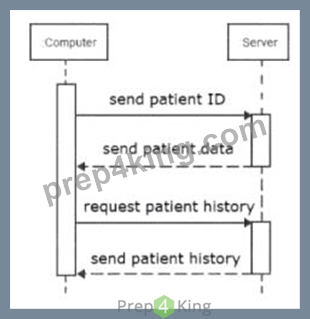
What is the purpose of a sequence diagram?
- A. It depicts program operations, branches, and loops.
- B. It outlines the needed computations.
- C. It outlines the potential actions of a user
- D. It illustrates the communication steps for a particular software scenario.
Answer: D
Explanation:
A sequence diagram is a type of interaction diagram that details how operations are carried out within a system. It is used to model the interactions between objects or components in a sequence that reflects the order of operations, particularly focusing on the messages exchanged between these objects over time. The vertical axis of a sequence diagram represents time, and the horizontal axis represents the objects involved in the interaction. The purpose of a sequence diagram is to illustrate the sequence of messages or events that occur between these objects, typically in the context of a specific use case or scenario within the software system1234.
References:
* The information provided is based on standard practices in software engineering and UML (Unified Modeling Language) documentation. For further reading on sequence diagrams and their applications, you can refer to resources such as Visual Paradigm1, Creately2, IBM Developer3, and Lucidchart4.
NEW QUESTION # 90
Which operation should be used to check if the difference of two values is greater than 1?
- A. Division
- B. Addition
- C. Multiplication
- D. Subtraction
Answer: D
Explanation:
To determine if the difference between two values is greater than 1, the subtraction operation should be used.
By subtracting one value from the other, you obtain the difference. If this difference is greater than 1, it confirms that the two values are separated by more than a single unit. This is a fundamental operation in programming and mathematics for comparing magnitudes and is supported by the logical comparison operator > which checks if the result of the subtraction is greater than 1123.
NEW QUESTION # 91
What does a function definition consist of?
- A. A list of all other functions that call the function
- B. An invocation of a function's name
- C. The function's name, inputs, outputs, and statements
- D. The function's argument values
Answer: C
Explanation:
A function definition is the blueprint for a block of code designed to perform a specific task. Here's what it includes:
* Function Name: A unique name to identify and call the function (e.g., calculate_area).
* Inputs (Parameters/Arguments): Values or variables passed into the function when it's called (e.
g., width, height).
* Outputs (Return Value): The result the function produces after processing (e.g., the calculated area).
This value may or may not be explicitly returned.
* Statements (Function Body): Contains the code that performs the actions and calculations within the function.
NEW QUESTION # 92
A program adds a service fee to the total cost of concert tickets when the tickets are printed and mailed to customers. Another service fee is also added if the
- A. Multiple if statements
- B. While loop
- C. If statement
- D. Do-while loop
Answer: A
Explanation:
The scenario describes conditional logic where service fees depend on these factors:
* Printing: There seems to be a base service fee whenever tickets are printed.
* Mailing: An additional fee applies if tickets are printed and mailed.
The most suitable way to model this logic is using multiple if statements:
* First if: Checks if tickets are printed. If so, add the base printing fee.
* Second if (nested): Checks if tickets are mailed (and by implication, already printed). If so, add the mailing fee.
NEW QUESTION # 93
A software developer creates a list of all objects and functions that will be used in a board game application and then begins to write the code for each object.
- A. Design and implementation
- B. Design and testing
- C. Analysis and design
- D. Analysis and implementation
Answer: A
Explanation:
The process described involves two main phases: first, the developer is designing the application by creating a list of all objects and functions (the design phase), and then they are writing the code for each object (the implementation phase). This aligns with option C, Design and Implementation. Analysis would involve understanding the requirements or problems the software will address, which is not mentioned in the scenario.
Testing is a separate phase that typically occurs after implementation to ensure the code works as intended.
NEW QUESTION # 94
Which output results from the given algorithm?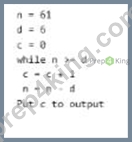
- A. 0
- B. 1
- C. 2
- D. 3
Answer: D
Explanation:
The algorithm depicted in the image is a simple loop that iterates 5 times. Each iteration multiplies the current value of i by 2 and adds it to the variable sum. The loop starts with i equal to 1 and sum equal to 0. Here's the breakdown:
* First iteration: i = 1, sum = 0 + (1 * 2) = 2
* Second iteration: i = 2, sum = 2 + (2 * 2) = 6
* Third iteration: i = 3, sum = 6 + (3 * 2) = 12
* Fourth iteration: i = 4, sum = 12 + (4 * 2) = 20
* Fifth iteration: i = 5, sum = 20 + (5 * 2) = 30
However, the algorithm includes a condition that checks if sum is greater than 10. If this condition is true, the algorithm outputs the value of i and stops. This condition is met during the third iteration, where sum becomes
12. Therefore, the algorithm outputs the value of i at that point, which is 3.
References: The explanation is based on the standard behavior of loops and conditional statements in programming. For more information on algorithms and their implementation, you can refer to resources like
"Introduction to Algorithms" by Cormen et al. and online platforms like GeeksforGeeks1.
NEW QUESTION # 95
A programmer is writing code using C. Which paradigm could the programmer be using?
- A. A procedural paradigm using sialic types
- B. An event-driven paradigm using static types
- C. A procedural paradigm using dynamic types
- D. A functional paradigm using dynamic types
Answer: A
Explanation:
C is a programming language that primarily follows the procedural programming paradigm1. This paradigm is a subset of imperative programming and emphasizes on procedure in terms of the underlying machine model1. It involves writing a sequence of instructions to tell the computer what to do step by step, and it relies on the concept of procedure calls, where procedures, also known as routines, subroutines, or functions, are a set of instructions that perform a specific task1.
The procedural paradigm in C uses static typing, where the type of a variable is known at compile time1. This means that the type of a variable is declared and does not change over time, which is in contrast to dynamic typing, where the type can change at runtime. C's type system requires that each variable and function is explicitly declared with a type and it does not support dynamic typing as seen in languages like Python or JavaScript1.
References: 1: Introduction of Programming Paradigms - GeeksforGeeks
NEW QUESTION # 96
......
Latest Scripting-and-Programming-Foundations dumps - Instant Download PDF: https://www.prep4king.com/Scripting-and-Programming-Foundations-exam-prep-material.html
Verified & Latest Scripting-and-Programming-Foundations Dump Q&As with Correct Answers: https://drive.google.com/open?id=1slo-kpeOw-yes3-4xJvn2uFudxG6vE0N
