

Real 300-420 dumps - Real Cisco dumps PDF in here [Jul-2023]
Realistic Prep4King 300-420 Dumps PDF - 100% Passing Guarantee
Cisco 300-420 exam covers a wide range of topics related to designing enterprise networks, including advanced routing and switching technologies, network design principles, network security, wireless networking, and network automation. Candidates are required to demonstrate their understanding of various Cisco technologies and their ability to design and implement complex network solutions that meet business requirements. 300-420 exam consists of multiple-choice questions, drag-and-drop questions, and simulation exercises.
Cisco 300-420 exam, also known as Designing Cisco Enterprise Networks, is a certification exam that validates the knowledge and skills of IT professionals in designing enterprise networks using Cisco technologies. 300-420 exam is intended for network designers, architects, and engineers who are responsible for designing and implementing complex enterprise networks.
NEW QUESTION # 58
A large chain of stores currently uses MPLS-based T1 lines to connect their stores to their data center. An architect must design a new solution to improve availability and reduce costs while keeping these considerations in mind:
* The company uses multicast to deliver training to the stores.
* The company uses dynamic routing protocols and has implemented QoS.
* To simplify deployments, tunnels should be created dynamically on the hub when additional stores open.
Which solution should be included in this design?
- A. DMVPN
- B. VPLS
- C. GET VPN
- D. IPsec
Answer: A
NEW QUESTION # 59
Refer to the exhibit.
Which statement about the INTERNET ACL is true?
- A. The denied entries will be logged because of the explicit deny ipv6 any any log line.
- B. HTTPS traffic from the 2001:DB8:AD59:BA21::/64 subnet will automatically be permitted along with HTTP traffic.
- C. A packet with a source address of 2001:DB8:AD59:ACC0:2020:882:DB8:1125 will be denied.
- D. A packet with a source address of 2001:DB80:AD59:BA21:101:CAB:64:38 destined to port 80 will be permitted.
Answer: D
Explanation:
Explanation/Reference:
NEW QUESTION # 60
Refer to the exhibit.
Which solution decreases the EIGRP convergence time?
- A. Enable stub routing on the spokes
- B. Enable subsecond timers
- C. Increase the dead timer value
- D. Increase the hold time value
Answer: A
NEW QUESTION # 61
Refer to the exhibit. An architect must design a solution to connect the two ASs. To optimize bandwidth, the design will implement load sharing between router R6 and router R4. Which solution should the design include?
- A. Configure the eBGP TTL to support eBGP multihop.
- B. Use maximum-paths to install multiple paths in the routing table.
- C. Use next-hop-serf attributes only for routes that are learned from eBGP peers.
- D. Use update-source to specify the Loopback interface.
Answer: B
NEW QUESTION # 62
An engineer must design a routing solution for a company that is single-homed to an ISP. The company's goal is to run BGP between theCEand the PE devices. To support running BGP, the company obtained a public AS number and IP subnet from ARIN. Which solution must the engineer select?
- A. * The customer announces the public IP subnet to the ISP
* The ISP announces the default route to the customer. - B. * The customer announces the default route to the ISP
* The ISP announces the default route to the customer - C. * The ISP announces the customer public IP subnet.
* The ISP announces the partial BGP table to the customer. - D. * The customer announces the public IP subnet to the ISP
* The ISP announces the BGP table to the customer
Answer: C
NEW QUESTION # 63
Refer to the exhibit. An IPv6 network was just deployed in the environment and the help desk has reported that R3 is not able to SSH to R2's Loopback interface. Which sequence number of the filter is preventing access?
- A. 0
- B. 1
- C. 2
- D. 3
Answer: B
NEW QUESTION # 64
Refer to the exhibit.
A network engineer must design a multicast solution based on:
* Many-to-many communications between the users and sources
* Support of up to 50 multicast sources
* Users that must register for steams
Which multicast solution must the engineer select?
- A. Bidirectional PIM
- B. Source-Specific Multicast
- C. Multicast VPN
- D. Any Source Multicast
Answer: A
NEW QUESTION # 65
Which two techniques improve the application experience in a Cisco SD-WAN design? (Choose two.)
- A. utilizing forward error correction
- B. implementing Cisco Umbrella
- C. implementing a stateful application firewall
- D. implementing AMP
- E. utilizing quality of service
Answer: A,E
NEW QUESTION # 66
Drag and drop the properties from the left onto the Cisco SD-WAN components that perform them on the right.
Answer:
Explanation: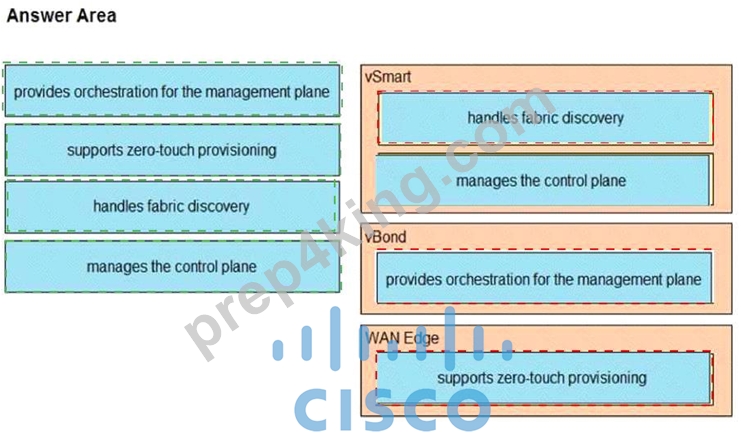
Explanation
Graphical user interface, application Description automatically generated
NEW QUESTION # 67
Refer to the exhibit.
Refer to the exhibit. The connection between SW2 and SW3 is fiber and occasionally experiences unidirectional link failure. An architect must optimize the network to reduce the change of layer2 forwarding loops when the link fails. Which solution should the architect include?
- A. Utilize BPDU guard on SW1
- B. Utilize loop guard on SW2
- C. Utilize 8PDU filter on SW3.
- D. Utilize root guard on SW1.
Answer: B
NEW QUESTION # 68
An engineer must propose a solution for a campus network that includes the capability to create multiple Layer 3 virtual networks. Each network must have its own addressing structure and routing table for data forwarding. The solution must be scalable to support hundreds of virtual networks and allow simple configuration and management with minimal administrative overhead. Which solution does the engineer recommend?
- A. hop-by-hop EVN
- B. multihop MPLS core
- C. hop-by-hop VRF-Lite
- D. multihop IPsec tunneling
Answer: A
NEW QUESTION # 69
Which design element should an engineer consider when multicast is included in a Cisco SD-Access architecture?
- A. Multicast traffic is transported in the overlay and the EID space for wired and wireless clients.
- B. Rendezvous points must be used in a PIM SSM deployment.
- C. PIM SSM must run in the underlay.
- D. Multicast clients reside in the underlay, and the multicast source is outside the fabric or in the overlay.
Answer: A
Explanation:
Explanation
Multicast traffic is transported in the overlay, in the EID space, for both wired and wireless clientshttps://www.ciscolive.com/c/dam/r/ciscolive/us/docs/2018/pdf/BRKEWN-2020.pdf
https://www.cisco.com/c/dam/en/us/td/docs/cloud-systems-management/network-automation-and-management/d
NEW QUESTION # 70
An engineer is creating a design to enable IPv6 to run on an existing IPv4 IS-IS network. The IPv4 and IPv6 topologies will match exactly, and the engineer plans to use the same router levels for each protocol per interface. Which IS-IS design is required?
- A. multi topology with transition feature enabled
- B. single topology with transition feature enabled
- C. single topology without enabling transition feature
- D. multi topology without enabling transition feature
Answer: B
Explanation:
https://www.cisco.com/c/en/us/td/docs/ios-xml/ios/iproute_isis/configuration/xe-3s/irs-xe-3s-book/ip6-route-isis-xe.html#GUID-04990BCF-8228-459E-AFAA-9FAF1E2136E9 For single-topology IS-IS IPv6, routers must be configured to run the same set of address families. IS-IS performs consistency checks on hello packets and will reject hello packets that do not have the same set of configured address families. For example, a router running IS-IS for both IPv4 and IPv6 will not form an adjacency with a router running IS-IS for IPv4 or IPv6 only. In order to allow adjacency to be formed in mismatched address-families network, the adjacency-check command in IPv6 address family configuration mode must be disabled.
NEW QUESTION # 71
An engineer must use YANG with an XML representation to configure a Cisco IOS XE switch with these specifications:
* IP address 10.10.10.10/27 configured on the interface GigabitEthernet2/1/0
* connectivity from a directly connected host 10.10.10.1/27
Which YANG data model set must the engineer choose?
- A. Text, email Description automatically generated

- B. Text, letter Description automatically generated

- C. Text, letter Description automatically generated

- D. Text, letter Description automatically generated

Answer: B
NEW QUESTION # 72 
Refer to the exhibit. An engineer is planning an IPv4 to IPv6 migration solution for a customer. The routers in the network can support IPv4 and IPv6, except for the DWDM routers. The DWDM routers provide a Layer 2 link in which the routers peer directly with each other across a DWDM circuit. The circuit also provides connectivity between the mail servers. Which IPv6 migration technique must the engineer deploy?
- A. ISATAP
- B. 6rd
- C. 6to4
- D. dual-stack
Answer: B
NEW QUESTION # 73
Refer to the exhibit. Customers report low video quality and delays when having point-to-point telepresence video calls between the two locations. An architect must optimize a design so that traffic follows the same path for egress and ingress traffic flows. Which technique optimizes the design?
- A. Configure the high metric on the router in area 4.
- B. Configure route filter on the router in area 4.
- C. Configure route leaking on the router in area 1.
- D. Configure route leaking on the router in area 2.
Answer: A
NEW QUESTION # 74
See the solution below
Explanation/Reference:
There are two ways to configure interVLAN routing in this case:
+ Use RouterC as a "router on a stick" and SwitchC as a pure Layer2 switch. Trunking must be established between RouterC and SwitchC.
+ Only use SwitchC for interVLAN routing without using RouterC, SwitchC should be configured as a Layer 3 switch (which supports ip routing function as a router). No trunking requires.
The question clearly states "No trunking has been configured on RouterC" so RouterC does not contribute to interVLAN routing of hosts H1 & H2 -> SwitchC must be configured as a Layer 3 switch with SVIs for interVLAN routing.
We should check the default gateways on H1 & H2. Click on H1 and H2 and type the "ipconfig" command to get their default gateways.
Answer:
Explanation:
\>ipconfig
We will get the default gateways as follows:
Host1:
+ Default gateway: 190.200.250.33
Host2:
+ Default gateway: 190.200.250.65
Now we have enough information to configure SwitchC (notice the EIGRP AS in this case is 650) Note: VLAN2 and VLAN3 were created and gi0/10, gi0/11 interfaces were configured as access ports so we don't need to configure them in this sim.
SwitchC# configure terminal
SwitchC(config)# int gi0/1
SwitchC(config-if)#no switchport -> without using this command, the simulator does not let you assign IP address on Gi0/1 interface.
SwitchC(config-if)# ip address 10.10.10.2 255.255.255.0 ->RouterC has used IP 10.10.10.1 so this is the lowest usable IP address.
SwitchC(config-if)# no shutdown
SwitchC(config-if)# exit
SwitchC(config)# int vlan 2
SwitchC(config-if)# ip address 190.200.250.33 255.255.255.224
SwitchC(config-if)# no shutdown
SwitchC(config-if)# int vlan 3
SwitchC(config-if)# ip address 190.200.250.65 255.255.255.224
SwitchC(config-if)# no shutdown
SwitchC(config-if)#exit
SwitchC(config)# ip routing (Notice: MLS will not work without this command) SwitchC(config)# router eigrp 65010 SwitchC(config-router)# network 10.10.10.0 0.0.0.255 SwitchC(config-router)# network 190.200.250.32 0.0.0.31 SwitchC(config-router)# network 190.200.250.64 0.0.0.31 NOTE: THE ROUTER IS CORRECTLY CONFIGURED, so you will not miss within it in the exam, also don't modify/delete any port just do the above configuration. Also some reports said the "no auto-summary" command can't be used in the simulator, in fact it is not necessary because the network 190.200.0.0/16 is not used anywhere else in this topology.
In order to complete the lab, you should expect the ping to SERVER to succeed from the MLS, and from the PCs as well.
Also make sure you use the correct EIGRP AS number (in the configuration above it is 650 but it will change when you take the exam) but we are not allowed to access RouterC so the only way to find out the EIGRP AS is to look at the exhibit above. If you use wrong AS number, no neighbor relationship is formed between RouterC and SwitchC.
In fact, we are pretty sure instead of using two commands "network 190.200.250.32 0.0.0.31″ and "network
190.200.250.64 0.0.0.31″ we can use one simple command "network 190.200.0.0″ because it is the nature of distance vector routing protocol like EIGRP: only major networks need to be advertised; even without "no auto- summary" command the network still works correctly. But in the exam the sim is just a flash based simulator so we should use two above commands, just for sure. But after finishing the configuration, we can use "show run" command to verify, only the summarized network 190.200.0.0 is shown.
NEW QUESTION # 75
Refer to the exhibit.
An architect must design an IPv6 migration solution for an enterprise customer to support these requirements:
* Clients will transition to the new IPv6 network, which provides NAT64 and IPv6 DNS resolution services, using the same DNS name that points to the IPv4 address.
* The service provider will create a client-facing IPv6 interface with a new IPv6 virtual address that points to the same IPv4 DNS server.
* The service provider will support clients that use global IPv6 addresses and encapsulate IPv4 packets into IPv6 tunnels.
Which two migration solutions must the architect choose? (Choose two.)
- A. Use IPv6 tunneling from the devices to the core MPLS network.
- B. Use dual-stack lite from the MPLS network to the IGR.
- C. Use NAT44/64 from the MPLS network to the IGR.
- D. Use dual-stack lite from the devices to the core MPLS network.
- E. Use NAT44/64 from the devices to the core MPLS network.
Answer: C,D
NEW QUESTION # 76
An engineer must propose a solution for a campus network that includes the capability to create multiple Layer
3 virtual networks. Each network must have its own addressing structure and routing table for data forwarding.
The solution must be scalable to support hundreds of virtual networks and allow simple configuration and management with minimal administrative overhead. Which solution does the engineer recommend?
- A. hop-by-hop EVN
- B. multihop MPLS core
- C. hop-by-hop VRF-Lite
- D. multihop IPsec tunneling
Answer: A
NEW QUESTION # 77
Refer to the exhibit.
Refer to the exhibit A customer wants to adopt a dynamic site-to-site VPN solution to secure communication for VoIP, video, and FTP traffic between the remote branches and the headquarters. The customer also wants the branches to communicate directly, thereby reducing traffic at the headquarters location. The solution must consider that the branch routers are limited in available memory. Which VPN solution meets these requirements?
- A. DMVPN Phase 2 Hub and Spoke design
- B. DMVPN Phase 3 Hub and Spoke design
- C. DMVPN Phase 3 Hierarchical design
- D. DMVPN Phase 1 Hub and Spoke design
Answer: B
NEW QUESTION # 78
......
Cisco 300-420 exam is a 90-minute test with 60-70 multiple-choice questions. 300-420 exam is conducted in English and is available at Pearson VUE test centers worldwide. 300-420 exam fee is $300 USD, and the certification is valid for three years. Candidates who pass the exam will earn the Cisco Certified Design Professional (CCDP) certification.
Verified 300-420 dumps Q&As Latest 300-420 Download: https://www.prep4king.com/300-420-exam-prep-material.html
Free Cisco 300-420 Exam Questions and Answer: https://drive.google.com/open?id=1FMGTtpaB85JY6EpAPfpPIiIkcgjuVJE2
