

Professional-Machine-Learning-Engineer Exam Dumps, Professional-Machine-Learning-Engineer Practice Test Questions
PDF (New 2023) Actual Google Professional-Machine-Learning-Engineer Exam Questions
NEW QUESTION 26
You need to execute a batch prediction on 100 million records in a BigQuery table with a custom TensorFlow DNN regressor model, and then store the predicted results in a BigQuery table. You want to minimize the effort required to build this inference pipeline. What should you do?
- A. Import the TensorFlow model with BigQuery ML, and run the ml.predict function.
- B. Use the TensorFlow BigQuery reader to load the data, and use the BigQuery API to write the results to BigQuery.
- C. Create a Dataflow pipeline to convert the data in BigQuery to TFRecords. Run a batch inference on Vertex AI Prediction, and write the results to BigQuery.
- D. Load the TensorFlow SavedModel in a Dataflow pipeline. Use the BigQuery I/O connector with a custom function to perform the inference within the pipeline, and write the results to BigQuery.
Answer: A
NEW QUESTION 27
A Data Science team within a large company uses Amazon SageMaker notebooks to access data stored in Amazon S3 buckets. The IT Security team is concerned that internet-enabled notebook instances create a security vulnerability where malicious code running on the instances could compromise data privacy. The company mandates that all instances stay within a secured VPC with no internet access, and data communication traffic must stay within the AWS network.
How should the Data Science team configure the notebook instance placement to meet these requirements?
- A. Associate the Amazon SageMaker notebook with a private subnet in a VPC. Place the Amazon SageMaker endpoint and S3 buckets within the same VPC.
- B. Associate the Amazon SageMaker notebook with a private subnet in a VPC. Ensure the VPC has S3 VPC endpoints and Amazon SageMaker VPC endpoints attached to it.
- C. Associate the Amazon SageMaker notebook with a private subnet in a VPC. Use IAM policies to grant access to Amazon S3 and Amazon SageMaker.
- D. Associate the Amazon SageMaker notebook with a private subnet in a VPC. Ensure the VPC has a NAT gateway and an associated security group allowing only outbound connections to Amazon S3 and Amazon SageMaker.
Answer: B
NEW QUESTION 28
A Machine Learning Specialist is given a structured dataset on the shopping habits of a company's customer base. The dataset contains thousands of columns of data and hundreds of numerical columns for each customer. The Specialist wants to identify whether there are natural groupings for these columns across all customers and visualize the results as quickly as possible.
What approach should the Specialist take to accomplish these tasks?
- A. Embed the numerical features using the t-distributed stochastic neighbor embedding (t-SNE) algorithm and create a scatter plot.
- B. Run k-means using the Euclidean distance measure for different values of k and create an elbow plot.
- C. Embed the numerical features using the t-distributed stochastic neighbor embedding (t-SNE) algorithm and create a line graph.
- D. Run k-means using the Euclidean distance measure for different values of k and create box plots for each numerical column within each cluster.
Answer: B
NEW QUESTION 29
You want to rebuild your ML pipeline for structured data on Google Cloud. You are using PySpark to conduct data transformations at scale, but your pipelines are taking over 12 hours to run. To speed up development and pipeline run time, you want to use a serverless tool and SQL syntax. You have already moved your raw data into Cloud Storage. How should you build the pipeline on Google Cloud while meeting the speed and processing requirements?
- A. Convert your PySpark into SparkSQL queries to transform the data and then run your pipeline on Dataproc to write the data into BigQuery.
- B. Ingest your data into BigQuery using BigQuery Load, convert your PySpark commands into BigQuery SQL queries to transform the data, and then write the transformations to a new table
- C. Use Data Fusion's GUI to build the transformation pipelines, and then write the data into BigQuery
- D. Ingest your data into Cloud SQL convert your PySpark commands into SQL queries to transform the data, and then use federated queries from BigQuery for machine learning
Answer: B
Explanation:
Google has bought this software and support for this tool is not good. SQL can work in Cloud fusion pipelines too but I would prefer to use a single tool like Bigquery to both transform and store data.
NEW QUESTION 30
You have a demand forecasting pipeline in production that uses Dataflow to preprocess raw data prior to model training and prediction. During preprocessing, you employ Z-score normalization on data stored in BigQuery and write it back to BigQuery. New training data is added every week. You want to make the process more efficient by minimizing computation time and manual intervention. What should you do?
- A. Normalize the data using Google Kubernetes Engine
- B. Normalize the data with Apache Spark using the Dataproc connector for BigQuery
- C. Translate the normalization algorithm into SQL for use with BigQuery
- D. Use the normalizer_fn argument in TensorFlow's Feature Column API
Answer: C
NEW QUESTION 31
Your company manages a video sharing website where users can watch and upload videos. You need to create an ML model to predict which newly uploaded videos will be the most popular so that those videos can be prioritized on your company's website.
Which result should you use to determine whether the model is successful?
- A. The model predicts 95% of the most popular videos measured by watch time within 30 days of being uploaded.
- B. The model predicts 97.5% of the most popular clickbait videos measured by number of clicks.
- C. The model predicts videos as popular if the user who uploads them has over 10,000 likes.
- D. The Pearson correlation coefficient between the log-transformed number of views after 7 days and 30 days after publication is equal to 0.
Answer: A
NEW QUESTION 32
You are developing an ML model intended to classify whether X-Ray images indicate bone fracture risk. You have trained on Api Resnet architecture on Vertex AI using a TPU as an accelerator, however you are unsatisfied with the trainning time and use memory usage. You want to quickly iterate your training code but make minimal changes to the code. You also want to minimize impact on the models accuracy. What should you do?
- A. Configure your model to use bfloat16 instead float32
- B. Reduce the number of layers in the model architecture
- C. Reduce the dimensions of the images used un the model
- D. Reduce the global batch size from 1024 to 256
Answer: D
NEW QUESTION 33
You work for a social media company. You need to detect whether posted images contain cars. Each training example is a member of exactly one class. You have trained an object detection neural network and deployed the model version to Al Platform Prediction for evaluation. Before deployment, you created an evaluation job and attached it to the Al Platform Prediction model version. You notice that the precision is lower than your business requirements allow. How should you adjust the model's final layer softmax threshold to increase precision?
- A. Increase the number of false positives
- B. Decrease the number of false negatives
- C. Decrease the recall.
- D. Increase the recall
Answer: B
NEW QUESTION 34
You work for a magazine distributor and need to build a model that predicts which customers will renew their subscriptions for the upcoming year. Using your company's historical data as your training set, you created a TensorFlow model and deployed it to AI Platform. You need to determine which customer attribute has the most predictive power for each prediction served by the model. What should you do?
- A. Use the AI Explanations feature on AI Platform. Submit each prediction request with the 'explain' keyword to retrieve feature attributions using the sampled Shapley method.
- B. Use the What-If tool in Google Cloud to determine how your model will perform when individual features are excluded. Rank the feature importance in order of those that caused the most significant performance drop when removed from the model.
- C. Stream prediction results to BigQuery. Use BigQuery's CORR(X1, X2) function to calculate the Pearson correlation coefficient between each feature and the target variable.
- D. Use AI Platform notebooks to perform a Lasso regression analysis on your model, which will eliminate features that do not provide a strong signal.
Answer: B
NEW QUESTION 35
A Data Scientist needs to analyze employment data. The dataset contains approximately 10 million observations on people across 10 different features. During the preliminary analysis, the Data Scientist notices that income and age distributions are not normal. While income levels shows a right skew as expected, with fewer individuals having a higher income, the age distribution also show a right skew, with fewer older individuals participating in the workforce.
Which feature transformations can the Data Scientist apply to fix the incorrectly skewed data? (Choose two.)
- A. Logarithmic transformation
- B. High-degree polynomial transformation
- C. Numerical value binning
- D. One hot encoding
- E. Cross-validation
Answer: C,E
NEW QUESTION 36
You have been asked to build a model using a dataset that is stored in a medium-sized (~10 GB) BigQuery table. You need to quickly determine whether this data is suitable for model development. You want to create a one-time report that includes both informative visualizations of data distributions and more sophisticated statistical analyses to share with other ML engineers on your team. You require maximum flexibility to create your report. What should you do?
- A. Use the output from TensorFlow Data Validation on Dataflow to generate the report.
- B. Use Vertex AI Workbench user-managed notebooks to generate the report.
- C. Use Dataprep to create the report.
- D. Use the Google Data Studio to create the report.
Answer: A
NEW QUESTION 37
Your organization's call center has asked you to develop a model that analyzes customer sentiments in each call. The call center receives over one million calls daily, and data is stored in Cloud Storage. The data collected must not leave the region in which the call originated, and no Personally Identifiable Information (Pll) can be stored or analyzed. The data science team has a third-party tool for visualization and access which requires a SQL ANSI-2011 compliant interface. You need to select components for data processing and for analytics. How should the data pipeline be designed?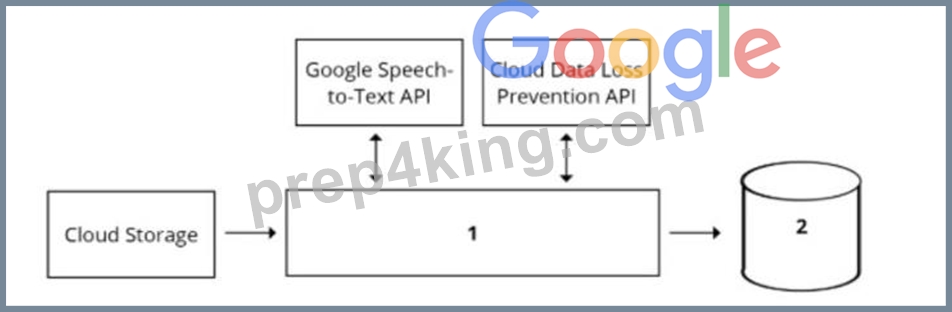
- A. 1 = Dataflow, 2 = Cloud SQL
- B. 1 = Cloud Function, 2 = Cloud SQL
- C. 1 = Dataflow, 2 = BigQuery
- D. 1 = Pub/Sub, 2 = Datastore
Answer: D
NEW QUESTION 38
A Machine Learning Specialist trained a regression model, but the first iteration needs optimizing. The Specialist needs to understand whether the model is more frequently overestimating or underestimating the target.
What option can the Specialist use to determine whether it is overestimating or underestimating the target value?
- A. Root Mean Square Error (RMSE)
- B. Residual plots
- C. Area under the curve
- D. Confusion matrix
Answer: C
NEW QUESTION 39
You are an ML engineer at a bank that has a mobile application. Management has asked you to build an ML-based biometric authentication for the app that verifies a customer's identity based on their fingerprint. Fingerprints are considered highly sensitive personal information and cannot be downloaded and stored into the bank databases. Which learning strategy should you recommend to train and deploy this ML model?
- A. MD5 to encrypt data
- B. Data Loss Prevention API
- C. Differential privacy
- D. Federated learning
Answer: D
NEW QUESTION 40
You manage a team of data scientists who use a cloud-based backend system to submit training jobs. This system has become very difficult to administer, and you want to use a managed service instead. The data scientists you work with use many different frameworks, including Keras, PyTorch, theano. Scikit-team, and custom libraries. What should you do?
- A. Use the Al Platform custom containers feature to receive training jobs using any framework
- B. Set up Slurm workload manager to receive jobs that can be scheduled to run on your cloud infrastructure.
- C. Create a library of VM images on Compute Engine; and publish these images on a centralized repository
- D. Configure Kubeflow to run on Google Kubernetes Engine and receive training jobs through TFJob
Answer: A
Explanation:
because AI platform supported all the frameworks mentioned. And Kubeflow is not managed service in GCP. https://cloud.google.com/ai-platform/training/docs/getting-started-pytorch
https://cloud.google.com/ai-platform/training/docs/containers-overview#advantages_of_custom_containers Use the ML framework of your choice. If you can't find an AI Platform Training runtime version that supports the ML framework you want to use, then you can build a custom container that installs your chosen framework and use it to run jobs on AI Platform Training.
NEW QUESTION 41
Your team needs to build a model that predicts whether images contain a driver's license, passport, or credit card. The data engineering team already built the pipeline and generated a dataset composed of 10,000 images with driver's licenses, 1,000 images with passports, and 1,000 images with credit cards. You now have to train a model with the following label map: ['driversjicense', 'passport', 'credit_card']. Which loss function should you use?
- A. Sparse categorical cross-entropy
- B. Categorical cross-entropy
- C. Categorical hinge
- D. Binary cross-entropy
Answer: B
Explanation:
- **Categorical entropy** is better to use when you want to **prevent the model from giving more importance to a certain class**. Or if the **classes are very unbalanced** you will get a better result by using Categorical entropy.
- But **Sparse Categorical Entropy** is a more optimal coice if you have a huge amount of classes, enough to make a lot of memory usage, so since sparse categorical entropy uses less columns it **uses less memory**.
https://stats.stackexchange.com/questions/326065/cross-entropy-vs-sparse-cross-entropy-when-to-use-one-over-the-other
NEW QUESTION 42
You have been asked to productionize a proof-of-concept ML model built using Keras. The model was trained in a Jupyter notebook on a data scientist's local machine. The notebook contains a cell that performs data validation and a cell that performs model analysis. You need to orchestrate the steps contained in the notebook and automate the execution of these steps for weekly retraining. You expect much more training data in the future. You want your solution to take advantage of managed services while minimizing cost. What should you do?
- A. Write the code as a TensorFlow Extended (TFX) pipeline orchestrated with Vertex AI Pipelines. Use standard TFX components for data validation and model analysis, and use Vertex AI Pipelines for model retraining.
- B. Move the Jupyter notebook to a Notebooks instance on the largest N2 machine type, and schedule the execution of the steps in the Notebooks instance using Cloud Scheduler.
- C. Extract the steps contained in the Jupyter notebook as Python scripts, wrap each script in an Apache Airflow BashOperator, and run the resulting directed acyclic graph (DAG) in Cloud Composer.
- D. Rewrite the steps in the Jupyter notebook as an Apache Spark job, and schedule the execution of the job on ephemeral Dataproc clusters using Cloud Scheduler.
Answer: A
NEW QUESTION 43
You work on a data science team at a bank and are creating an ML model to predict loan default risk. You have collected and cleaned hundreds of millions of records worth of training data in a BigQuery table, and you now want to develop and compare multiple models on this data using TensorFlow and Vertex AI. You want to minimize any bottlenecks during the data ingestion state while considering scalability. What should you do?
- A. Use the BigQuery client library to load data into a dataframe, and use tf.data.Dataset.from_tensor_slices() to read it.
- B. Use TensorFlow I/O's BigQuery Reader to directly read the data.
- C. Export data to CSV files in Cloud Storage, and use tf.data.TextLineDataset() to read them.
- D. Convert the data into TFRecords, and use tf.data.TFRecordDataset() to read them.
Answer: B
Explanation:
TensorFlow I/O's BigQuery Reader allows you to directly read data from BigQuery tables into your TensorFlow model without the need to export the data to a separate file format. This can minimize any bottlenecks during the data ingestion stage and also it can increase the scalability. By using BigQuery Reader, you can easily read large amounts of data from BigQuery and use it to train your model without having to worry about the performance impact of reading from a dataframe or CSV file.
You can use the tfio.BigQueryRecordDataset which will return a dataset of dictionaries, and where each key corresponds to a table column and each value corresponds to the value in that column.
NEW QUESTION 44
......
Preparation Process
The candidates for the Google Professional Machine Learning Engineer certification can find everything they need to efficiently prepare for the qualifying test on the official website. The most recommended resource offered by the vendor is the Machine Learning Engineer learning path. It contains both lessons and practical labs for a comprehensive understanding of the exam content. Moreover, the students can take advantage of the sample questions designed to help the potential test takers familiarize themselves with the possible exam questions. Finally, the applicants can opt for the Machine Learning Engineer Prep Webinar to join the Google experts and recently certified professionals for the tips and insights on the Machine Learning models, data processing systems, solution quality, and more.
Updated Jan-2023 Pass Professional-Machine-Learning-Engineer Exam - Real Practice Test Questions: https://www.prep4king.com/Professional-Machine-Learning-Engineer-exam-prep-material.html
Dumps Moneyack Guarantee - Professional-Machine-Learning-Engineer Dumps UpTo 90% Off: https://drive.google.com/open?id=1BLRx88k1J3TW2vPu5QON-pGl-iH-zheC
