

Kubernetes Administrator CKA Real Exam Questions and Answers FREE Updated on Sep 06, 2021
CKA Ultimate Study Guide - Prep4King
NEW QUESTION 14
Create a pod as follows:
Name: mongo
Using Image: mongo
In a new Kubernetes namespace named: my-website
Answer:
Explanation:
See the solution below.
Explanation
solution
F:\Work\Data Entry Work\Data Entry\20200827\CKA\9 B.JPG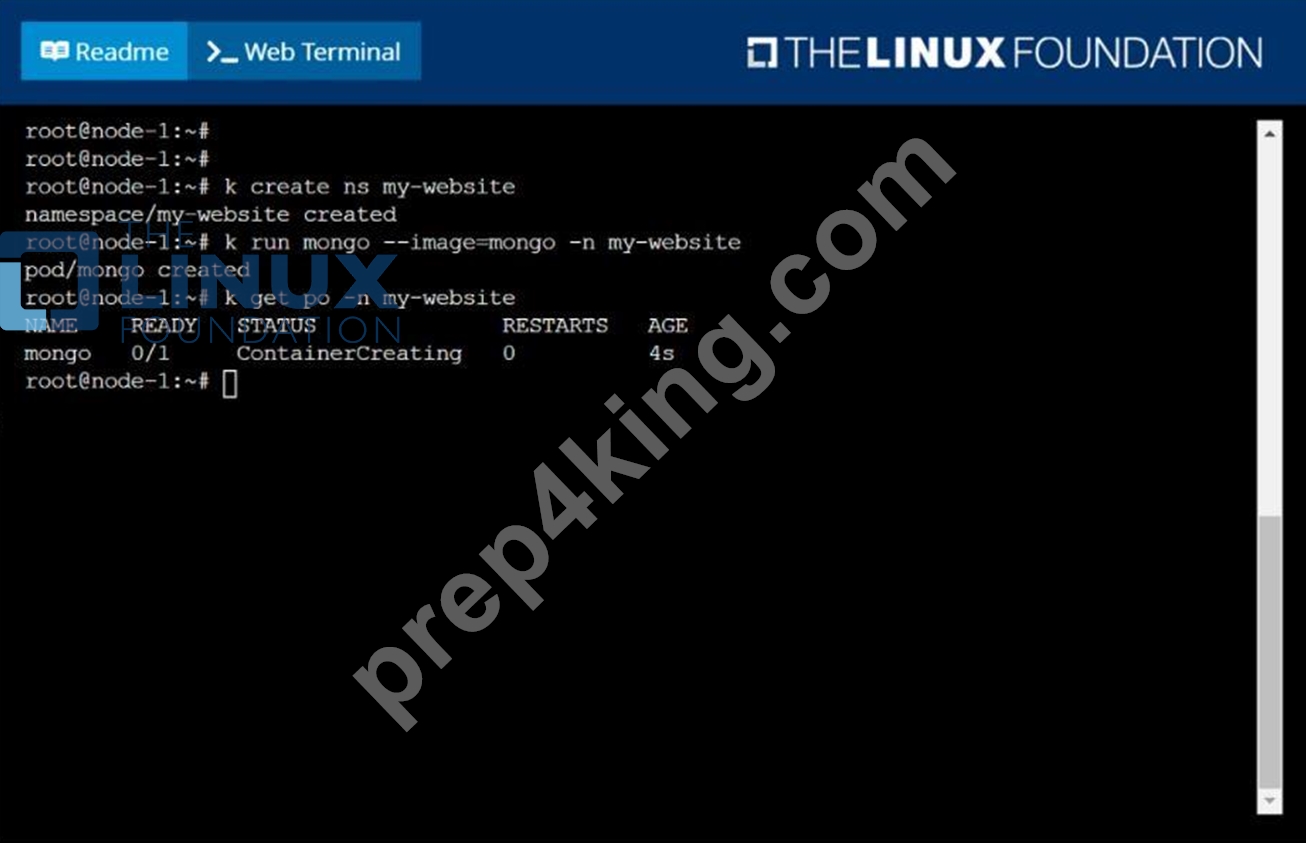
NEW QUESTION 15
Clean the cluster by deleting deployment and hpa you just created
Answer:
Explanation:
kubectl delete deploy webapp kubectl delete hpa webapp
NEW QUESTION 16
Create a namespace called 'development' and a pod with image nginx called nginx on this namespace.
Answer:
Explanation:
kubectl create namespace development kubectl run nginx --image=nginx --restart=Never -n development
NEW QUESTION 17
Updates to dynamic user group membership are automatic therefore using dynamic user groups instead of static group objects allows you to:
- A. respond to changes in user behavior and confirmed threats with manual policy changes
- B. respond to changes in user behavior or potential threats without manual policy changes
- C. respond to changes in user behavior or potential threats without automatic policy changes
- D. respond to changes in user behavior or potential threats using manual policy changes
Answer: B
NEW QUESTION 18
Create a Pod nginx and specify both CPU, memory requests and limits together and verify.
- A. kubectl run nginx-request --image=nginx --restart=Always --dryrun -o yaml > nginx-request.yml
// add the resources section and create
apiVersion: v1
kind: Pod
metadata:
labels:
run: nginx
name: nginx-request
spec:
containers:
- image: nginx
name: nginx
resources:
requests:
memory: "100Mi"
cpu: "0.5"
limits:
memory: "200Mi"
cpu: "1"
restartPolicy: Always
k kubectl apply -f nginx-request.yaml
// Verify
Kubectl top po - B. kubectl run nginx-request --image=nginx --restart=Always --dryrun -o yaml > nginx-request.yml
// add the resources section and create
apiVersion: v1
kind: Pod
metadata:
labels:
run: nginx
name: nginx
resources:
requests:
memory: "100Mi"
cpu: "0.4"
limits:
memory: "200Mi"
cpu: "7"
restartPolicy: Always
k kubectl apply -f nginx-request.yaml
// Verify
Kubectl top po
Answer: A
NEW QUESTION 19
Change the label for one of the pod to env=uat and list all the pods to verify
Answer:
Explanation:
kubectl label pod/nginx-dev3 env=uat --overwrite kubectl get pods --show-labels
NEW QUESTION 20
Monitor the logs of pod foo and:
* Extract log lines corresponding unable-to-access-website
* Write them to/opt/KULM00201/foo
Answer:
Explanation:
See the solution below.
Explanation
solution

NEW QUESTION 21
Deployment
a. Create a deployment of webapp with image nginx:1.17.1 with
container port 80 and verify the image version
- A. // Create initial YAML file with -dry-run option
kubectl create deploy webapp --image=nginx:1.17.1 --dryrun=client -o yaml > webapp.yaml vim webapp.yaml apiVersion: apps/v1 kind: Deployment metadata:
labels:
app: webapp
name: webapp
spec: replicas: 1 selector: matchLabels: app: webapp template: metadata: labels: app: webapp spec: containers: - image: nginx:1.17.1 name: nginx kubectl create -f webapp.yaml -record=true //Verify Image Version kubectl describe deploy webapp | grep -i "Image" Using JsonPath kubectl get deploy -o=jsonpath='{range.items [*]}{.[*]} {.metadata.name}{"\t"}{.spec.template.spec.containers[*].i mage}{"\n"}' - B. // Create initial YAML file with -dry-run option
kubectl create deploy webapp --image=nginx:1.17.1 --dryrun=client -o yaml > webapp.yaml vim webapp.yaml apiVersion: apps/v1 kind: Deployment metadata:
labels:
app: webapp
name: webapp
spec: replicas: 1 containers: - image: nginx:1.17.1 name: nginx kubectl create -f webapp.yaml -record=true //Verify Image Version kubectl describe deploy webapp | grep -i "Image" Using JsonPath kubectl get deploy -o=jsonpath='{range.items [*]}{.[*]} {.metadata.name}{"\t"}{.spec.template.spec.containers[*].i mage}{"\n"}'
Answer: A
NEW QUESTION 22
Create PersistentVolume named task-pv-volume with storage 10Gi, access modes ReadWriteMany, storageClassName manual, and volume at /mnt/data and Create a PersistentVolumeClaim of at least 3Gi storage and access mode ReadWriteOnce and verify
- A. vim task-pv-volume.yaml
apiVersion: v1
kind: PersistentVolume
metadata:
name: task-pv-volume
labels:
type: local
spec:
storageClassName: manual
capacity:
storage: 10Gi
accessModes:
- ReadWriteMany
hostPath:
path: "/mnt/data"
kubectl apply -f task-pv-volume.yaml
//Verify
kubectl get pv
vim task-pvc-volume.yaml
apiVersion: v1
- ReadWriteMany
resources:
requests:
storage: 3Gi
kubectl apply -f task-pvc-volume.yaml
//Verify
Kuk kubectl get pvc - B. vim task-pv-volume.yaml
apiVersion: v1
kind: PersistentVolume
metadata:
name: task-pv-volume
labels:
type: local
spec:
storageClassName: manual
capacity:
storage: 10Gi
accessModes:
- ReadWriteMany
hostPath:
path: "/mnt/data"
kubectl apply -f task-pv-volume.yaml
//Verify
kubectl get pv
vim task-pvc-volume.yaml
apiVersion: v1
kind: PersistentVolumeClaim
metadata:
name: task-pv-claim
spec:
storageClassName: manual
accessModes:
- ReadWriteMany
resources:
requests:
storage: 3Gi
kubectl apply -f task-pvc-volume.yaml
//Verify
Kuk kubectl get pvc
Answer: B
NEW QUESTION 23
Create a Kubernetes secret as follows:
Name: super-secret
password: bob
Create a pod named pod-secrets-via-file, using the redis Image, which mounts a secret named super-secret at
/secrets.
Create a second pod named pod-secrets-via-env, using the redis Image, which exports password as CONFIDENTIAL
Answer:
Explanation:
See the solution below.
Explanation
solution
F:\Work\Data Entry Work\Data Entry\20200827\CKA\12 B.JPG
F:\Work\Data Entry Work\Data Entry\20200827\CKA\12 C.JPG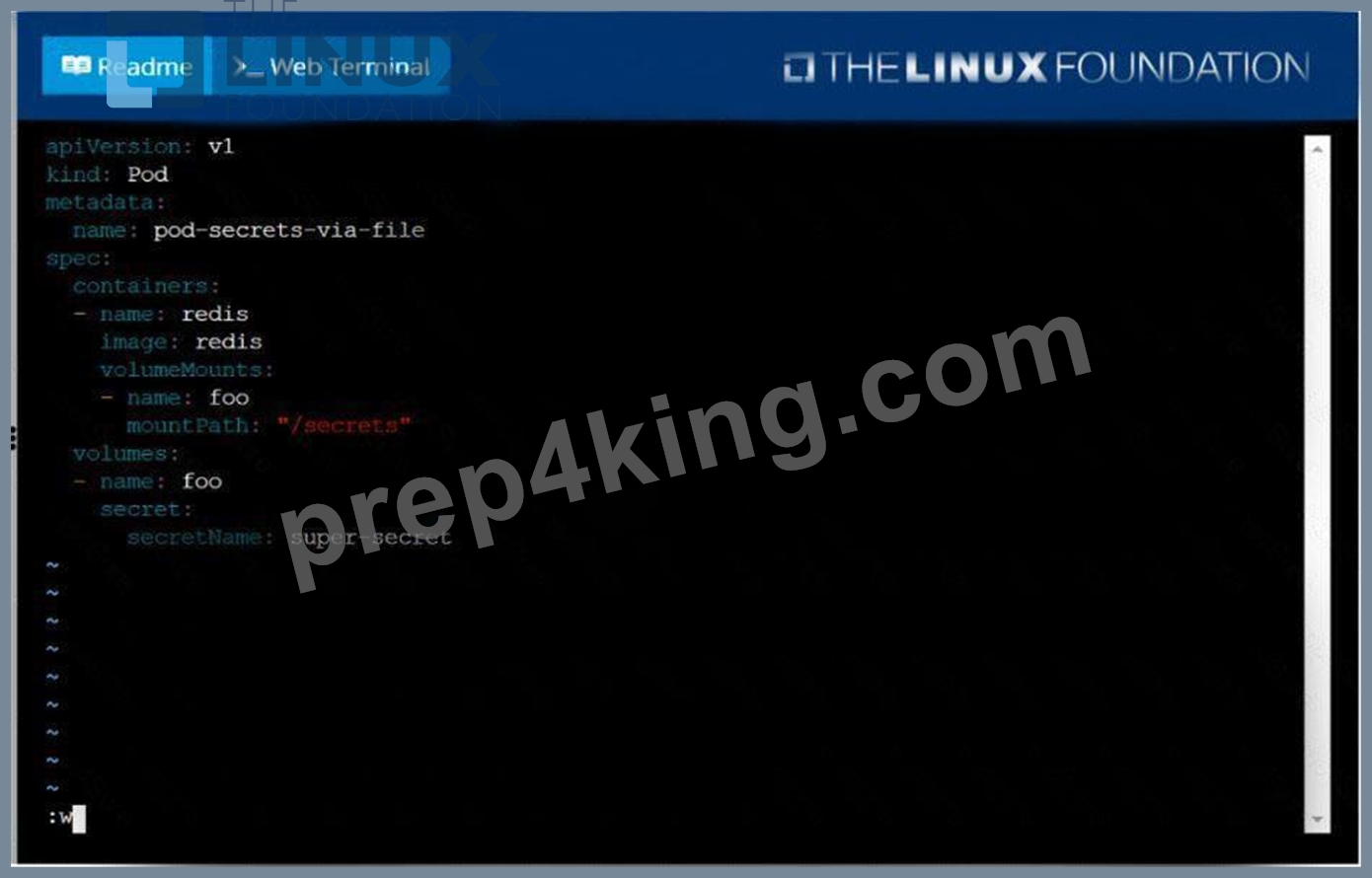
F:\Work\Data Entry Work\Data Entry\20200827\CKA\12 D.JPG
NEW QUESTION 24
Create a pod as follows:
* Name: non-persistent-redis
* container Image: redis
* Volume with name: cache-control
* Mount path: /data/redis
The pod should launch in the staging namespace and the volume must not be persistent.
Answer:
Explanation:
See the solution below.
Explanation
solution


NEW QUESTION 25
Score: 4%
Task
Create a pod named kucc8 with a single app container for each of the following images running inside (there may be between 1 and 4 images specified): nginx + redis + memcached .
Answer:
Explanation:
See the solution below.
Explanation
Solution:
kubectl run kucc8 --image=nginx --dry-run -o yaml > kucc8.yaml
# vi kucc8.yaml
apiVersion: v1
kind: Pod
metadata:
creationTimestamp: null
name: kucc8
spec:
containers:
- image: nginx
name: nginx
- image: redis
name: redis
- image: memcached
name: memcached
- image: consul
name: consul
#
kubectl create -f kucc8.yaml
#12.07
NEW QUESTION 26
List all configmap and secrets in the cluster in all namespace and write it to a file /opt/configmap-secret
Answer:
Explanation:
kubectl get configmap,secrets --all-namespaces > /opt/configmap-secret // Verify Cat /opt/configmap-secret
NEW QUESTION 27
Modify "hello-job" and make it run 10 times one after one and 5 times parallelism: 5
- A. kubectl create job hello-job --image=busybox --dry-run -o yaml
-- echo "Hello I am from job" > hello-job.yaml
// edit the yaml file to add completions: 10 and
kubectl create -f hello-job.yaml
YAML File:
apiVersion: batch/v1
kind: Job
metadata:
name: hello-job
spec:
completions: 10
parallelism: 5
template:
metadata:
spec:
containers:
- command:
- echo
- Hello I am from job
image: busybox
name: hello-job
restartPolicy: Never - B. kubectl create job hello-job --image=busybox --dry-run -o yaml
-- echo "Hello I am from job" > hello-job.yaml
// edit the yaml file to add completions: 16 and
kubectl create -f hello-job.yaml
YAML File:
apiVersion: batch/v1
kind: Job
metadata:
name: hello-job
spec:
completions: 16
parallelism: 5
template:
metadata:
spec:
containers:
- command:
- echo
- Hello I am from job
image: busybox
name: hello-job
restartPolicy: Never
Answer: A
NEW QUESTION 28
Create an nginx pod and list the pod with different levels of verbosity
- A. // create a pod
kubectl run nginx --image=nginx --restart=Never --port=80
// List the pod with different verbosity
kubectl get po nginx --v=7
kubectl get po nginx --v=6
kubectl get po nginx --v=9 - B. // create a pod
kubectl run nginx --image=nginx --restart=Never --port=80
// List the pod with different verbosity
kubectl get po nginx --v=7
kubectl get po nginx --v=8
kubectl get po nginx --v=9
Answer: B
NEW QUESTION 29
Create a job named "hello-job" with the image busybox which echos "Hello I'm running job"
- A. kubectl create job hello-job --image=busybox --dry-run -o yaml
-- echo "Hello I'm running job" > hello-job.yaml
kubectl create -f hello-job.yaml
//Verify Job
kubectl get job
kubectl get po
kubectl logs hello-job-* - B. kubectl create job hello-job --image=busybox --dry-run -o yaml
-- echo "Hello I'm running job" > hello-job.yaml
kubectl create -f hello-job.yaml
//Verify Job
kubectl get po
kubectl logs hello-job-*
Answer: A
NEW QUESTION 30
Create a pod with environment variables as var1=value1.Check the environment variable in pod
- A. kubectl run nginx --image=nginx --restart=Never --env=var1=value1
# then
kubectl exec -it nginx -- env
# or
kubectl exec -it nginx -- sh -c 'echo $var1'
# or
kubectl describe po nginx | grep value1 - B. kubectl run nginx --image=nginx --restart=Never --env=var1=value1
# then
kubectl exec -it nginx -- env
# or
kubectl describe po nginx | grep value1
Answer: A
NEW QUESTION 31
Create a redis pod and expose it on port 6379
- A. kubectl run redis --image=redis --restart=Never --port=6379
YAML File :
apiVersion: v1
kind: Pod
metadata:
labels:
run: redis
name: redis
spec:
containers:
- image: redis
name: redis
ports:
- containerPort: 6379
Rt restartPolicy: Always - B. kubectl run redis --image=redis --restart=Never --port=6379
YAML File :
apiVersion: v1
kind: Pod
metadata:
labels:
run: redis
name: redis
spec:
containers:
ports:
- containerPort: 6679
Rt restartPolicy: Alwaysf
Answer: A
NEW QUESTION 32
Create a pod that having 3 containers in it? (Multi-Container)
Answer:
Explanation:
See the solution below.
Explanation
image=nginx, image=redis, image=consul
Name nginx container as "nginx-container"
Name redis container as "redis-container"
Name consul container as "consul-container"
Create a pod manifest file for a container and append container
section for rest of the images
kubectl run multi-container --generator=run-pod/v1 --image=nginx --
dry-run -o yaml > multi-container.yaml
# then
vim multi-container.yaml
apiVersion: v1
kind: Pod
metadata:
labels:
run: multi-container
name: multi-container
spec:
containers:
- image: nginx
name: nginx-container
- image: redis
name: redis-container
- image: consul
name: consul-container
restartPolicy: Always
NEW QUESTION 33
......
Ultimate Guide to Prepare CKA Certification Exam for Kubernetes Administrator: https://www.prep4king.com/CKA-exam-prep-material.html
Use Real CKA Dumps - Linux Foundation Correct Answers: https://drive.google.com/open?id=1lKuIIcOcMbEOjtuDAY0NBDw3b9RuRUTs
