

Free Microsoft DP-200 Test Practice Test Questions Exam Dumps
Prepare Top Microsoft DP-200 Exam Audio Study Guide Practice Questions Edition
Potential Candidates and Requirements
According to the fact that this is an associate-level certification track, there are no strict requirements that you must fulfill except passing two exams. Thus, if you are planning to take Microsoft DP-200, you can be an Azure Data Engineer who wants to verify the skills to get certified or a specialist who is just starting an IT career. In both cases, you should have a solid knowledge of the content and be able to clear the tests with high results.
A potential candidate for the Microsoft DP-200 exam should know how to identify and meet the requirements by collaborating with the business stakeholders to implement data solutions that use Azure data services. Besides that, it is required that the individuals have the relevant skills in implementing various data solutions, such as Azure Blob storage, Azure Databricks, Azure Data Factory, Azure Stream Analytics, Azure Synapse Analytics, and Azure Cosmos DB. Also, they need to be able to ingest batch and streaming data, provision data storage services, identify performance bottlenecks, implement security requirements, access external data sources, transform data, and implement data retention policies. /
NEW QUESTION 123
Note: This question is part of a series of questions that present the same scenario. Each question in the series contains a unique solution that might meet the stated goals. Some question sets might have more than one correct solution, while others might not have a correct solution.
After you answer a question in this scenario, you will NOT be able to return to it. As a result, these questions will not appear in the review screen.
You have a container named Sales in an Azure Cosmos DB database. Sales has 120 GB of data. Each entry in Sales has the following structure.
The partition key is set to the OrderId attribute.
Users report that when they perform queries that retrieve data by ProductName, the queries take longer than expected to complete.
You need to reduce the amount of time it takes to execute the problematic queries.
Solution: You create a lookup collection that uses ProductName as a partition key and OrderId as a value.
Does this meet the goal?
- A. No
- B. Yes
Answer: B
Explanation:
Explanation
One option is to have a lookup collection "ProductName" for the mapping of "ProductName" to "OrderId".
References:
https://azure.microsoft.com/sv-se/blog/azure-cosmos-db-partitioning-design-patterns-part-1/
NEW QUESTION 124
You need to provision the polling data storage account.
How should you configure the storage account? To answer, drag the appropriate Configuration Value to the correct Setting. Each Configuration Value may be used once, more than once, or not at all. You may need to drag the split bar between panes or scroll to view content.
NOTE: Each correct selection is worth one point.
Answer:
Explanation:
Explanation
Account type: StorageV2
You must create new storage accounts as type StorageV2 (general-purpose V2) to take advantage of Data Lake Storage Gen2 features.
Scenario: Polling data is stored in one of the two locations:
* An on-premises Microsoft SQL Server 2019 database named PollingData
* Azure Data Lake Gen 2
Data in Data Lake is queried by using PolyBase
Replication type: RA-GRS
Scenario: All services and processes must be resilient to a regional Azure outage.
Geo-redundant storage (GRS) is designed to provide at least 99.99999999999999% (16 9's) durability of objects over a given year by replicating your data to a secondary region that is hundreds of miles away from the primary region. If your storage account has GRS enabled, then your data is durable even in the case of a complete regional outage or a disaster in which the primary region isn't recoverable.
If you opt for GRS, you have two related options to choose from:
* GRS replicates your data to another data center in a secondary region, but that data is available to be read only if Microsoft initiates a failover from the primary to secondary region.
* Read-access geo-redundant storage (RA-GRS) is based on GRS. RA-GRS replicates your data to another data center in a secondary region, and also provides you with the option to read from the secondary region. With RA-GRS, you can read from the secondary region regardless of whether Microsoft initiates a failover from the primary to secondary region.
References:
https://docs.microsoft.com/bs-cyrl-ba/azure/storage/blobs/data-lake-storage-quickstart-create-account
https://docs.microsoft.com/en-us/azure/storage/common/storage-redundancy-grs
NEW QUESTION 125
You need to ensure polling data security requirements are met.
Which security technologies should you use? To answer, select the appropriate options in the answer area.
NOTE: Each correct selection is worth one point.
Answer:
Explanation:
References:
https://docs.microsoft.com/en-us/sql/t-sql/statements/create-database-scoped-credential-transact-sql
NEW QUESTION 126
You have data stored in thousands of CSV files in Azure Data Lake Storage Gen2. Each file has a header row followed by a property formatted carriage return (/r) and line feed (/n).
You are implementing a pattern that batch loads the files daily into an Azure SQL data warehouse by using PolyBase.
You need to skip the header row when you import the files into the data warehouse.
Which three actions should you perform in sequence? To answer, move the appropriate actions from the list of actions to the answer area and arrange them in the correct order.
Which three actions you perform in sequence? To answer, move the appropriate actions from the list of actions to the answer area and arrange them in the correct order.
Answer:
Explanation:
Explanation
Step 1: Create an external data source and set the First_Row option.
Creates an External File Format object defining external data stored in Hadoop, Azure Blob Storage, or Azure Data Lake Store. Creating an external file format is a prerequisite for creating an External Table.
FIRST_ROW = First_row_int
Specifies the row number that is read first in all files during a PolyBase load. This parameter can take values
1-15. If the value is set to two, the first row in every file (header row) is skipped when the data is loaded.
Rows are skipped based on the existence of row terminators (/r/n, /r, /n).
Step 2: Create an external data source that uses the abfs location
The hadoop-azure module provides support for the Azure Data Lake Storage Gen2 storage layer through the
"abfs" connector
Step 3: Use CREATE EXTERNAL TABLE AS SELECT (CETAS) and create a view that removes the empty row.
References:
https://docs.microsoft.com/en-us/sql/t-sql/statements/create-external-file-format-transact-sql
https://hadoop.apache.org/docs/r3.2.0/hadoop-azure/abfs.html
NEW QUESTION 127
You have an Azure Synapse Analytics SQL pool named Pool1 on a logical Microsoft SQL server named Server1.
You need to implement Transparent Data Encryption (TDE) on Pool1 by using a custom key named key1.
Which five actions should you perform in sequence? To answer, move the appropriate actions from the list of actions to the answer area and arrange them in the correct order.
Answer:
Explanation:
Explanation
Step 1: Assign a managed identity to Server1
You will need an existing Managed Instance as a prerequisite.
Step 2: Create an Azure key vault and grant the managed identity permissions to the vault Create Resource and setup Azure Key Vault.
Step 3 :Add key1 to the Azure key vault
The recommended way is to import an existing key from a .pfx file or get an existing key from the vault.
Alternatively, generate a new key directly in Azure Key Vault.
Step 4: Configure key1 as the TDE protector for Server1
Provide TDE Protector key
Step 5: Enable TDE on Pool1
Reference:
https://docs.microsoft.com/en-us/azure/azure-sql/managed-instance/scripts/transparent-data-encryption-byok-po
NEW QUESTION 128
You are a data engineer. You are designing a Hadoop Distributed File System (HDFS) architecture. You plan to use Microsoft Azure Data Lake as a data storage repository.
You must provision the repository with a resilient data schema. You need to ensure the resiliency of the Azure Data Lake Storage. What should you use? To answer, select the appropriate options in the answer area.
NOTE: Each correct selection is worth one point.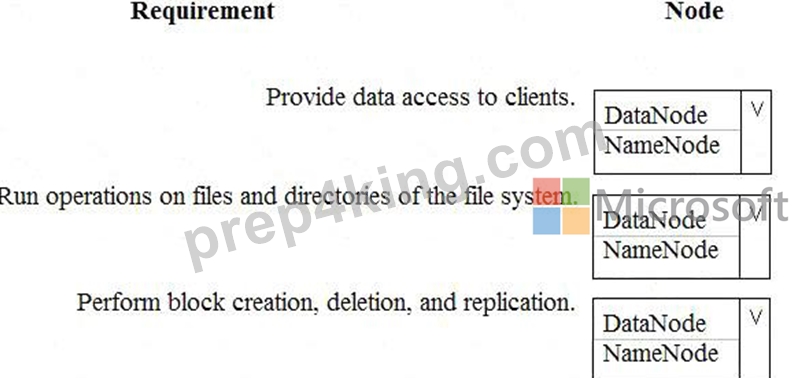
Answer:
Explanation:
Explanation
Box 1: NameNode
An HDFS cluster consists of a single NameNode, a master server that manages the file system namespace and regulates access to files by clients.
Box 2: DataNode
The DataNodes are responsible for serving read and write requests from the file system's clients.
Box 3: DataNode
The DataNodes perform block creation, deletion, and replication upon instruction from the NameNode.
Note: HDFS has a master/slave architecture. An HDFS cluster consists of a single NameNode, a master server that manages the file system namespace and regulates access to files by clients. In addition, there are a number of DataNodes, usually one per node in the cluster, which manage storage attached to the nodes that they run on. HDFS exposes a file system namespace and allows user data to be stored in files. Internally, a file is split into one or more blocks and these blocks are stored in a set of DataNodes. The NameNode executes file system namespace operations like opening, closing, and renaming files and directories. It also determines the mapping of blocks to DataNodes. The DataNodes are responsible for serving read and write requests from the file system's clients. The DataNodes also perform block creation, deletion, and replication upon instruction from the NameNode.
References:
https://hadoop.apache.org/docs/r1.2.1/hdfs_design.html#NameNode+and+DataNodes
NEW QUESTION 129
You are implementing an Azure Blob storage account for an application that has the following requirements:
* Data created during the last 12 months must be readily accessible.
* Blobs older than 24 months must use the lowest storage costs. This data will be accessed infrequently.
* Data created 12 to 24 months ago will be accessed infrequently but must be readily accessible at the lowest storage costs.
Which four actions should you perform in sequence? To answer, move the appropriate actions from the list of actions to the answer area and arrange them in the correct order.
Answer:
Explanation:
Explanation
Step 1: Create a block blob in a Blob storage account
First create the block blob.
Step 2: Use an Azure Resource Manager template that has a lifecycle management policy Azure Blob storage lifecycle management offers a rich, rule-based policy for GPv2 and Blob storage accounts.
Step 3: Create a rule that has the rule actions of TierCool, TierToArchive, and Delete Each rule definition includes a filter set and an action set. The filter set limits rule actions to a certain set of objects within a container or objects names. The action set applies the tier or delete actions to the filtered set of objects.
Step 4: Schedule the lifecycle management policy to run.
NEW QUESTION 130
You need to receive an alert when Azure SQL Data Warehouse consumes the maximum allotted resources.
Which resource type and signal should you use to create the alert in Azure Monitor? To answer, select the appropriate options in the answer area.
NOTE: Each correct selection is worth one point.
Answer:
Explanation:
Explanation
Resource type: SQL data warehouse
DWU limit belongs to the SQL data warehouse resource type.
Signal: DWU USED
References:
https://docs.microsoft.com/en-us/azure/sql-database/sql-database-insights-alerts-portal
NEW QUESTION 131
You have an Azure Databricks resource.
You need to log actions that relate to compute changes triggered by the Databricks resources.
Which Databricks services should you log?
- A. SSH
- B. workspace
- C. lobs
- D. clusters
- E. DBFS
Answer: D
Explanation:
Explanation
An Azure Databricks cluster is a set of computation resources and configurations on which you run data engineering, data science, and data analytics workloads.
Reference:
https://docs.microsoft.com/en-us/azure/databricks/clusters/
NEW QUESTION 132
Use the following login credentials as needed:
Azure Username: xxxxx
Azure Password: xxxxx
The following information is for technical support purposes only:
Lab Instance: 10543936
You need to replicate db1 to a new Azure SQL server named db1-copy10543936 in the US West region.
To complete this task, sign in to the Azure portal.
Answer:
Explanation:
1. In the Azure portal, browse to the database db1-copy10543936 that you want to set up for geo-replication.
2. On the SQL database page, select geo-replication, and then select the region to create the secondary database: US West region
3. Select or configure the server and pricing tier for the secondary database.
4. Click Create to add the secondary.
5. The secondary database is created and the seeding process begins.
6. When the seeding process is complete, the secondary database displays its status.
Reference:
https://docs.microsoft.com/en-us/azure/sql-database/sql-database-active-geo-replication-portal
NEW QUESTION 133
Use the following login credentials as needed:
Azure Username: xxxxx
Azure Password: xxxxx
The following information is for technical support purposes only:
Lab Instance: 10543936
You need to create an elastic pool that contains an Azure SQL database named db2 and a new SQL database named db3.
To complete this task, sign in to the Azure portal.
Answer:
Explanation:
See the explanation below.
Explanation
Step 1: Create a new SQL database named db3
1. Select SQL in the left-hand menu of the Azure portal. If SQL is not in the list, select All services, then type SQL in the search box.
2. Select + Add to open the Select SQL deployment option page. Select Single Database. You can view additional information about the different databases by selecting Show details on the Databases tile.
3. Select Create:
4. Enter the required fields if necessary.
5. Leave the rest of the values as default and select Review + Create at the bottom of the form.
6. Review the final settings and select Create. Use Db3 as database name.
On the SQL Database form, select Create to deploy and provision the resource group, server, and database.
Step 2: Create your elastic pool using the Azure portal.
1. Select Azure SQL in the left-hand menu of the Azure portal. If Azure SQL is not in the list, select All services, then type Azure SQL in the search box.
2. Select + Add to open the Select SQL deployment option page.
3. Select Elastic pool from the Resource type drop-down in the SQL Databases tile. Select Create to create your elastic pool.
4. Configure your elastic pool with the following values:
Name: Provide a unique name for your elastic pool, such as myElasticPool.
Subscription: Select your subscription from the drop-down.
ResourceGroup: Select the resource group.
Server: Select the server
5. Select Configure elastic pool
6. On the Configure page, select the Databases tab, and then choose to Add database.
7. Add the Azure SQL database named db2, and the new SQL database named db3 that you created in Step 1.
8. Select Review + create to review your elastic pool settings and then select Create to create your elastic pool.
Reference:
https://docs.microsoft.com/bs-latn-ba/azure/sql-database/sql-database-elastic-pool-failover-group-tutorial
NEW QUESTION 134
You need to receive an alert when Azure SQL Data Warehouse consumes the maximum allotted resources.
Which resource type and signal should you use to create the alert in Azure Monitor? To answer, select the appropriate options in the answer area.
NOTE: Each correct selection is worth one point.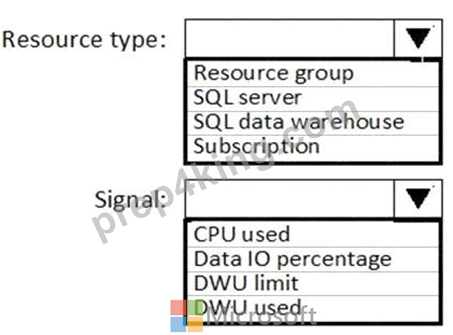
Answer:
Explanation:
Explanation
Resource type: SQL data warehouse
DWU limit belongs to the SQL data warehouse resource type.
Signal: DWU USED
References:
https://docs.microsoft.com/en-us/azure/sql-database/sql-database-insights-alerts-portal
NEW QUESTION 135
Your company analyzes images from security cameras and sends to security teams that respond to unusual activity. The solution uses Azure Databricks.
You need to send Apache Spark level events, Spark Structured Streaming metrics, and application metrics to Azure Monitor.
Which three actions should you perform in sequence? To answer, move the appropriate actions from the list of actions in the answer area and arrange them in the correct order.
Answer:
Explanation:
Explanation
You can send application logs and metrics from Azure Databricks to a Log Analytics workspace.
Spark uses a configurable metrics system based on the Dropwizard Metrics Library.
Prerequisites: Configure your Azure Databricks cluster to use the monitoring library.
Note: The monitoring library streams Apache Spark level events and Spark Structured Streaming metrics from your jobs to Azure Monitor.
To send application metrics from Azure Databricks application code to Azure Monitor, follow these steps:
Step 1. Build the spark-listeners-loganalytics-1.0-SNAPSHOT.jar JAR file Step 2: Create Dropwizard gauges or counters in your application code.
Reference:
https://docs.microsoft.com/bs-latn-ba/azure/architecture/databricks-monitoring/application-logs
NEW QUESTION 136
You use Azure Stream Analytics to receive Twitter data from Azure Event Hubs and to output the data to an Azure Blob storage account.
You need to output the count of tweets during the last five minutes every five minutes. Each tweet must only be counted once.
Which windowing function should you use?
- A. a five-minute Session window
- B. a five-minute Tumbling window
- C. a five-minute Hopping window that has one-minute hop
- D. a five-minute Sliding window
Answer: B
Explanation:
Explanation
Tumbling window functions are used to segment a data stream into distinct time segments and perform a function against them, such as the example below. The key differentiators of a Tumbling window are that they repeat, do not overlap, and an event cannot belong to more than one tumbling window.
References:
https://docs.microsoft.com/en-us/azure/stream-analytics/stream-analytics-window-functions
NEW QUESTION 137
You have a SQL pool in Azure Synapse.
A user reports that queries against the pool take longer than expected to complete.
You need to add monitoring to the underlying storage to help diagnose the issue.
Which two metrics should you monitor? Each correct answer presents part of the solution.
NOTE: Each correct selection is worth one point.
- A. Cache used percentage
- B. Snapshot Storage Size
- C. DWU Limit
- D. Active queries
- E. Cache hit percentage
Answer: A,E
Explanation:
Explanation
A: Cache used is the sum of all bytes in the local SSD cache across all nodes and cache capacity is the sum of the storage capacity of the local SSD cache across all nodes.
E: Cache hits is the sum of all columnstore segments hits in the local SSD cache and cache miss is the columnstore segments misses in the local SSD cache summed across all nodes Reference:
https://docs.microsoft.com/en-us/azure/synapse-analytics/sql-data-warehouse/sql-data-warehouse-concept-resour
NEW QUESTION 138
You need to replace the SSIS process by using Data Factory.
Which four actions should you perform in sequence? To answer, move the appropriate actions from the list of actions to the answer area and arrange them in the correct order.
Answer:
Explanation:
Explanation
Scenario: A daily process creates reporting data in REPORTINGDB from the data in SALESDB. The process is implemented as a SQL Server Integration Services (SSIS) package that runs a stored procedure from SALESDB.
Step 1: Create a linked service to each database
Step 2: Create two datasets
You can create two datasets: InputDataset and OutputDataset. These datasets are of type AzureBlob. They refer to the Azure Storage linked service that you created in the previous section.
Step 3: Create a pipeline
You create and validate a pipeline with a copy activity that uses the input and output datasets.
Step 4: Add a copy activity
References:
https://docs.microsoft.com/en-us/azure/data-factory/quickstart-create-data-factory-portal
NEW QUESTION 139
A company plans to use Platform-as-a-Service (PaaS) to create the new data pipeline process. The process must meet the following requirements.
Ingest:
*Access multiple data sources
*Provide the ability to orchestrate workflow
*Provide the capability to run SQL Server Integration Services packages.
Store:
*Optimize storage for big data workloads.
*Provide encryption of data at rest.
*Operate with no size limits.
Prepare and Train:
*Provide a fully-managed and interactive workspace for exploration and visualization.
*Provide the ability to program in R, SQL, Python, Scala, and Java.
*Provide seamless user authentication with Azure Active Directory.
Model & Serve:
*Implement native columnar storage.
*Support for the SQL language
*Provide support for structured streaming.
You need to build the data integration pipeline.
Which technologies should you use? To answer, select the appropriate options in the answer area.
Answer:
Explanation:
Explanation
Ingest: Azure Data Factory
Azure Data Factory pipelines can execute SSIS packages.
In Azure, the following services and tools will meet the core requirements for pipeline orchestration, control flow, and data movement: Azure Data Factory, Oozie on HDInsight, and SQL Server Integration Services (SSIS).
Store: Data Lake Storage
Data Lake Storage Gen1 provides unlimited storage.
Note: Data at rest includes information that resides in persistent storage on physical media, in any digital format. Microsoft Azure offers a variety of data storage solutions to meet different needs, including file, disk, blob, and table storage. Microsoft also provides encryption to protect Azure SQL Database, Azure Cosmos DB, and Azure Data Lake.
Prepare and Train: Azure Databricks
Azure Databricks provides enterprise-grade Azure security, including Azure Active Directory integration.
With Azure Databricks, you can set up your Apache Spark environment in minutes, autoscale and collaborate on shared projects in an interactive workspace. Azure Databricks supports Python, Scala, R, Java and SQL, as well as data science frameworks and libraries including TensorFlow, PyTorch and scikit-learn.
Model and Serve: SQL Data Warehouse
SQL Data Warehouse stores data into relational tables with columnar storage.
Azure SQL Data Warehouse connector now offers efficient and scalable structured streaming write support for SQL Data Warehouse. Access SQL Data Warehouse from Azure Databricks using the SQL Data Warehouse connector.
References:
https://docs.microsoft.com/bs-latn-ba/azure/architecture/data-guide/technology-choices/pipeline-orchestration-da
https://docs.microsoft.com/en-us/azure/azure-databricks/what-is-azure-databricks
NEW QUESTION 140
......
Go to DP-200 Questions - Try DP-200 dumps pdf : https://www.prep4king.com/DP-200-exam-prep-material.html
