

Databricks-Certified-Data-Engineer-Professional Practice Test Questions Answers Updated 250 Questions
Databricks-Certified-Data-Engineer-Professional dumps & Databricks Certification Sure Practice with 250 Questions
NEW QUESTION # 20
A data engineer is using the AUTO CDC API in Lakeflow Spark Declarative Pipeline to propagate deletions from a source table (orders_source) to a target table (orders_target). The source has Change Data Feed (CDF) enabled, but some delete events arrive out of order due to upstream delays. How does the AUTO CDC API internally ensure deletions are applied correctly despite out-of-order events?
- A. It manually sorts incoming events by timestamp before applying changes.
- B. It runs VACUUM on the target table to purge conflicting records.
- C. It ignores deletions if they arrive after updates for the same key.
- D. It uses sequence_by to order events and retains tombstones for deleted rows until older sequences are processed.
Answer: D
Explanation:
AUTO CDC uses the sequence_by column to deterministically order change events for each key.
Delete operations create tombstones that are retained until all earlier sequence values have been processed, ensuring that out-of-order delete events are still applied correctly and consistently in the target table.
NEW QUESTION # 21
A data engineer is building a customer data pipeline in Lakeflow Spark Declarative Pipelines. The source is a cloud-based event stream with limited retention containing inserts, updates, and deletes for customer records. These changes are being applied using the AUTO CDC INTO syntax to maintain an SCD Type 1 table as the target table, customer_dim. How should the data engineer build a downstream job that streams from the customer_dim table to only act on updates and delete events, processing data incrementally?
- A. Read change data feed from customer_dim table and apply filters to incrementally act on the change events.
- B. Use ignoreChanges flag while streaming from customer_dim to avoid breaking the pipeline during updates and deletes.
- C. When stored as SCD 1, the target of AUTO CDC INTO includes updates and deletes. Streaming from customer_dim can fail due to these operations. Instead, build another stream from the original source.
- D. Streaming from customer_dim table would only be possible in the case of SCD 2 retention.
Answer: A
Explanation:
Reading the change data feed from the customer_dim table enables downstream processing to react specifically to update and delete events while operating incrementally. Change data feed exposes row-level change types and versions, making it the correct mechanism for streaming only the relevant changes from an SCD Type 1 table maintained with AUTO CDC INTO.
NEW QUESTION # 22
The data engineering team has configured a job to process customer requests to be forgotten (have their data deleted). All user data that needs to be deleted is stored in Delta Lake tables using default table settings.
The team has decided to process all deletions from the previous week as a batch job at 1am each Sunday. The total duration of this job is less than one hour. Every Monday at 3am, a batch job executes a series of VACUUM commands on all Delta Lake tables throughout the organization.
The compliance officer has recently learned about Delta Lake's time travel functionality. They are concerned that this might allow continued access to deleted data.
Assuming all delete logic is correctly implemented, which statement correctly addresses this concern?
- A. Because Delta Lake's delete statements have ACID guarantees, deleted records will be permanently purged from all storage systems as soon as a delete job completes.
- B. Because the default data retention threshold is 7 days, data files containing deleted records will be retained until the vacuum job is run 8 days later.Get Latest & Actual Certified-Data-Engineer-Professional Exam's Question and Answers from
- C. Because the vacuum command permanently deletes all files containing deleted records, deleted records may be accessible with time travel for around 24 hours.
- D. Because the default data retention threshold is 24 hours, data files containing deleted records will be retained until the vacuum job is run the following day.
- E. Because Delta Lake time travel provides full access to the entire history of a table, deleted records can always be recreated by users with full admin privileges.
Answer: B
Explanation:
https://learn.microsoft.com/en-us/azure/databricks/delta/vacuum
NEW QUESTION # 23
A data engineer wants to enforce the principle of least privilege when configuring ACLs for Databricks jobs in a collaborative workspace. Which approach should the data engineer use?
- A. Use only folder-level permissions and avoid setting permissions on individual jobs.
- B. Assign users only the minimum permission level (e.g., CAN RUN or CAN VIEW) required for their role on each job.
- C. Grant CAN RUN permission to everyone and CAN MANAGE to a single admin group.
- D. Grant all users CAN MANAGE permission on all jobs to avoid access issues.
Answer: B
Explanation:
Assigning the minimum required permission level on each job ensures users can perform only the actions necessary for their role. This directly enforces the principle of least privilege while maintaining secure and controlled access in a collaborative workspace.
NEW QUESTION # 24
A data architect has heard about lake's built-in versioning and time travel capabilities. For auditing purposes they have a requirement to maintain a full of all valid street addresses as they appear in the customers table.
The architect is interested in implementing a Type 1 table, overwriting existing records with new values and relying on Delta Lake time travel to support long-term auditing. A data engineer on the project feels that a Type 2 table will provide better performance and scalability. Which piece of information is critical to this decision?
- A. Shallow clones can be combined with Type 1 tables to accelerate historic queries for long-term versioning.
- B. Delta Lake only supports Type 0 tables; once records are inserted to a Delta Lake table, they cannot be modified.
- C. Delta Lake time travel cannot be used to query previous versions of these tables because Type 1 changes modify data files in place.
- D. Delta Lake time travel does not scale well in cost or latency to provide a long-term versioning solution.
- E. Data corruption can occur if a query fails in a partially completed state because Type 2 tables requires setting multiple fields in a single update.
Answer: D
Explanation:
Delta Lake's time travel feature allows users to access previous versions of a table, providing a powerful tool for auditing and versioning. However, using time travel as a long-term versioning solution for auditing purposes can be less optimal in terms of cost and performance, especially as the volume of data and the number of versions grow. For maintaining a full history of valid street addresses as they appear in a customers table, using a Type 2 table (where each update creates a new record with versioning) might provide better scalability and performance by avoiding the overhead associated with accessing older versions of a large table. While Type 1 tables, where existing records are overwritten with new values, seem simpler and can leverage time travel for auditing, the critical piece of information is that time travel might not scale well in cost or latency for long-term versioning needs, making a Type 2 approach more viable for performance and scalability.
NEW QUESTION # 25
In order to prevent accidental commits to production data, a senior data engineer has instituted a policy that all development work will reference clones of Delta Lake tables. After testing both deep and shallow clone, development tables are created using shallow clone. A few weeks after initial table creation, the cloned versions of several tables implemented as Type 1 Slowly Changing Dimension (SCD) stop working. The transaction logs for the source tables show that vacuum was run the day before.
Why are the cloned tables no longer working?
- A. Running vacuum automatically invalidates any shallow clones of a table; deep clone should always be used when a cloned table will be repeatedly queried.
- B. Because Type 1 changes overwrite existing records, Delta Lake cannot guarantee data consistency for cloned tables.
- C. The metadata created by the clone operation is referencing data files that were purged as invalid by the vacuum command
- D. The data files compacted by vacuum are not tracked by the cloned metadata; running refresh on the cloned table will pull in recent changes.
- E. Tables created with SHALLOW CLONE are automatically deleted after their default retention threshold of 7 days.
Answer: C
Explanation:
In Delta Lake, a shallow clone creates a new table by copying the metadata of the source table without duplicating the data files. When the vacuum command is run on the source table, it removes old data files that are no longer needed to maintain the transactional log's integrity, potentially including files referenced by the shallow clone's metadata. If these files are purged, the shallow cloned tables will reference non-existent data files, causing them to stop working properly. This highlights the dependency of shallow clones on the source table's data files and the impact of data management operations like vacuum on these clones.
NEW QUESTION # 26
A Structured Streaming job deployed to production has been resulting in higher than expected cloud storage costs. At present, during normal execution, each microbatch of data is processed in less than 3s; at least 12 times per minute, a microbatch is processed that contains 0 records. The streaming write was configured using the default trigger settings. The production job is currently scheduled alongside many other Databricks jobs in a workspace with instance pools provisioned to reduce start-up time for jobs with batch execution.
Holding all other variables constant and assuming records need to be processed in less than 10 minutes, which adjustment will meet the requirement?
- A. Use the trigger once option and configure a Databricks job to execute the query every 10 minutes; this approach minimizes costs for both compute and storage.
- B. Set the trigger interval to 3 seconds; the default trigger interval is consuming too many records per batch, resulting in spill to disk that can increase volume costs.
- C. Increase the number of shuffle partitions to maximize parallelism, since the trigger interval cannot be modified without modifying the checkpoint directory.
- D. Set the trigger interval to 500 milliseconds; setting a small but non-zero trigger interval ensures that the source is not queried too frequently.
- E. Set the trigger interval to 10 minutes; each batch calls APIs in the source storage account, so decreasing trigger frequency to maximum allowable threshold should minimize this cost.
Answer: E
NEW QUESTION # 27
A data architect has designed a system in which two Structured Streaming jobs will concurrently write to a single bronze Delta table. Each job is subscribing to a different topic from an Apache Kafka source, but they will write data with the same schema. To keep the directory structure simple, a data engineer has decided to nest a checkpoint directory to be shared by both streams.
The proposed directory structure is displayed below:
Which statement describes whether this checkpoint directory structure is valid for the given scenario and why?
- A. Yes; Delta Lake supports infinite concurrent writers.
- B. No; Delta Lake manages streaming checkpoints in the transaction log.
- C. Yes; both of the streams can share a single checkpoint directory.
- D. No; only one stream can write to a Delta Lake table.
- E. No; each of the streams needs to have its own checkpoint directory.
Answer: E
Explanation:
This is the correct answer because checkpointing is a critical feature of Structured Streaming that provides fault tolerance and recovery in case of failures. Checkpointing stores the current state and progress of a streaming query in a reliable storage system, such as DBFS or S3. Each streaming query must have its own checkpoint directory that is unique and exclusive to that query. If two streaming queries share the same checkpoint directory, they will interfere with each other and cause unexpected errors or data loss.
NEW QUESTION # 28
A data engineering team uses Databricks Lakehouse Monitoring to track the percent_null metric for a critical column in their Delta table.
The profile metrics table (prod_catalog.prod_schema.customer_data_profile_metrics) stores hourly percent_null values.
The team wants to:
Trigger an alert when the daily average of percent_null exceeds 5% for
three consecutive days.
Ensure that notifications are not spammed during sustained issues.
- A. SELECT percent_null
FROM prod_catalog.prod_schema.customer_data_profile_metrics
WHERE window.end >= CURRENT_TIMESTAMP - INTERVAL '1' DAY
Alert Condition: percent_null > 5
Notification Frequency: At most every 24 hours - B. SELECT SUM(CASE WHEN percent_null > 5 THEN 1 ELSE 0 END) AS violation_days FROM prod_catalog.prod_schema.customer_data_profile_metrics WHERE window.end >= CURRENT_TIMESTAMP - INTERVAL '3' DAY Alert Condition: violation_days >= 3 Notification Frequency: Just once
- C. WITH daily_avg AS (
SELECT DATE_TRUNC('DAY', window.end) AS day,
AVG(percent_null) AS avg_null
FROM prod_catalog.prod_schema.customer_data_profile_metrics
GROUP BY DATE_TRUNC('DAY', window.end)
)
SELECT day, avg_null
FROM daily_avg
ORDER BY day DESC
LIMIT 3
Alert Condition: ALL avg_null > 5 for the latest 3 rows
Notification Frequency: Just once - D. SELECT AVG(percent_null) AS daily_avg
FROM prod_catalog.prod_schema.customer_data_profile_metrics
WHERE window.end >= CURRENT_TIMESTAMP - INTERVAL '3' DAY
Alert Condition: daily_avg > 5
Notification Frequency: Each time alert is evaluated
Answer: C
Explanation:
The key requirement is to detect when the daily average of percent_null is greater than 5% for three consecutive days.
Option A only checks the last 24 hours, not consecutive days. It would trigger too frequently and cause spam.
Option C calculates an average across all records in the last 3 days, but this could be skewed by one high or low day -- it does not ensure consecutive daily violations.
Option D simply counts days where the threshold was exceeded, but it does not guarantee that those days were consecutive. This could incorrectly trigger on non-adjacent violations.
Option B is correct:
It aggregates hourly values into daily averages.
It checks that the last 3 consecutive days all had averages above 5%.
It avoids redundant alerts by using Notification Frequency: Just once.
This matches Databricks Lakehouse Monitoring best practices, where SQL alerts should be designed to aggregate metrics to the correct granularity (daily here) and ensure consecutive threshold violations before triggering.
NEW QUESTION # 29
The data governance team is reviewing code used for deleting records for compliance with GDPR. They note the following logic is used to delete records from the Delta Lake table named users.
Assuming that user_id is a unique identifying key and that delete_requests contains all users that have requested deletion, which statement describes whether successfully executing the above logic guarantees that the records to be deleted are no longer accessible and why?
- A. No; the Delta cache may return records from previous versions of the table until the cluster is restarted.
- B. Yes; the Delta cache immediately updates to reflect the latest data files recorded to disk.
- C. No; files containing deleted records may still be accessible with time travel until a vacuum command is used to remove invalidated data files.
- D. No; the Delta Lake delete command only provides ACID guarantees when combined with the merge into command.
- E. Yes; Delta Lake ACID guarantees provide assurance that the delete command succeeded fully and permanently purged these records.
Answer: C
Explanation:
The code uses the DELETE FROM command to delete records from the users table that match a condition based on a join with another table called delete_requests, which contains all users that have requested deletion. The DELETE FROM command deletes records from a Delta Lake table by creating a new version of the table that does not contain the deleted records. However, this does not guarantee that the records to be deleted are no longer accessible, because Delta Lake supports time travel, which allows querying previous versions of the table using a timestamp or version number. Therefore, files containing deleted records may still be accessible with time travel until a vacuum command is used to remove invalidated data files from physical storage.
NEW QUESTION # 30
A departing platform owner currently holds ownership of multiple catalogs and controls storage credentials and external locations. A data engineer has been asked to ensure continuity: transfer catalog ownership to the platform team group, delegate ongoing privilege management, and retain the ability to receive and share data via Delta Sharing. Which role must be in place to perform these actions across the metastore?
- A. Catalog Owner, because catalog owners can transfer any object in any catalog in the metastore.
- B. Metastore Admin, because metastore admins can transfer ownership and manage privileges across all metastore objects, including shares and recipients.
- C. Workspace Admin, because workspace admins can transfer ownership of any Unity Catalog object.
- D. Account Admin, because account admins can only create metastores but cannot change ownership of catalogs.
Answer: B
Explanation:
Metastore Admins have the highest administrative privileges within a Unity Catalog metastore.
They can transfer ownership of any Unity Catalog object, including catalogs, schemas, tables, storage credentials, and external locations. Metastore Admins are also required to manage Delta Sharing configurations such as creating or transferring shares and recipients.
Account Admins, by contrast, only create metastores and cannot change ownership or manage Delta Sharing objects. Workspace Admins have privileges limited to workspace-level management, not cross-metastore access.
NEW QUESTION # 31
The Databricks workspace administrator has configured interactive clusters for each of the data engineering groups. To control costs, clusters are set to terminate after 30 minutes of inactivity.
Each user should be able to execute workloads against their assigned clusters at any time of the day.
Assuming users have been added to a workspace but not granted any permissions, which of the following describes the minimal permissions a user would need to start and attach to an already configured cluster.
- A. Workspace Admin privileges, cluster creation allowed. "Can Attach To" privileges on the required cluster
- B. "Can Restart" privileges on the required cluster
- C. Cluster creation allowed. "Can Restart" privileges on the required cluster
- D. Cluster creation allowed. "Can Attach To" privileges on the required cluster
- E. "Can Manage" privileges on the required cluster
Answer: B
Explanation:
https://learn.microsoft.com/en-us/azure/databricks/security/auth-authz/access-control/cluster-acl
https://docs.databricks.com/en/security/auth-authz/access-control/cluster-acl.html Get Latest & Actual Certified-Data-Engineer-Professional Exam's Question and Answers from
NEW QUESTION # 32
A user wants to use DLT expectations to validate that a derived table report contains all records from the source, included in the table validation_copy.
The user attempts and fails to accomplish this by adding an expectation to the report table definition.
Which approach would allow using DLT expectations to validate all expected records are present in this table?
- A. Define a function that performs a left outer join on validation_copy and report and report, and check against the result in a DLT expectation for the report table
- B. Define a view that performs a left outer join on validation_copy and report, and reference this view in DLT expectations for the report table
- C. Define a temporary table that perform a left outer join on validation_copy and report, and define an expectation that no report key values are null
- D. Define a SQL UDF that performs a left outer join on two tables, and check if this returns null values for report key values in a DLT expectation for the report table.
Answer: B
Explanation:
To validate that all records from the source are included in the derived table, creating a view that performs a left outer join between the validation_copy table and the report table is effective. The view can highlight any discrepancies, such as null values in the report table's key columns, indicating missing records. This view can then be referenced in DLT (Delta Live Tables) expectations for the report table to ensure data integrity. This approach allows for a comprehensive comparison between the source and the derived table.
NEW QUESTION # 33
Although the Databricks Utilities Secrets module provides tools to store sensitive credentials and avoid accidentally displaying them in plain text users should still be careful with which credentials are stored here and which users have access to using these secrets.
Which statement describes a limitation of Databricks Secrets?
- A. Because the SHA256 hash is used to obfuscate stored secrets, reversing this hash will display the value in plain text.
- B. Account administrators can see all secrets in plain text by logging on to the Databricks Accounts console.
- C. The Databricks REST API can be used to list secrets in plain text if the personal access token has proper credentials.
- D. Iterating through a stored secret and printing each character will display secret contents in plain text.
- E. Secrets are stored in an administrators-only table within the Hive Metastore; database administrators have permission to query this table by default.
Answer: C
Explanation:
This is the correct answer because it describes a limitation of Databricks Secrets. Databricks Secrets is a module that provides tools to store sensitive credentials and avoid accidentally displaying them in plain text. Databricks Secrets allows creating secret scopes, which are collections of secrets that can be accessed by users or groups. Databricks Secrets also allows creating and managing secrets using the Databricks CLI or the Databricks REST API. However, a limitation of Databricks Secrets is that the Databricks REST API can be used to list secrets in plain text if the personal access token has proper credentials. Therefore, users should still be careful with which credentials are stored in Databricks Secrets and which users have access to using these secrets.
NEW QUESTION # 34
A junior data engineer is migrating a workload from a relational database system to the Databricks Lakehouse. The source system uses a star schema, leveraging foreign key constrains and multi-table inserts to validate records on write.
Which consideration will impact the decisions made by the engineer while migrating this workload?
- A. Databricks only allows foreign key constraints on hashed identifiers, which avoid collisions in highly-parallel writes.
- B. All Delta Lake transactions are ACID compliance against a single table, and Databricks does not enforce foreign key constraints.
- C. Foreign keys must reference a primary key field; multi-table inserts must leverage Delta Lake's upsert functionality.
- D. Committing to multiple tables simultaneously requires taking out multiple table locks and can lead to a state of deadlock.
- E. Databricks supports Spark SQL and JDBC; all logic can be directly migrated from the source system without refactoring.
Answer: B
NEW QUESTION # 35
The Databricks CLI is use to trigger a run of an existing job by passing the job_id parameter. The response that the job run request has been submitted successfully includes a filed run_id.
Which statement describes what the number alongside this field represents?
- A. The job_id and number of times the job has been are concatenated and returned.
- B. The globally unique ID of the newly triggered run.
- C. The total number of jobs that have been run in the workspace.
- D. The job_id is returned in this field.
- E. The number of times the job definition has been run in the workspace.
Answer: B
Explanation:
When triggering a job run using the Databricks CLI, the run_id field in the response represents a globally unique identifier for that particular run of the job. This run_id is distinct from the job_id.
While the job_id identifies the job definition and is constant across all runs of that job, the run_id is unique to each execution and is used to track and query the status of that specific job run within the Databricks environment. This distinction allows users to manage and reference individual executions of a job directly.
NEW QUESTION # 36
The data governance team is reviewing user for deleting records for compliance with GDPR. The following logic has been implemented to propagate deleted requests from the user_lookup table to the user aggregate table.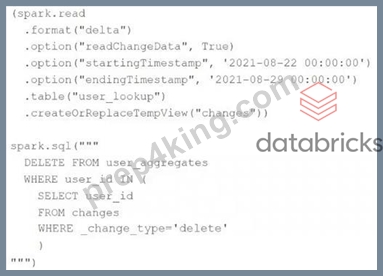
Assuming that user_id is a unique identifying key and that all users have requested deletion have been removed from the user_lookup table, which statement describes whether successfully executing the above logic guarantees that the records to be deleted from the user_aggregates table are no longer accessible and why?
- A. Yes; Delta Lake ACID guarantees provide assurance that the DELETE command successed fully and permanently purged these records.
- B. Yes; the change data feed uses foreign keys to ensure delete consistency throughout the Lakehouse.
- C. No; the Delta Lake DELETE command only provides ACID guarantees when combined with the MERGE INTO command
- D. No; files containing deleted records may still be accessible with time travel until a BACUM command is used to remove invalidated data files.
- E. No; the change data feed only tracks inserts and updates not deleted records.
Answer: D
Explanation:
The DELETE operation in Delta Lake is ACID compliant, which means that once the operation is successful, the records are logically removed from the table. However, the underlying files that contained these records may still exist and be accessible via time travel to older versions of the table. To ensure that these records are physically removed and compliance with GDPR is maintained, a VACUUM command should be used to clean up these data files after a certain retention period. The VACUUM command will remove the files from the storage layer, and after this, the records will no longer be accessible.
NEW QUESTION # 37
A data engineer is optimizing a MERGE operation on an 800GB UC-managed table that experiences frequent updates and deletions. Which two actions should the engineer prioritize to improve MERGE performance? (Choose two.)
- A. Apply liquid clustering using the merge join keys.
- B. Enable deletion vectors on the table if not already enabled.
- C. Use ZORDER on high-cardinality columns.
- D. Partition the table by date.
- E. Overwrite the table instead of Merge.
Answer: A,B
Explanation:
Liquid clustering on the merge join keys improves data locality and reduces the amount of data scanned during MERGE operations, which is especially effective for large, frequently updated tables. Enabling deletion vectors avoids rewriting entire Parquet files for updates and deletes, significantly reducing I/O and improving MERGE performance on Unity Catalog-managed tables.
NEW QUESTION # 38
In order to facilitate near real-time workloads, a data engineer is creating a helper function to Get Latest & Actual Certified-Data-Engineer-Professional Exam's Question and Answers from leverage the schema detection and evolution functionality of Databricks Auto Loader. The desired function will automatically detect the schema of the source directly, incrementally process JSON files as they arrive in a source directory, and automatically evolve the schema of the table when new fields are detected.
The function is displayed below with a blank:
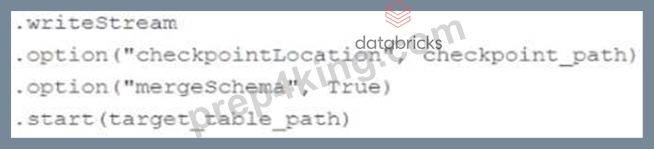
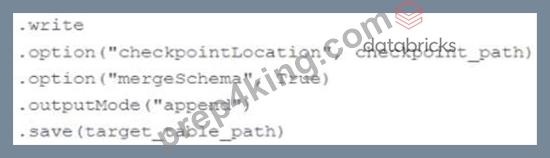
Which response correctly fills in the blank to meet the specified requirements?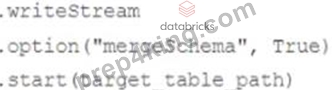
- A.
- B. Get Latest & Actual Certified-Data-Engineer-Professional Exam's Question and Answers from
- C.
- D.

- E.
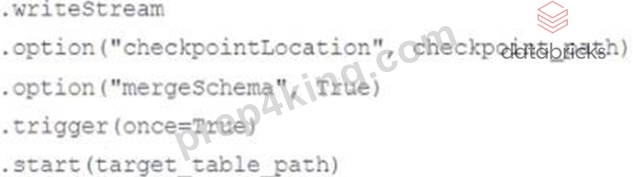
Answer: A
Explanation:
https://docs.databricks.com/en/ingestion/auto-loader/schema.html
NEW QUESTION # 39
The DevOps team has configured a production workload as a collection of notebooks scheduled to run daily using the Jobs UI. A new data engineering hire is onboarding to the team and has requested access to one of these notebooks to review the production logic.
What are the maximum notebook permissions that can be granted to the user without allowing accidental changes to production code or data?
- A. Can Run
- B. Can Manage
- C. Can Read
- D. No permissions
- E. Can Edit
Answer: C
NEW QUESTION # 40
A Structured Streaming job deployed to production has been experiencing delays during peak hours of the day. At present, during normal execution, each microbatch of data is processed in less than 3 seconds. During peak hours of the day, execution time for each microbatch becomes very inconsistent, sometimes exceeding 30 seconds. The streaming write is currently configured with a trigger interval of 10 seconds.
Holding all other variables constant and assuming records need to be processed in less than 10 seconds, which adjustment will meet the requirement?
- A. Increase the trigger interval to 30 seconds; setting the trigger interval near the maximum execution time observed for each batch is always best practice to ensure no records are dropped.
- B. Use the trigger once option and configure a Databricks job to execute the query every 10 seconds; this ensures all backlogged records are processed with each batch.
- C. The trigger interval cannot be modified without modifying the checkpoint directory; to maintain the current stream state, increase the number of shuffle partitions to maximize parallelism.
- D. Decrease the trigger interval to 5 seconds; triggering batches more frequently allows idle executors to begin processing the next batch while longer running tasks from previous batches finish.
- E. Decrease the trigger interval to 5 seconds; triggering batches more frequently may prevent records from backing up and large batches from causing spill.
Answer: E
Explanation:
The adjustment that will meet the requirement of processing records in less than 10 seconds is to decrease the trigger interval to 5 seconds. This is because triggering batches more frequently may prevent records from backing up and large batches from causing spill. Spill is a phenomenon where the data in memory exceeds the available capacity and has to be written to disk, which can slow down the processing and increase the execution time. By reducing the trigger interval, the streaming query can process smaller batches of data more quickly and avoid spill. This can also improve the latency and throughput of the streaming job.
NEW QUESTION # 41
A developer has successfully configured credential for Databricks Repos and cloned a remote Git repository. Hey don not have privileges to make changes to the main branch, which is the only branch currently visible in their workspace.
Use Response to pull changes from the remote Git repository commit and push changes to a branch that appeared as a changes were pulled.
- A. Use Repos to merge all differences and make a pull request back to the remote repository.
- B. Use repos to create a fork of the remote repository commit all changes and make a pull request on the source repository
- C. Use Repos to pull changes from the remote Git repository; commit and push changes to a branch that appeared as changes were pulled.
- D. Use repos to merge all difference and make a pull request back to the remote repository.
- E. Use Repos to create a new branch commit all changes and push changes to the remote Git repertory.
Get Latest & Actual Certified-Data-Engineer-Professional Exam's Question and Answers from
Answer: E
Explanation:
In Databricks Repos, when a user does not have privileges to make changes directly to the main branch of a cloned remote Git repository, the recommended approach is to create a new branch within the Databricks workspace. The developer can then make changes in this new branch, commit those changes, and push the new branch to the remote Git repository. This workflow allows for isolated development without affecting the main branch, enabling the developer to propose changes via a pull request from the new branch to the main branch in the remote repository. This method adheres to common Git collaboration workflows, fostering code review and collaboration while ensuring the integrity of the main branch.
NEW QUESTION # 42
......
New Databricks-Certified-Data-Engineer-Professional Exam Questions| Real Databricks-Certified-Data-Engineer-Professional Dumps: https://www.prep4king.com/Databricks-Certified-Data-Engineer-Professional-exam-prep-material.html
