

Based on Official Syllabus Topics of Actual Microsoft DP-800 Exam
Free DP-800 Dumps are Available for Instant Access
NEW QUESTION # 17
You need to recommend a solution that will resolve the ingestion pipeline failure issues. Which two actions should you recommend? Each correct answer presents part of the solution. NOTE: Each correct selection is worth one point.
- A. Use a trigger to automatically rewrite malformed JSON.
- B. Add a check constraint that validates the JSON structure.
- C. Add foreign key constraints on the table.
- D. Enable snapshot isolation on the database.
- E. Create a unique index on a hash of the payload.
Answer: B,E
Explanation:
The two correct actions are D and E because the ingestion failures are caused by malformed JSON and duplicate payloads , and these two controls address those two problems directly. Microsoft's JSON documentation states that SQL Server and Azure SQL support validating JSON with ISJSON , and Microsoft specifically recommends using a CHECK constraint to ensure JSON text stored in a column is properly formatted.
For the duplicate-payload issue, creating a unique index on a hash of the payload is the appropriate design.
Microsoft documents using hashing functions such as HASHBYTES to hash column values, and SQL Server allows a deterministic computed column to be used as a key column in a UNIQUE constraint or unique index . That makes a persisted hash-based computed column plus a unique index a practical and exam- consistent way to reject duplicate payloads efficiently.
The other options do not solve the stated root causes:
* Snapshot isolation addresses concurrency behavior, not malformed JSON or duplicate payload detection.
* A trigger to rewrite malformed JSON is not the right integrity control and is brittle.
* Foreign key constraints enforce referential integrity, not JSON validity or duplicate-payload prevention
NEW QUESTION # 18
You have a SQL database in Microsoft Fabric that contains a table named dbo.Orders, dbo.Orders has a clustered index, contains three years of data, and is partitioned by a column named OrderDate by month.
You need to remove all the rows for the oldest month. The solution must minimize the impact on other queries that access the data in dbo.orders.
Solution; Identify the partition scheme (or the oldest month, and then run the following Transact-SQL statement.
ALTER TABLE dbo.Orders
DROP PARTITION SCHEME (partition_scheme_name);
Does this meet the goal?
- A. Yes
- B. No
Answer: B
Explanation:
This also does not meet the goal. DROP PARTITION SCHEME removes the partition scheme object from the database; it is not the command used to remove just the rows for the oldest month from a partitioned table.
Microsoft's DROP PARTITION SCHEME documentation is explicit that the statement removes the partition scheme itself.
For removing only the oldest month's rows with minimal impact, Microsoft points to partition-level maintenance operations such as truncating a single partition on a partitioned table. That targets only the needed data subset and is more efficient for retention workloads.
NEW QUESTION # 19
Hotspot Question
You have an Azure SQL database that contains a table named Sales.Customer. Sales.Customer contains columns named CustomerId, FullName, Email, TaxID, and RegionId.
You have a database role named AppSupport that is used by a support application.
You need to implement a security solution for AppSupport that meets the following requirements:
- AppSupport must be prevented from viewing TaxID.
- AppSupport must be able to query Sales.Customer to troubleshoot
issues.
- AppSupport must be able to run a stored procedure named
Sales.usp_GetCustomerByCustomerId.
Which Transact-SQL statements should you include in the solution? To answer, select the appropriate options in the answer area.
NOTE: Each correct selection is worth one point.
Answer:
Explanation:
NEW QUESTION # 20
You have an Azure SQL database that supports an OLTP application.
You need to write Transact-SQL code that returns blocking chain details. The output must return only sessions that ate blocked or are blocking other sessions.
How should you complete the code? To answer, drag the appropriate values to the correct targets. Each value may be used once, more than once, or not at all. You may need to drag the split bar between panes or scroll to view content NOTE: Each correct selection is worth one point.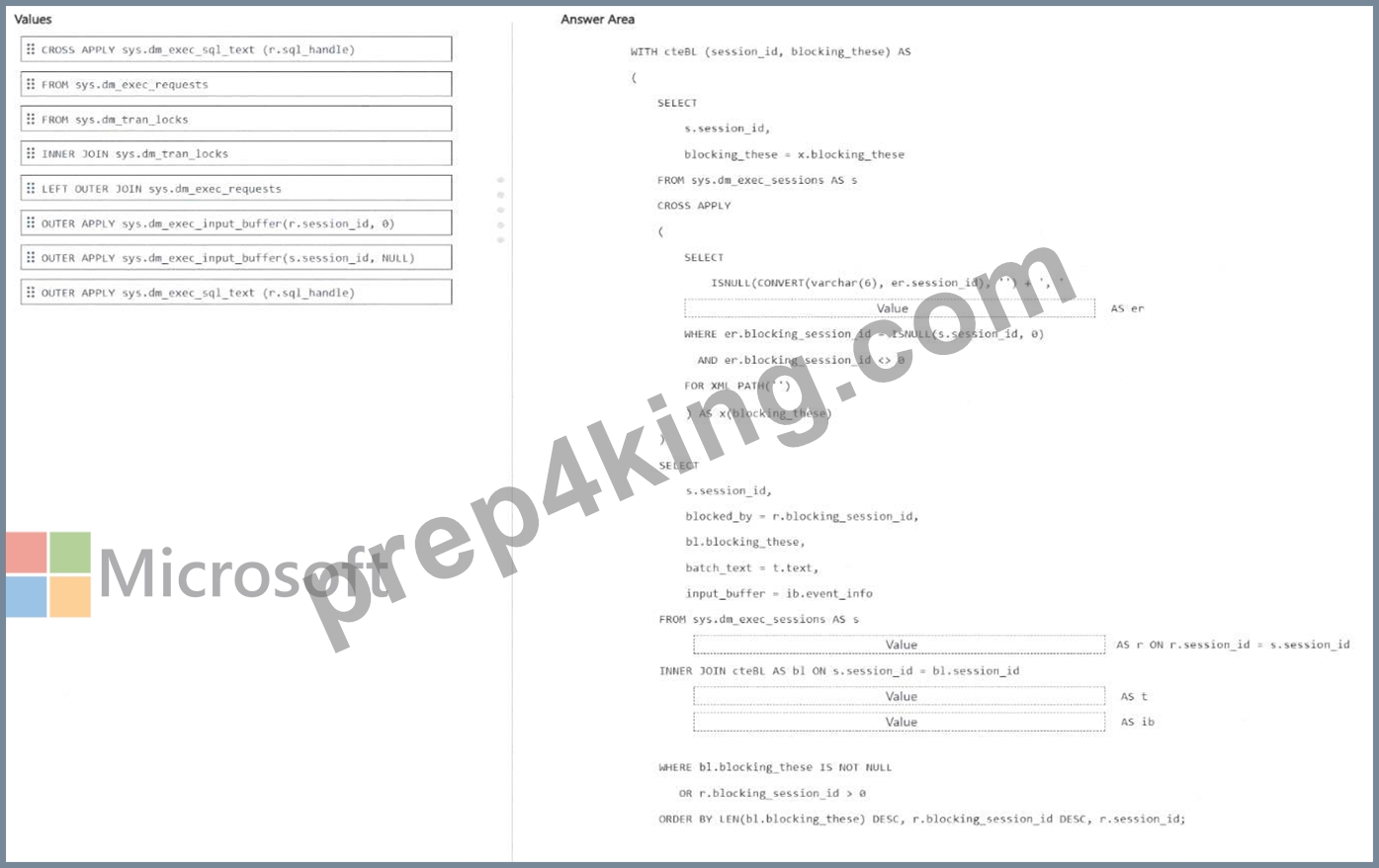
Answer:
Explanation:
Explanation:
* CTE inner source # FROM sys.dm_exec_requests
* Join after sys.dm_exec_sessions AS s # LEFT OUTER JOIN sys.dm_exec_requests
* Text retrieval # OUTER APPLY sys.dm_exec_sql_text(r.sql_handle)
* Input buffer retrieval # OUTER APPLY sys.dm_exec_input_buffer(r.session_id, r.request_id) The correct drag-and-drop choices are based on how blocking-chain details are normally assembled in Azure SQL Database.
The CTE must read from sys.dm_exec_requests because the alias er is used with er.session_id and er.
blocking_session_id, and those columns come from sys.dm_exec_requests. Microsoft documents that sys.
dm_exec_requests returns information about executing requests and includes the blocking_session_id column used to identify blockers.
After FROM sys.dm_exec_sessions AS s, the correct join is LEFT OUTER JOIN sys.dm_exec_requests so the query can still return sessions from sys.dm_exec_sessions even when a current request row is missing.
This is useful when showing sessions that are blocked or blocking, while still attempting to attach current request details when available.
For batch text, use OUTER APPLY sys.dm_exec_sql_text(r.sql_handle) because Microsoft documents sys.
dm_exec_sql_text(sql_handle) as the function that returns the SQL batch text for the specified sql_handle.
For the input buffer, use OUTER APPLY sys.dm_exec_input_buffer(r.session_id, r.request_id) because Microsoft documents that sys.dm_exec_input_buffer takes session_id and request_id and returns event_info, which is commonly used when sys.dm_exec_sql_text is null or when you want the last command text.
So the completed code uses:
* FROM sys.dm_exec_requests
* LEFT OUTER JOIN sys.dm_exec_requests
* OUTER APPLY sys.dm_exec_sql_text(r.sql_handle)
* OUTER APPLY sys.dm_exec_input_buffer(r.session_id, r.request_id)
NEW QUESTION # 21
You have a GitHub Actions workflow that builds and deploys an Azure SQL database. The schema is stored in a GitHub repository as an SDK-style SQL database project.
Following a code review, you discover that you need to generate a report that shows whether the production schema has diverged from the model in source control.
Which action should you add to the pipeline?
- A. SqlPackage.exe /Action:Script
- B. SqlPackage.exe /Action:DeployReport
- C. SqlPackage.exe /Action:DriftReport
- D. SqlPackage.exe /Action:Extract
Answer: C
Explanation:
Microsoft documents that DriftReport creates an XML report showing changes that have been made to the registered database since it was last registered . That is the action intended to detect whether the production schema has diverged from the expected model baseline in your deployment workflow.
This is different from DeployReport , which shows the changes that would be made by a publish action . In other words:
* DriftReport answers: Has the deployed database drifted from the registered state/model?
* DeployReport answers: What changes would be applied if I published now?
The other options are not the right fit:
* Extract creates a DACPAC from an existing database, not a drift analysis report.
* Script generates a deployment script, not a schema-drift report.
So to generate a report that shows whether production has diverged from the model in source control , add:
SqlPackage.exe /Action:DriftReport
NEW QUESTION # 22
You have an Azure SQL database that contains a table named knowledgebase, knowledgebase stores human resources (HR) policy documents and contains columns named title, content, category, and embedding.
You have an application named App1. App1 queries two relational tables named employee_pnofiles and benefits_enrollnent that contain HR data. App1 hosts a chatbot that calls a large language model (LLM) directly.
Users report that the chatbot answers general HR questions correctly but provides outdated or incorrect answers when policies change. The chatbot also fails to answer questions that reference internal policy documents by title or category.
You need to recommend a Retrieval Augmented Generation (RAG) solution to resolve the chatbot issues.
What should you recommend? To answer, select the appropriate options in the answer area.
NOTE: Each correct selection is worth one point.
Answer:
Explanation:
Explanation:
The correct recommendation is to retrieve grounding data from knowledge_base and, at inference time, generate query embeddings and run a vector similarity search .
The chatbot currently answers some general HR questions but fails when policies change and when users ask about internal policy documents by title or category . That is exactly the kind of problem RAG is meant to solve: ground the LLM in the organization's proprietary content instead of relying on the model's training data or unrelated transactional tables. Microsoft's RAG guidance states that RAG extends LLMs by grounding responses in your own content and that, for agentic retrieval, knowledge bases unify knowledge sources for retrieval.
So the grounding data should come from knowledge_base , because that table stores the HR policy documents and already includes fields like title, content, category, and embedding. Those are the fields directly tied to the missing and outdated policy answers. By contrast:
* employee_profiles and benefits_enrollment are operational HR tables, not the authoritative store for policy-document grounding.
* PDF exports of the policies would be inferior to querying the indexed/structured knowledge base already prepared for retrieval.
* The LLM training data is specifically the wrong source when the issue is outdated internal content.
For the retrieval step, Microsoft's guidance says to use embeddings for vector queries and notes that vector similarity search matches concepts, not exact terms . This is especially important because users ask about policy documents by title or category and also phrase questions in ways that might not exactly match document wording. Generating a query embedding and then running a vector similarity search is the appropriate retrieval step in a RAG pipeline.
NEW QUESTION # 23
Case Study 1 - Contoso
Existing Environment
Azure Environment
Contoso has an Azure subscription in North Europe that contains the corporate infrastructure.
The current infrastructure contains a Microsoft SQL Server 2017 database. The database contains the following tables.
The FeedbackJsoncolumn has a full-text index and stores JSON documents in the following format.
The support staff at Contoso never has the UNMASKpermission.
Problem Statements
Contoso is deploying a new Azure SQL database that will become the authoritative data store for the following:
* AI workloads
* Vector search
* Modernized API access
* Retrieval Augmented Generation (RAG) pipelines
Sometimes the ingestion pipeline fails due to malformed JSON and duplicate payloads.
The engineers at Contoso report that the following dashboard query runs slowly.
You review the execution plan and discover that the plan shows a clustered index scan.
VehicleIncidentReportsoften contains details about the weather, traffic conditions, and location. Analysts report that it is difficult to find similar incidents based on these details.
Requirements
Planned Changes
Contoso wants to modernize Fleet Intelligence Platform to support AI-powered semantic search over incident reports.
Security Requirements
Contoso identifies the following security requirements:
* Restrict the support staff from viewing Personally Identifiable Information (PII) data, which is full email addresses and phone numbers.
* Enforce row-level filtering so that analysts see only incidents for the fleets to which they are assigned. The analysts can be assigned to multiple fleets.
Database Performance and Requirements
Contoso identifies the following telemetry requirements:
* Telemetry data must be stored in a partitioned table.
* Telemetry data must provide predictable performance for ingestion and retention operations.
* latitude, longitude, and accuracyJSON properties must be filtered by using an index seek.
Contoso identifies the following maintenance data requirements:
* Ensure that any changes to a row in the MaintenanceEventstable updates the corresponding value in the LastModifiedUtccolumn to the time of the change.
* Avoid recursive updates.
AI Search, Embeddings, and Vector Indexing
Contoso plans to implement semantic search over incident data to meet the following requirements:
* Embeddings must be stored in dedicated Azure SQL Database tables.
* Embeddings must be generated from rich natural language fields.
* Chunking must preserve semantic coherence.
* Hybrid search must combine the following:
- Vector similarity
- Keyword filtering or boosting
Development Requirements
The development team at Contoso will use Microsoft Visual Studio Code and GitHub Copilot and will retrieve live metadata from the databases.
Contoso identifies the following requirements for querying data in the FeedbackJsoncolumn of the CustomerFeedbacktable:
* Extract the customer feedback text from the JSON document.
* Filter rows where the JSON text contains a keyword.
* Calculate a fuzzy similarity score between the feedback text and a known issue description.
* Order the results by similarity score, with the highest score first.
You need to recommend a solution for the development team to retrieve the live metadata. The solution must meet the development requirements. What should you include in the recommendation?
- A. Add the schema to a GitHub Copilot instruction file.
- B. Include the database project in the code repository.
- C. Use an MCP server.
- D. Export the database schema as a .dacpac file and load the schema into a GitHub Copilot context window.
Answer: D
Explanation:
Scenario: Development Requirements
The development team at Contoso will use Microsoft Visual Studio Code and GitHub Copilot and will retrieve live metadata from the databases.
To retrieve live metadata from Azure SQL databases and use it with GitHub Copilot in Visual Studio Code (VS Code), you must use the SQL Server (mssql) extension. This extension provides the native capability to extract a database schema as a .dacpac file directly within the editor.
1. Export the Schema as a .dacpac File
You can extract the schema of your live Azure SQL database using the SQL Server (mssql) extension.
2. Load the .dacpac into GitHub Copilot Context
Once the .dacpac file is saved in your VS Code workspace, you can provide it as context to GitHub Copilot Chat using #-mentions or Drag & Drop.
Reference:
https://learn.microsoft.com/en-us/sql/tools/sql-database-projects/concepts/data-tier- applications/extract-dacpac-from-database
NEW QUESTION # 24
Hotspot Question
You have an Azure subscription. The subscription contains an Azure SQL database named SalesDB and an Azure App Service app named sales-api. sales-api uses virtual network integration to a subnet named vnet-prod/subnet-app and reads from SalesDB.
You need to configure authentication and network access to meet the following requirements:
- Ensure that sales-api connects to SalesDB by using passwordless
authentication.
- Ensure that all the database traffic remains within the subscription.
The solution must minimize administrative effort.
What should you configure? To answer, select the appropriate options in the answer area.
NOTE: Each correct selection is worth one point.
Answer:
Explanation:
NEW QUESTION # 25
You have a SQL database in Microsoft Fabric that contains a table named WebSite. Logs. WebSite.Logs stores application telemetry data. Website.Logs contains a nvarehar(iMx) column named log that stores JSON documents You have a daily report that filters by the $.severity JSON property and returns Logld. LogDateTime, and log.
The report frequently causes full table scans.
You need to modify Website. Logs to support efficient filtering by $. severity and avoid key lookups for the columns returned by the report.
How should you complete the Transact-SQL code to avoid full table scans? To answer, drag the appropriate values to the correct targets. Each value may be used once, more than once, or not at all. You may need to drag the split bar between panes or scroll to view content.
NOTE: Each correct selection is worth one point.
Answer:
Explanation: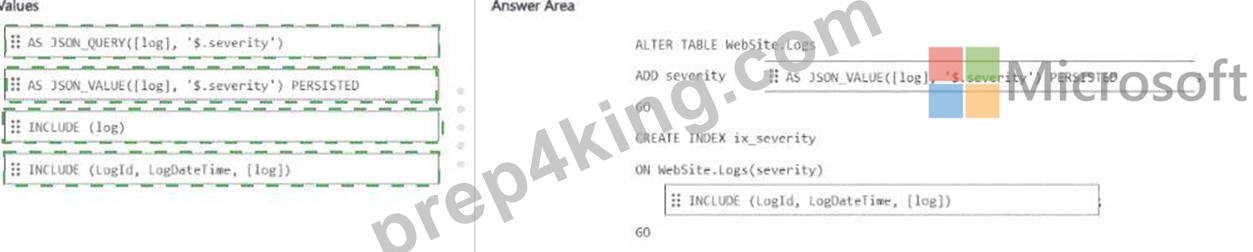
Explanation: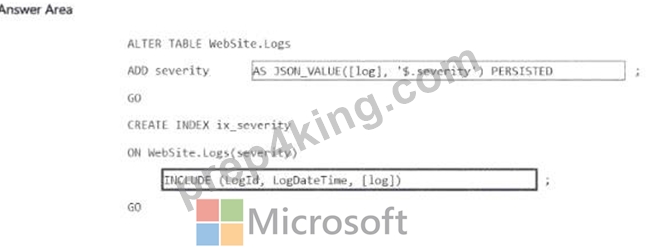
The correct way to avoid full table scans here is to add a computed column that extracts the JSON scalar property with JSON_VALUE , and then create a nonclustered index on that computed column with the report's returned columns in the INCLUDE list. Microsoft's JSON indexing guidance specifically recommends creating a computed column that exposes the JSON property you filter on, using the same expression as in the query, and then indexing that computed column.
So the computed column must be:
AS JSON_VALUE([log], ' $.severity ' ) PERSISTED
This is correct because $.severity is a scalar JSON value, so JSON_VALUE is the proper function.
JSON_QUERY would be for extracting an object or array, not a scalar property. Microsoft also notes that persisted computed columns can improve access speed for JSON-derived values.
The index should then include:
INCLUDE (LogId, LogDateTime, [log])
That is the right covering strategy because the report filters by severity but returns LogId, LogDateTime, and log. Microsoft's guidance on included columns explains that nonkey included columns let a nonclustered index cover more queries and reduce extra lookups to the base table.
So the completed code is:
ALTER TABLE WebSite.Logs
ADD severity AS JSON_VALUE([log], ' $.severity ' ) PERSISTED;
GO
CREATE INDEX ix_severity
ON WebSite.Logs(severity)
INCLUDE (LogId, LogDateTime, [log]);
GO
NEW QUESTION # 26
You have an Azure SQL database that stores order data. A reporting query aggregates monthly revenue per customer runs frequently.
You need to reduce how long it takes to retrieve the calculated values. The solution must NOT alter any underlying table structure. What should you do?
- A. Create a view by using ORDER BY without TOP. and then create a unique clustered index on the view.
- B. Create a view without using with SCHEMABHIDING, and then create a nonclustered index on the view.
- C. Create a view by using WITH SCHEHABINDING, include COUNT_BIG(*). and then create a unique clustered index on the view.
- D. Create a view by using GROUP BV. and then create a unique clustered index on the view.
Answer: C
Explanation:
To speed up repeated aggregate retrieval without changing base-table structure, the right pattern is an indexed view . Microsoft requires that an indexed view be created with WITH SCHEMABINDING , and if the view uses GROUP BY , it must also include COUNT_BIG(*) . After that, the first index on the view must be a unique clustered index .
The other options fail Microsoft's indexed-view rules:
* A is invalid because ORDER BY is not allowed in the indexed-view definition.
* B is invalid because indexed views require WITH SCHEMABINDING , and the first index cannot just be a nonclustered index.
* C is incomplete because a grouped indexed view must include COUNT_BIG(*) .
NEW QUESTION # 27
You have a Microsoft SQL Server 2025 instance that contains a database named SalesDB.
SalesDB supports a Retrieval Augmented Generation (RAG) pattern for internal support tickets.
The SQL Server instance runs without any outbound network connectivity.
You plan to generate embeddings inside the SQL Server instance and store them in a table for vector similarity queries.
You need to ensure that only a database user account named AIApplicationUser can run embedding generation by using the model.
Which two actions should you perform? Each correct answer presents part of the solution.
NOTE: Each correct selection is worth one point.
- A. Grant the CONTROL permission on SalesDB to AIApplicationUser.
- B. Grant the EXECUTE permission on the external model project to AIApplicationUser.
- C. Create an external model project by using ONNX runtime and local paths.
- D. Create an external model project that points to a Microsoft Foundry REST endpoint.
- E. Create a database audit specification on SalesDB owned by AIApplicationUser.
Answer: B,D
Explanation:
To implement a Retrieval Augmented Generation (RAG) pattern in an isolated SQL Server 2025 instance, you can use the new native vector capabilities to generate, store, and query embeddings without needing outbound internet access.
[E] 1. Enable External REST Endpoints
Because your instance is isolated, you must first enable the configuration that allows SQL Server to communicate with your internal Microsoft Foundry (or local) endpoint.
EXEC sp_configure 'external rest endpoint enabled', 1;
RECONFIGURE;
2. Create the External Model Project
Register your Microsoft Foundry REST endpoint as an external model. This allows SQL Server to treat the internal service as a registered provider for generating embeddings.
[C] 3. Grant Permission to a Specific User
To restrict embedding generation to a single specific database user, grant the EXECUTE permission on the newly created external model.
-- Granting EXECUTE only to the specific user 'AppUser'
GRANT EXECUTE ON EXTERNAL MODEL::[MyFoundryEmbeddingModel] TO [AppUser]; Use code with caution.
4. Generate and Store Embeddings
Use the AI_GENERATE_EMBEDDINGS function to process text into vectors and store them in a table with the new VECTOR data type.
Reference:
https://www.red-gate.com/simple-talk/databases/sql-server/sql-server-2025-create-external- model-and-ai_generate_embeddings-commands-explained/
NEW QUESTION # 28
You have a GitHub Codespaces environment that has GitHub Copilot Chat installed and is connected to a SQL database in Microsoft Fabric named DB1 DB1 contains tables named Sales.Orders and Sales.Customers.
You use GitHub Copilot Chat in the context of DB1 .
A company policy prohibits sharing customer Personally Identifiable Information (Pll), secrets, and query result sets with any Al service.
You need to use GitHub Copilot Chat to write and review Transact-SQL code for a new stored procedure that will join Sales.Orders to sales .Customers and return customer names and email addresses. The solution must NOT share the actual data in the tables with GitHub Copilot Chat.
What should you do?
- A. From Sales.Customers, paste several rows that include email addresses into a chat, so that GitHub Copilot Chat can infer edge cases.
- B. Provide the database connection string to GitHub Copilot Chat so that GitHub Copilot Chat can validate the stored procedure.
- C. Ask GitHub Copilot Chat to generate the stored procedure by using schema details only.
- D. Run a select statement that returns customer names and email addresses and provide the result set to GitHub Copilot Chat so that GitHub Copilot Chat can generate the stored procedure.
Answer: C
Explanation:
The correct answer is D because the policy explicitly prohibits sharing customer PII, secrets, and query result sets with any AI service. The safe way to use GitHub Copilot Chat here is to provide only schema- level information such as table names, column names, relationships, and the required procedure behavior, without sharing actual table contents or result sets. That lets Copilot help generate and review the Transact- SQL while avoiding disclosure of customer data. This is consistent with Microsoft and GitHub guidance that content provided in prompts is what the AI can use, so avoiding real data in the prompt is the appropriate control.
The other options violate the requirement:
* A pastes real rows containing email addresses, which is direct PII disclosure.
* B shares actual query result sets, which the policy forbids.
* C provides the connection string so Copilot can validate against the database, which is inappropriate because it exposes connection details and could enable access beyond schema-only assistance.
So the correct approach is to ask Copilot to generate the stored procedure using only the schema and requirements, not real customer data.
NEW QUESTION # 29
You need to recommend a solution to lesolve the slow dashboard query issue. What should you recommend?
- A. On Lastupdatedutc. create a nonclustered index that includes Fleetid.
- B. On Fleetid, create a filtered index where lastupdatedutc > DATEADD(DAV, -7, SYSuTCOATETIME()).
- C. Create a clustered index on Lastupdatedutc.
- D. On Fleetid, create a nonclustered index that includes Lastupdatedutc. inginestatus, and BatteryHealth.
Answer: D
Explanation:
The best recommendation is B because the slow query filters on FleetId and returns LastUpdatedUtc , EngineStatus , and BatteryHealth . A nonclustered index with FleetId as the key column allows the optimizer to perform an index seek instead of a clustered index scan, and including the other selected columns makes the index covering , which reduces extra lookups and I/O. Microsoft's SQL Server indexing guidance states that a nonclustered index with included columns can significantly improve performance when all query columns are available in the index, because the optimizer can satisfy the query directly from the index.
The query is:
SELECT VehicleId, LastUpdatedUtc, EngineStatus, BatteryHealth
FROM dbo.VehicleHealthSummary
WHERE FleetId = @FleetId
ORDER BY LastUpdatedUtc DESC;
Among the given choices, FleetId is the most important search argument because it appears in the WHERE predicate. Microsoft's index design guidance recommends putting columns used for searching in the key and using nonkey included columns to cover the rest of the query efficiently.
Why the other options are weaker:
* A is not appropriate because changing the clustered index to LastUpdatedUtc would not target the main filter predicate on FleetId, and a table can have only one clustered index.
* C makes LastUpdatedUtc the key, which is poor for a query whose primary filter is FleetId.
* D is not the right answer here because the query requirement does not specify only recent rows, and filtered indexes are meant for a well-defined subset; this option also uses a time-based expression that is not aligned to the stated query pattern.
Strictly speaking, the most optimal design for both filtering and ordering would usually be a composite key like (FleetId, LastUpdatedUtc), but since that is not one of the available options, B is the correct exam answer.
NEW QUESTION # 30
You need to design a generative Al solution that uses a Microsoft SOL Server 2025 database named DB1 as a data source. The solution must generate responses that meet the following requirements:
* Ait ' grounded In the latest transactional and reference data stored in D61
* Do NOT require retraining or fine-tuning the language model when the data changes
* Can include citations or references to the source data used in the response Which scenario is the best use case for implementing a Retrieval Augmented Generation (RAG) pattern?
More than one answer choice may achieve the goal. Select the BEST answer
- A. training a custom language model on historical database data
- B. answering user questions based on company-specific knowledge
- C. summarizing free-form user input text
- D. generating marketing slogans based on user sentiment analysis
Answer: B
Explanation:
The best use case for RAG is answering user questions based on company-specific knowledge . Microsoft defines RAG as a pattern that augments a language model with a retrieval system that provides grounding data at inference time, which is exactly what you need when responses must be based on the latest transactional and reference data , must avoid retraining/fine-tuning , and should be able to include citations or references to source data.
The other options do not fit as well:
* summarizing free-form user input does not inherently require retrieval from DB1,
* training a custom model contradicts the requirement to avoid retraining/fine-tuning,
* generating marketing slogans is a creative generation task, not a grounding-and-citation scenario. RAG is specifically strong when answers must come from your organization's own changing knowledge.
NEW QUESTION # 31
Case Study 1 - Contoso
Existing Environment
Azure Environment
Contoso has an Azure subscription in North Europe that contains the corporate infrastructure.
The current infrastructure contains a Microsoft SQL Server 2017 database. The database contains the following tables.
The FeedbackJsoncolumn has a full-text index and stores JSON documents in the following format.
The support staff at Contoso never has the UNMASKpermission.
Problem Statements
Contoso is deploying a new Azure SQL database that will become the authoritative data store for the following:
* AI workloads
* Vector search
* Modernized API access
* Retrieval Augmented Generation (RAG) pipelines
Sometimes the ingestion pipeline fails due to malformed JSON and duplicate payloads.
The engineers at Contoso report that the following dashboard query runs slowly.
You review the execution plan and discover that the plan shows a clustered index scan.
VehicleIncidentReportsoften contains details about the weather, traffic conditions, and location. Analysts report that it is difficult to find similar incidents based on these details.
Requirements
Planned Changes
Contoso wants to modernize Fleet Intelligence Platform to support AI-powered semantic search over incident reports.
Security Requirements
Contoso identifies the following security requirements:
* Restrict the support staff from viewing Personally Identifiable Information (PII) data, which is full email addresses and phone numbers.
* Enforce row-level filtering so that analysts see only incidents for the fleets to which they are assigned. The analysts can be assigned to multiple fleets.
Database Performance and Requirements
Contoso identifies the following telemetry requirements:
* Telemetry data must be stored in a partitioned table.
* Telemetry data must provide predictable performance for ingestion and retention operations.
* latitude, longitude, and accuracyJSON properties must be filtered by using an index seek.
Contoso identifies the following maintenance data requirements:
* Ensure that any changes to a row in the MaintenanceEventstable updates the corresponding value in the LastModifiedUtccolumn to the time of the change.
* Avoid recursive updates.
AI Search, Embeddings, and Vector Indexing
Contoso plans to implement semantic search over incident data to meet the following requirements:
* Embeddings must be stored in dedicated Azure SQL Database tables.
* Embeddings must be generated from rich natural language fields.
* Chunking must preserve semantic coherence.
* Hybrid search must combine the following:
- Vector similarity
- Keyword filtering or boosting
Development Requirements
The development team at Contoso will use Microsoft Visual Studio Code and GitHub Copilot and will retrieve live metadata from the databases.
Contoso identifies the following requirements for querying data in the FeedbackJsoncolumn of the CustomerFeedbacktable:
* Extract the customer feedback text from the JSON document.
* Filter rows where the JSON text contains a keyword.
* Calculate a fuzzy similarity score between the feedback text and a known issue description.
* Order the results by similarity score, with the highest score first.
Hotspot Question
You need to create a table in the database to store the telemetry data.
You have the following Transact-SQL code.
For each of the following statements, select Yes if the statement is true. Otherwise, select No.
NOTE: Each correct selection is worth one point.
Answer:
Explanation:
NEW QUESTION # 32
Note: This question is part of a series of questions that present the same scenario. Each question in the series contains a unique solution that might meet the stated goals. Some question sets might have more than one correct solution, while others might not have a correct solution.
After you answer a question in this section, you will NOT be able to return to it. As a result, these questions will not appear in the review screen.
You have a SQL database in Microsoft Fabric that contains a table named dbo.Orders.
dbo.Orders has a clustered index, contains three years of data, and is partitioned by a column named OrderDate by month.
You need to remove all the rows for the oldest month. The solution must minimize the impact on other queries that access the data in dbo.Orders.
Solution: Run the following Transact-SQL statement.
TRUNCATE TABLE dbo.Orders;
Does this meet the goal?
- A. Yes
- B. No
Answer: B
Explanation:
Correct:
* Identify the partition number for the oldest month, and then run the following Transact-SQL statement.
TRUNCATE TABLE dbo.Orders
WITH (PARTITIONS (partition number));
The best Transact-SQL statement to remove all rows for the oldest month while minimizing the impact on other queries is TRUNCATE TABLE with a WITH (PARTITIONS (...)) clause.
Why TRUNCATE TABLE ... WITH (PARTITIONS (...)) is Best
Efficiency: TRUNCATE TABLE is a Data Definition Language (DDL) operation that removes data by deallocating the data pages, which is a metadata operation and is very fast, regardless of the amount of data in the partition.
Minimal Logging: It uses less transaction log space compared to a DELETE statement, which logs each row deletion individually.
Low Impact on Concurrency: It performs a quick, partition-specific operation. A row-by-row DELETE would be a long-running transaction and could cause locking and blocking issues for other queries accessing the table.
Data Integrity: Because the table has a clustered index and is partitioned by the same column (aligned indexes), the TRUNCATE PARTITION operation is a fast, partition-level maintenance operation that targets only that specific data subset.
Incorrect:
* : Identify the partition scheme for the oldest month, and then run the following Transact-SQL statement.
ALTER TABLE dbo.Orders
DROP PARTITION SCHEME (partition_scheme_name);
The DROP PARTITION SCHEME statement removes the partition scheme object from the database but does not remove the data itself or free up the space, and it requires all tables to be moved off the scheme first, which is a complex operation. This does not meet the goal of removing the data efficiently.
* Run the following Transact-SQL statement.
DELETE FROM dbo.Orders
WHERE OrderDate < DATEADD(month, -36, SYSUTCDATETIME());
A standard DELETE statement, even with a WHERE clause that uses the partition column, can be a time-consuming, logged operation that causes locking and blocking on the main table, negatively impacting performance.
* Run the following Transact-SQL statement.
TRUNCATE TABLE dbo.Orders;
Reference:
https://stackoverflow.com/questions/63632963/truncate-partition-vs-drop-partition-performace- wise-which-one-is-efficient-an
NEW QUESTION # 33
Your team is developing an Azure SQL database solution from a locally cloned GitHub repository by using Microsoft Visual Studio Code and GitHub Copilot Chat.
You need to ensure that GitHub Copilot Chat uses the team's coding standards when generating Transact-SQL code in Visual Studio Code.
What should you use?
- A. .github/copilot-instructions.md
- B. %APPDATA%\Code\User\settings.json
- C. .vscode/settings.json
- D. %APPDATA%\Code\User\copilot-instructions.md
Answer: A
Explanation:
o ensure GitHub Copilot Chat adheres to your team's specific Transact-SQL (T-SQL) standards while deploying an Azure SQL database from VS Code, you should focus on Custom Instructions and Workspace Context.
Required Setup
Create a .github/copilot-instructions.md File
This is the most effective way to enforce standards.
Create this file in the root of your repository.
Copilot automatically reads this file to understand project-specific rules.
Include sections for:
Naming conventions (e.g., PascalCase for tables, proc_ prefix for stored procedures).
Formatting rules (e.g., keywords in UPPERCASE, use of 4 spaces).
Security practices (e.g., always use schema prefixes, avoid SELECT *).
Reference:
https://nikolay-dev.medium.com/master-web-development-with-github-spark-ai-b0b874525418
NEW QUESTION # 34
You have an Azure SQL database named SalesDB
You have a Data API builder (DAB) instance that exposes the following entities in SalesDB
* A table entity named Order mapped to a table named dbo. Orders
* A stored procedure entity named FinalizeOrder mapped to a stored procedure named dbo.usp_FinalizeOrder The DAB runtime configuration includes the following permissions.
Client requests include a Microsoft Entra access token. The client also sends HTTP header x-MS-APl-ROlE:
operations for both REST and GraphQL requests.
For each of the following statements, select Yes if the statement is true. Otherwise, select No.
NOTE: Each correct selection is worth one point.
Answer:
Explanation:
Explanation:
* A REST GET request to the order entity that includes the access token and x-MS-API-ROLE:
operations will return data. # No
* When DAB runs the stored procedure, the database policy defined on the FinalizeOrder entity will be enforced. # Yes
* If the client omits the x-MS-API-ROLE header but still sends the same access token, the order entity read request will run in the authenticated role context. # Yes The first statement is No . In Data API builder, when a valid token is sent with X-MS-API-ROLE, the request runs in that requested role if that role is present in the token . Here, that means the effective role becomes operations , not authenticated. But the order entity grants read only to the authenticated role, not to operations, so the GET request would not be authorized to return data.
The second statement is Yes . DAB evaluates the request against the permissions and policies configured for the effective role on the requested entity. The FinalizeOrder entity grants execute to role operations and includes a database policy of TenantId = @claims.tenantid, so that policy is part of the enforced authorization
/filtering behavior when the stored procedure entity is executed.
The third statement is Yes . If the client sends a valid access token without X-MS-API-ROLE, DAB uses the built-in Authenticated system role by default. Since the order entity allows read for the authenticated role, that read request runs in the authenticated role context.
Top of Form
Bottom of Form
NEW QUESTION # 35
You have an Azure SQL database that supports the OLTP workload of an order-processing application.
During a 10-minute incident window, you run a dynamic management view query and discover the following:
- Session 72 is sleeping with open_transaction_count = 1.
- Multiple other sessions show blocking_session_id = 72 in
sys.dm_exec_requests.
- sys.dm_exec_input_buffer(72, NULL) returns only BEGIN TRANSACTION
UPDATE Sales.Orders.
Users report that updates to Sales.Orders intermittently time out during the incident window. The timeouts stop only after you manually terminate session 72.
What is a possible cause of the blocking?
- A. An explicit transaction was started but not committed or rolled back.
- B. A long-running SELECT statement is blocking writers.
- C. Session 72 caused a deadlock.
- D. A lock escalation occurred.
Answer: A
Explanation:
This sounds like a classic orphaned transaction scenario.
The session was in a sleeping state with an open transaction, meaning the application sent the BEGIN TRANSACTION and the UPDATE statement, but then dropped the ball. Because SQL Server never received a COMMIT or ROLLBACK, it held onto the exclusive (X) locks on the Sales Order rows indefinitely.
Any other session trying to touch those same rows was forced to wait, leading to the blocking and eventual timeouts reported by your users. Manually killing the session forced a rollback, finally releasing the locks.
Reference:
https://learn.microsoft.com/en-ie/answers/questions/100075/sleeping-sessions-with-old-open- transactions-issue
NEW QUESTION # 36
Hotspot Question
You have a SQL database in Microsoft Fabric that contains the following functions:
- A multi-statement table-valued function (TVF) named
Sales.mstvf_OrderStatus() that returns order status information
- A scalar user-defined function (UDF) named dbo.ufn_GetTaxMultiplier
(@TaxAmt money, @StateCode char(2)) that returns a numeric multiplier
used in tax calculations
Reporting queries frequently join Sales.mstvf_OrderStatus() to a table named Sales.SalesOrderHeader and return large result sets. A performance review shows that the queries produce inconsistent execution plans.
During a code review, a developer discovers that the following Transact-SQL statement produced an error.
EXEC @ret = ufn_GetTaxMultiplier @TaxAmt = 100.00, @StateCode = 'WA';
For each of the following statements, select Yes if the statement is true. Otherwise, select No.
NOTE: Each correct selection is worth one point.
Answer:
Explanation:
NEW QUESTION # 37
......
The Most In-Demand DP-800 Pass Guaranteed Quiz : https://www.prep4king.com/DP-800-exam-prep-material.html
View All DP-800 Actual Exam Questions Answers and Explanations for Free: https://drive.google.com/open?id=1bQcpxXAh-kjfolkPKBiitkbATeNcGzGY
