

Steps Necessary To Pass The 4A0-100 Exam from Training Expert Prep4King
Valid Way To Pass Alcatel-Lucent Certifications's 4A0-100 Exam
Alcatel-Lucent 4A0-100 certification exam, also known as the Alcatel-Lucent Scalable IP Networks exam, is a comprehensive exam that tests the knowledge and skills of IT professionals in designing, implementing, and troubleshooting large-scale IP networks. Nokia IP Networksand Services Fundamentals certification is aimed at individuals who work with Alcatel-Lucent routers and switches, and are responsible for ensuring the smooth functioning of these networks.
NEW QUESTION # 49
How do protocols such as ATM and Frame-Relay support differentiating multiple customers or traffic types on the same physical wire?
- A. ATM and Frame-Relay are point-to-point protocols and do not support different customers or traffic type on the same physical wire.
- B. ATM and Frame-Relay are circuit switched protocols and use Virtual Circuits to create logical separation of traffic.
- C. ATM and Frame-Relay are circuit switched protocols and use VLAN's to create logical separation of traffic.
- D. ATM and Frame-Relay are circuit switched protocols and use IP Header information to create logical separation of traffic.
Answer: B
Explanation:
Section: Volume A
Explanation/Reference:
NEW QUESTION # 50
What is the purpose of the source and destination ports in the TCP header?
- A. TCP does not use source or destination ports.
- B. These ports identify the physical location of the sender and the receiver on the IP router.
- C. These ports are used as an address to identify the upper layer application using the TCP connection.
- D. These ports are used as addresses to communicate with the IP layer.
Answer: C
Explanation:
Section: Volume B
Explanation
NEW QUESTION # 51
Which of the following best describes a hub?
- A. A device used to connect cables with signal amplification.
- B. A device that receives and replicates data without Layer 2 header inspection.
- C. A device that receives and forwards data based on the MAC destination address.
- D. A device that receives and forwards data based on the Layer 3 destination address.
Answer: B
NEW QUESTION # 52
Which of the following is a characteristic of a subnet created with a /31 prefix?
- A. There is no broadcast address on the network.
- B. A /31 prefix is not supported on the SR and ESS platform.
- C. This specifies a single host address.
- D. The address can only be used as a loopback address.
Answer: A
Explanation:
Section: Volume A
NEW QUESTION # 53
Which of the following are considered Virtual Private Network (VPN) technologies? (Choose 3)
- A. VPLS
- B. BGP
- C. VPRN
- D. ISP
- E. VPWS
Answer: A,C,E
NEW QUESTION # 54
How does LDP select the path used for an LSP?
- A. LDP must be configured hop-by-hop by the service provider.
- B. LDP follows the path chosen by the IGP.
- C. LDP uses the shortest hop-count between two endpoints for the LSP.
- D. LDP monitors the available bandwidth on all links and signals the LSP based on this information.
Answer: B
NEW QUESTION # 55
A VPWS service maintains a MAC Forwarding Database (FDB) for Ethernet SAPs.
- A. True
- B. False
Answer: B
NEW QUESTION # 56
Based on the network diagram (click on the exhibit), what is the command to use on R1 to setup a static route to the network on CR1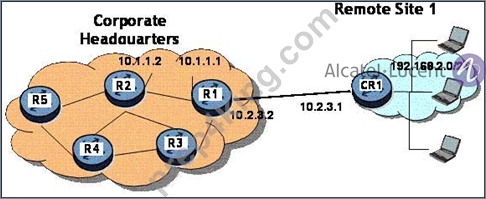
- A. config router static-route 10.2.3.1 next-hop 192.168.2.0
- B. config router static-route 192.168.2.0/24 next-hop 10.2.3.1
- C. config router static-route 10.2.3.2 next-hop 192.168.2.0
- D. config router static-route 192.168.2.0/24 next-hop 10.2.3.2
Answer: B
NEW QUESTION # 57
With a subnet mask of 255.255.255.224, which of the IP addresses below are valid host addresses? (Choose all that apply)
- A. 87.99.12.159
- B. 17.23.119.63
- C. 95.11.22.93
- D. 192.11.25.87
Answer: D
NEW QUESTION # 58
In the diagram, R3 receives an LSA with sequence number 112 from R7 and installs it in its link state database. 10 ms. Later it receives a copy of the same LSA with a sequence number of 111 from R1. What does R3 do with the LSA from R1?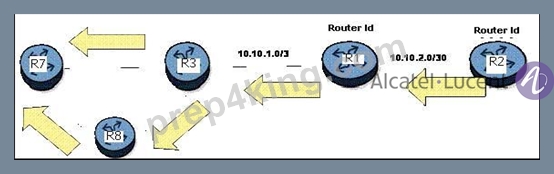
- A. R3 discards the LSA received from R1 and sends an ACK to R1.
- B. R3 discards the LSA received from R1 and sends a copy of the LSA from its link state base to R1.
- C. R3 installs the LSA received from R1 in its link state database and floods a copy to its neighbors.
- D. R3 installs the LSA received from R1 in its link state database, sends an ACK to R1 and floods a copy to its neighbors.
Answer: B
NEW QUESTION # 59
Which of the following best describes the function of the service label?
- A. Customer traffic is encapsulated with a service label by the ingress PE. The service label identifies the specific service the data belongs to.
- B. Customer traffic is encapsulated with a service label by the ingress PE. The service label identifies which transport tunnel to use.
- C. Customer traffic is encapsulated with a service label by the egress PE. The service label identifies which transport tunnel to use.
- D. Customer traffic is encapsulated with a service label by the egress PE. The service label identifies the specific service the data belongs to.
Answer: A
Explanation:
Section: Volume B
NEW QUESTION # 60
A VPWS service maintains a MAC Forwarding Database (FDB) for Ethernet SAPs.
- A. True
- B. False
Answer: B
Explanation:
Section: Volume B
NEW QUESTION # 61
What distance is supported using CAT-5 cabling for 10/100/1000 TX?
- A. 10 Km.
- B. 100 m.
- C. 500 m.
- D. 1 Km.
Answer: B
NEW QUESTION # 62
A network administrator is creating a subnet plan for the address 172.16.0.0/16. The network must support 459 hosts on each subnet while providing the maximum number of subnets. What subnet mask should be used?
- A. 255.255.224.0
- B. 255.255.128.0
- C. 255.255.0.0
- D. 255.255.254.0
Answer: D
Explanation:
Section: Volume A
NEW QUESTION # 63
What is the function of Layer 2?
- A. Layer 2 is responsible for encapsulating application data into TCP/UDP messages.
- B. Layer 2 is responsible for encapsulating packets into frames for transmission on physical media.
- C. Layer 2 is responsible for the timing of the signals on physical media.
- D. Layer 2 is responsible for encapsulating packets into IP datagrams and routing them.
Answer: C
NEW QUESTION # 64
With a subnet mask of 255.255.255.224, which of the IP addresses below are valid host addresses? (Choose all that apply)
- A. 87.99.12.159
- B. 17.23.119.63
- C. 95.11.22.93
- D. 192.11.25.87
Answer: C,D
NEW QUESTION # 65
......
All 4A0-100 Dumps and Nokia IP Networksand Services Fundamentals Training Courses: https://www.prep4king.com/4A0-100-exam-prep-material.html
Free Test Engine For Nokia IP Networksand Services Fundamentals Certification Exams: https://drive.google.com/open?id=1eY_nXfbHJO2s-_f2nG4pYdutE3pe9Vmr
