

PCNSE Certification Exam Dumps Questions in here [Apr-2026]
Updated PCNSE Exam Practice Test Questions
The PCNSE exam is intended for professionals who work with Palo Alto Networks security solutions on a daily basis. This includes security engineers, network architects, and security consultants who are responsible for designing and implementing enterprise-level security solutions. PCNSE exam is also suitable for individuals who want to enhance their knowledge and skills in the field of cybersecurity.
NEW QUESTION # 70
An engineer needs to configure a standardized template for all Panorama-managed firewalls. These settings will be configured on a template named "Global" and will be included in all template stacks.
Which three settings can be configured in this template? (Choose three.)
- A. Email scheduler
- B. Login banner
- C. Dynamic updates
- D. Log Forwarding profile
- E. SSL decryption exclusion
Answer: B,C,E
Explanation:
A template is a set of configuration options that can be applied to one or more firewalls or virtual systems managed by Panorama. A template can include settings from the Device and Network tabs on the firewall web interface, such as login banner, SSL decryption exclusion, and dynamic updates4. These settings can be configured in a template named "Global" and included in all template stacks. A template stack is a group of templates that Panorama pushes to managed firewalls in an ordered hierarchy4. References: Manage Templates and Template Stacks, PCNSE Study Guide (page 50)
NEW QUESTION # 71
A company hosts a publically accessible web server behind a Palo Alto Networks next generation firewall with the following configuration information.
- Users outside the company are in the "Untrust-L3" zone
- The web server physically resides in the "Trust-L3" zone.
- Web server public IP address: 23.54.6.10
- Web server private IP address: 192.168.1.10
Which two items must be NAT policy contain to allow users in the untrust-L3 zone to access the web server? (Choose two)
- A. Destination IP of 192.168.1.10
- B. Untrust-L3 for both Source and Destination zone
- C. Destination IP of 23.54.6.10
- D. Untrust-L3 for Source Zone and Trust-L3 for Destination Zone
Answer: B,C
Explanation: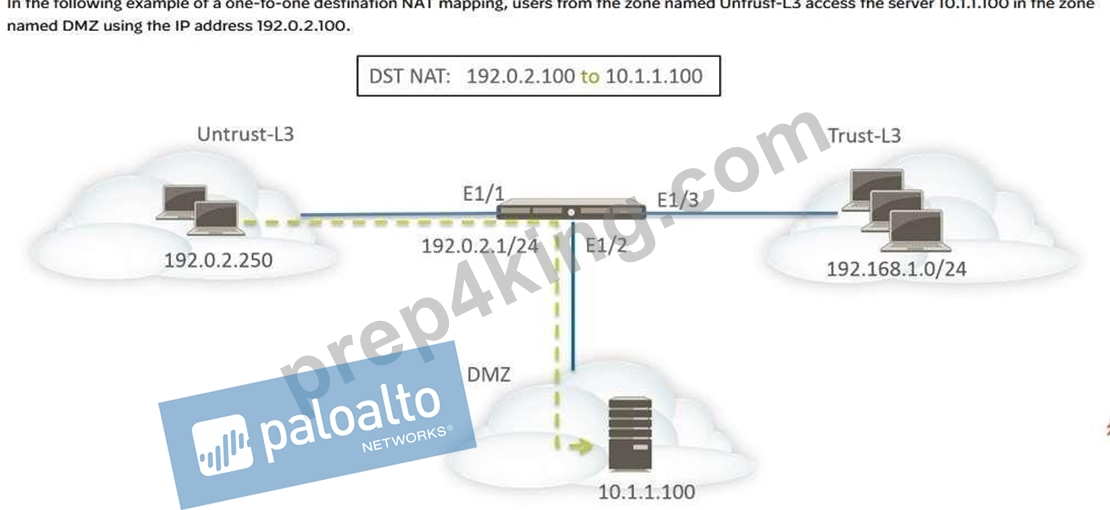
Before configuring the NAT rules, consider the sequence of events for this scenario.
Host 192.0.2.250 sends an ARP request for the address 192.0.2.100 (the public address of the destination server).
The firewall receives the ARP request packet for destination 192.0.2.100 on the Ethernet1/1 interface and processes the request. The firewall responds to the ARP request with its own MAC address because of the destination NAT rule configured.
The NAT rules are evaluated for a match. For the destination IP address to be translated, a destination NAT rule from zone Untrust-L3 to zone Untrust-L3 must be created to translate the destination IP of 192.0.2.100 to 10.1.1.100.
After determining the translated address, the firewall performs a route lookup for destination
10.1.1.100 to determine the egress interface. In this example, the egress interface is Ethernet1/2 in zone DMZ.
The firewall performs a security policy lookup to see if the traffic is permitted from zone Untrust- L3 to DMZ.
The direction of the policy matches the ingress zone and the zone where the server is physically located.
The security policy refers to the IP address in the original packet, which has a destination address of 192.0.2.100.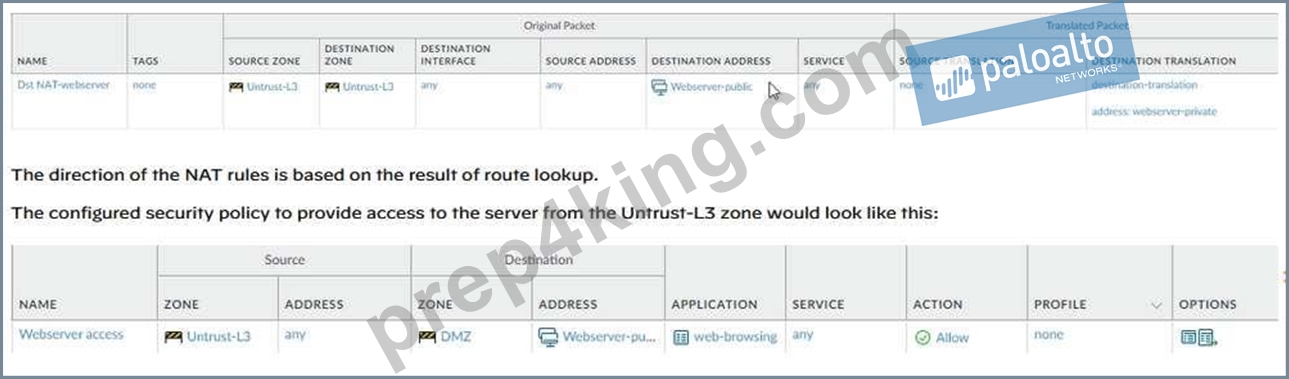
NEW QUESTION # 72
Which data flow describes redistribution of user mappings?
- A. Domain Controller to User-ID agent
- B. firewall to firewall
- C. User-ID agent to Panorama
- D. User-ID agent to firewall
Answer: B
Explanation:
https://www.paloaltonetworks.com/documentation/71/pan-os/pan-os/user-id/configure-firewalls-to-redistribute-user-mapping-information
https://docs.paloaltonetworks.com/pan-os/8-1/pan-os-admin/user-id/deploy-user-id-in-a-large-scale-network/redistribute-user-mappings-and-authentication-timestamps/firewall-deployment-for-user-id-redistribution.html#ide3661b46-4722-4936-bb9b-181679306809
NEW QUESTION # 73
The firewall identifies a popular application as an unknown-tcp.
Which two options are available to identify the application? (Choose two.)
- A. Create a custom application.
- B. Submit an Apple-ID request to Palo Alto Networks.
- C. Create a custom object for the custom application server to identify the custom application.
- D. Create a Security policy to identify the custom application.
Answer: A,C
Explanation:
Reference: https://www.paloaltonetworks.com/documentation/80/pan-os/pan-os/app-id/use- application-objects-in-policy/create-a- custom-application
NEW QUESTION # 74
What are three valid actions in a File Blocking Profile? (Choose three)
- A. Upload
- B. Forward
- C. Alret
- D. Block
- E. Reset-both
- F. Continue
Answer: B,C,D
Explanation:
https://live.paloaltonetworks.com/t5/Configuration-Articles/File-Blocking-Rulebase-and-Action-Precedence/ta-p/53623
NEW QUESTION # 75
An Administrator is configuring Authentication Enforcement and they would like to create an exemption rule to exempt a specific group from authentication. Which authentication enforcement object should they select?
- A. default-web-format
- B. default-authentication-bypass
- C. default-no-captive-portal
- D. default-browser-challenge
Answer: C
NEW QUESTION # 76
Which CLI command displays the current management plane memory utilization?
- A. > show system resources
- B. > debug management-server show
- C. > show system info
- D. > show running resource-monitor
Answer: A
Explanation:
Explanation
https://live.paloaltonetworks.com/t5/Learning-Articles/How-to-Interpret-show-system-resources/ta-p/59364
"The command show system resources gives a snapshot of Management Plane (MP) resource utilization including memory and CPU. This is similar to the 'top' command in Linux."
https://live.paloaltonetworks.com/t5/Learning-Articles/How-to-Interpret-show-system-resources/ta-p/59364
NEW QUESTION # 77
Given the following configuration, which route is used for destination 10 10 0 4?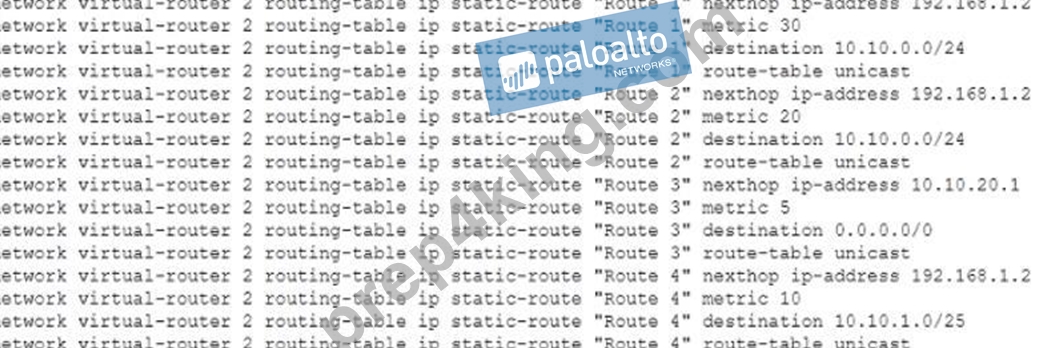
- A. Route 4
- B. Route 3
- C. Route 1
- D. Route 2
Answer: D
NEW QUESTION # 78
An engineer configures SSL decryption in order to have more visibility to the internal users' traffic when it is regressing the firewall.
Which three types of interfaces support SSL Forward Proxy? (Choose three.)
- A. Tap
- B. Virtual Wire
- C. Layer 3
- D. Layer 2
- E. High availability (HA)
Answer: B,C,D
Explanation:
PAN-OS can decrypt and inspect SSL inbound and outbound connections going through the firewall. SSL decryption can occur on interfaces in virtual wire, Layer 2 or Layer 3 mode https://knowledgebase.paloaltonetworks.com/KCSArticleDetail?id=kA10g000000ClmyCAC
NEW QUESTION # 79
A firewall engineer has determined that, in an application developed by the company's internal team, sessions often remain idle for hours before the client and server exchange any dat a. The application is also currently identified as unknown-tcp by the firewalls. It is determined that because of a high level of trust, the application does not require to be scanned for threats, but it needs to be properly identified in Traffic logs for reporting purposes.
Which solution will take the least time to implement and will ensure the App-ID engine is used to identify the application?
- A. Access the Palo Alto Networks website and complete the online form to request that a new application be added to App-ID.
- B. Create a custom application with specific timeouts, then create an application override rule and reference the custom application.
- C. Access the Palo Alto Networks website and raise a support request through the Customer Support Portal.
- D. Create a custom application with specific timeouts and signatures based on patterns discovered in packet captures.
Answer: B
Explanation:
For an application that is currently identified as unknown-tcp and has sessions that often remain idle for long periods, creating a custom application and using an application override rule is the most time-efficient solution.
C . The process involves:
Creating a custom application in the Palo Alto Networks firewall and configuring it with specific timeouts to accommodate the application's idle session behavior. This step ensures that the firewall does not prematurely close the application's sessions due to inactivity.
Next, creating an application override rule that references the custom application. This rule directs the firewall to identify traffic matching the rule criteria (such as source, destination, and port information) as the custom application, bypassing the App-ID engine's regular identification process.
This approach allows for the quick implementation of a solution that ensures the application is properly identified in traffic logs without undergoing threat scanning, meeting the requirements for both identification and reporting.
NEW QUESTION # 80
Which three authentication factors does PAN-OS@software support for MFA? (Choose three.)
- A. Okta Adaptive
- B. Voice
- C. Pull
- D. Push
- E. SMS
Answer: B,D,E
Explanation:
https://docs.paloaltonetworks.com/pan-os/10-2/pan-os-admin/authentication/authentication- types/multi-factor-authentication
NEW QUESTION # 81
What must be taken into consideration when preparing a log forwarding design for all of a customer's deployed Palo Alto Networks firewalls?
- A. The logs will not contain the names of the identified applications unless the "Enable enhanced application logging" option is selected
- B. Traffic and threat logs will not be forwarded unless the relevant Log Forwarding profile is selected in "Logging and Reporting Settings"
- C. Traffic and threat logs will not be forwarded unless the relevant Log Forwarding profile is attached to the security rules
- D. App-ID engine will not identify any application traffic unless the "Enable enhanced application logging" option is selected
Answer: C
Explanation:
For log forwarding in PAN-OS, traffic and threat logs require a Log Forwarding profile attached to Security rules (Option B) to send logs to external systems (e.g., syslog, Panorama). Without this, logs are stored locally but not forwarded, a critical design consideration.
NEW QUESTION # 82
An organization conducts research on the benefits of leveraging the Web Proxy feature of PAN-OS 11.0.
What are two benefits of using an explicit proxy method versus a transparent proxy method? (Choose two.)
- A. Explicit proxy allows for easier troubleshooting, since the client browser is aware of the existence of the proxy.
- B. No client configuration is required for explicit proxy, which simplifies the deployment complexity.
- C. It supports the X-Authenticated-User (XAU) header, which contains the authenticated username in the outgoing request
- D. Explicit proxy supports interception of traffic using non-standard HTTPS ports.
Answer: A,D
Explanation:
1. Explicit proxy allows for easier troubleshooting, since the client browser is aware of the existence of the proxy12. This means that the client can see the proxy's IP address and port number, and can use tools like ping or traceroute to check connectivity and latency issues. Transparent proxies are invisible to the client browser, which makes it harder to diagnose problems.
2. Explicit proxy supports interception of traffic using non-standard HTTPS ports3. This means that the proxy can handle HTTPS requests that use ports other than 443, which may be required by some applications or websites. Transparent proxies can only intercept HTTPS traffic on port 443, which limits their functionality.
NEW QUESTION # 83
An administrator is configuring an IPSec VPN to a Cisco ASA at the administrator's home and experiencing issues completing the connection. the following is the output from the command: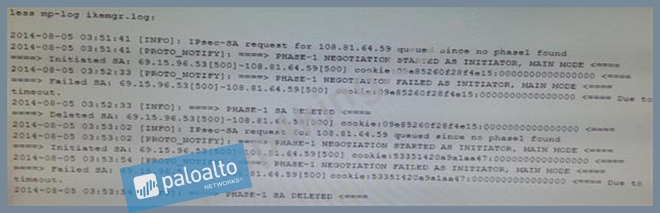
What could be the cause of this problem?
- A. The dead peer detection settings do not match between the Palo Alto Networks Firewall and the ASA.
- B. The public IP addresses do not match for both the Palo Alto Networks Firewall and the ASA.
- C. The Proxy IDs on the Palo Alto Networks Firewall do not match the setting on the ASA.
- D. The shared secrets do not match between the Palo Alto Networks Firewall and the ASA.
Answer: B
NEW QUESTION # 84 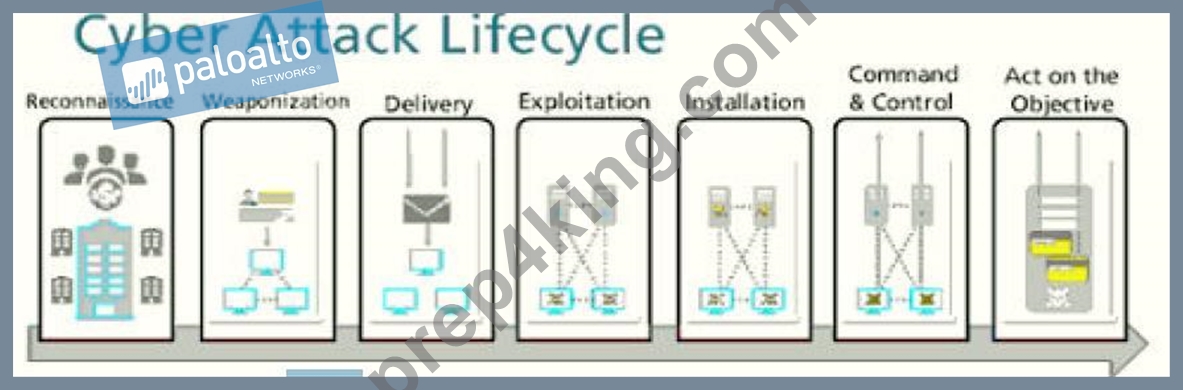
At which stage of the cyber-attack lifecycle would the attacker attach an infected PDF file to an email?
- A. exploitation
- B. IP command and control
- C. delivery
- D. reconnaissance
Answer: D
NEW QUESTION # 85
Which GlobalProtect Client connect method requires the distribution and use of machine certificates?
- A. At-boot
- B. On-demand
- C. User-logon (Always on)
- D. Pre-logon
Answer: D
Explanation:
Client certificate refers to user cert, it can be used for 'user-logon'/'on-demand' connect methods. Used to authenticate a user. -Machine certificate refers to device cert, it can be used for 'pre-logon' connect method. This is used to authenticate a device, not a user.
https://knowledgebase.paloaltonetworks.com/KCSArticleDetail?id=kA10g000000ClFoCAK
NEW QUESTION # 86
What are two best practices for incorporating new and modified App-IDs? (Choose two.)
- A. Run the latest PAN-OS version in a supported release tree to have the best performance for the new App-IDs
- B. Configure a security policy rule to allow new App-IDs that might have network-wide impact
- C. Study the release notes and install new App-IDs if they are determined to have low impact
- D. Perform a Best Practice Assessment to evaluate the impact of the new or modified App-IDs
Answer: B,D
Explanation:
https://docs.paloaltonetworks.com/pan-os/9-0/pan-os-admin/app-id/manage-new-app-ids-introduced-in-content-releases/app-id-updates-workflow.html
NEW QUESTION # 87
......
Palo Alto Networks Certified Security Engineer (PCNSE) certification exam is designed to validate the knowledge and skills of security professionals in deploying, configuring, and managing Palo Alto Networks security solutions. Palo Alto Networks Certified Network Security Engineer Exam certification is recognized worldwide as a standard for measuring the competencies of cybersecurity professionals in the Palo Alto Networks ecosystem. It provides a comprehensive overview of the latest PAN-OS 10.0 version, including advanced security features, threat prevention, and network security technologies.
Palo Alto Networks PCNSE (Palo Alto Networks Certified Security Engineer) certification is a highly respected credential in the cybersecurity industry. Palo Alto Networks Certified Network Security Engineer Exam certification is awarded to individuals who have demonstrated their expertise in designing, deploying, configuring, maintaining, and troubleshooting the Palo Alto Networks next-generation firewall technology. Palo Alto Networks Certified Network Security Engineer Exam certification exam covers the latest PAN-OS 10.0 release and provides a comprehensive assessment of an individual's knowledge and skills in network security.
Verified PCNSE dumps Q&As 100% Pass in First Attempt Guaranteed Updated Dump: https://drive.google.com/open?id=1DR-OqS84zI9-uukqJsw24TxSdZpEpCSK
Pass PCNSE PAN-OS PCNSE Exam With 375 Questions: https://www.prep4king.com/PCNSE-exam-prep-material.html
