

[Nov-2025] 1Z1-591 Pre-Exam Practice Tests | Exam Questions and Answers for Java and Middleware Study Guide
Oracle Business Intelligence Foundation Suite 11g Essentials Certification Sample Questions
NEW QUESTION # 32
What are the two disadvantages of implementing Query Caching?
- A. Needs a lot of administrators' time
- B. Increased network traffic
- C. Storage space for cache
- D. Cache results being old
- E. Reduction in BI server processing time
Answer: C,D
Explanation:
Explanation
B: The problem with caching of any kind is how to deal with stale data. How you decide to deal with this depends on how time critical your business intelligence queries happen to be. OBIEE provides a wide variety of mechanisms for dealing with stale data. The cache can be purged automatically at intervals. Caching can be enabled selectively for individual physical tables, so that data in a frequently updated table is never cached.
OBIEE provides a set of ODBC procedures that can be called when ETL processes complete to programmatically purge designated tables. But, by far the best way to selectively purge the cache is to use an event polling table. This table is populated by the client database whenever changes are made to any table (by an ETL process for a data warehouse or by a table-based trigger for an OLTP database). At specified intervals the BI Server polls this event polling table and deletes from its cache any query results that are dependent on the changed data.
NEW QUESTION # 33
How do System Session Variables obtain their values?
- A. They are obtained from data fields in the Physical Layer
- B. They are entered by user input on a dashboard
- C. They are obtained from the Presentation Layer
- D. They are obtained from the Initialization Block
Answer: D
Explanation:
Explanation/Reference:
Initialization blocks are used to initialize dynamic repository variables, system session variables, and nonsystem session variables.
NEW QUESTION # 34
Query Limits are used to manage Query environment in the repository for users and roles and can_________.
- A. Control aggregation
- B. Limit Queries by maximum run time
- C. Control WriteBack Capabilities
- D. Control runaway queries
- E. Control User Authentication
Answer: B
Explanation:
Query Limits. You can limit queries by the number of rows received, by maximum run time, and by restricting to particular time periods. You can also allow or disallow direct database requests or the Populate privilege.
See figure below.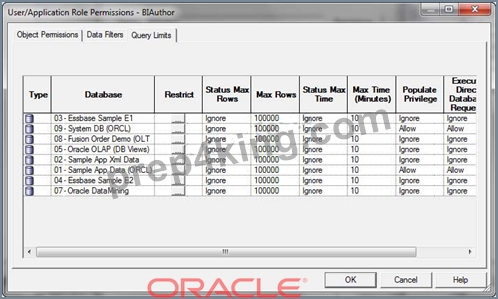
http://123obi.com/wp-content/uploads/2011/04/25-04-2011-10-26-45.png
NEW QUESTION # 35
When adding a new dimension to an existing logical table, what is the significance of the Logical Level setting in the Logical Table Source properties?
- A. It creates a new session variable.
- B. It defines the granularity of the dimension.
- C. It creates a foreign key relationship.
- D. It determines the actual value of the dimension.
Answer: B
Explanation:
Explanation
OBIEE - Grain (Level of summarization)
Grain definition in the context of OBIEE.
The following list describes the different grains in navigating a query:
* Aggregation grain. The grain of the aggregate source of from a level based metrics
* Query grain. The grain of the request.
* Time Series grain. The grain at which the time series function aggregation is requested.
* Storage grain. The query in the example can be computed from daily sales or from monthly sales, or from quarterly sales.
Note:
The aggregation grain is defined in the content tab of the logical table source.
When the query grain match the aggregation grain of a logical table source, this one is used to create the physical query.
http://gerardnico.com/wiki/_media/dat/obiee/bi_server/design/fact_table/obiee_fragmentation_content_one_colu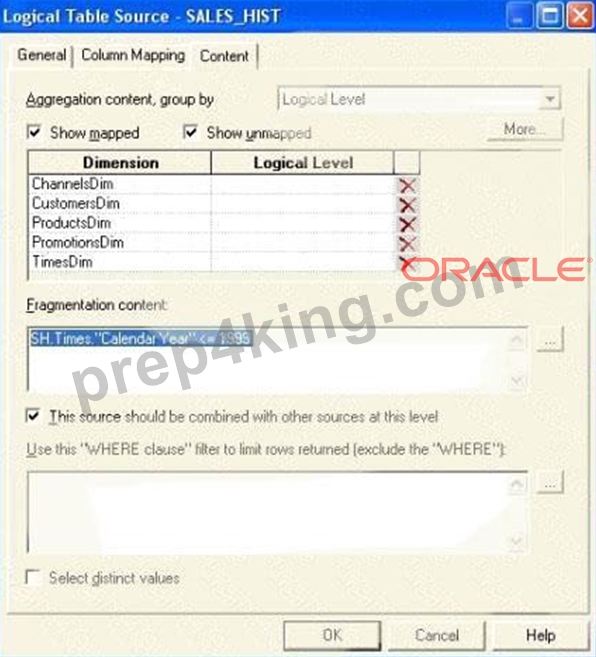
NEW QUESTION # 36
When Exporting an Analysis from a Dashboard, which of the following is NOT an option?
- A. PDF
- B. MS Excel
- C. MS Word
- D. CSV
Answer: C
Explanation:
Explanation/Reference:
Incorrect answers:
C: Use the PDF and Print Properties to export analysis to PDF format.
NEW QUESTION # 37
The Oracle BI office plug-in allows you to import the results of an OBI request into which two MS applications?
- A. MS Visio
- B. MS Project
- C. MS Excel
- D. MS Word
Answer: C,D
Explanation:
Oracle Business Intelligence Office Plug-In is a Windows application that is an optional feature under the Oracle Business Intelligence Presentation Services. The Plug-In provides a way to browse the Analytics catalog, select a report, and then drop that report into Microsoft Word or Excel.
NEW QUESTION # 38
You run the Consistency Check and receive the warning:
[39003] Missing functional dependency association for column: DIM_Offer_End_Date.CREATE_DT.
What would you check?
- A. Whether there is a logical join between the DIM and FACT tables
- B. Whether there is a physical join between the DIM and FACT tables
- C. Whether the columns creating CREATE_DT have been deleted
- D. Whether there is a physical column mapped to the logical column
- E. Whether the logical table source for this column has been disabled
- F. DIM_Offer_End_Date.CREATE_DT
Answer: E
Explanation:
This warning indicates that the given column is only mapped to logical table sources that are disabled. The warning brings this issue to the repository developer's attention in case the default behavior is not desired.
NEW QUESTION # 39
The WebLogic Console will allow you to perform which of the following functions in the BI Managed Server?
- A. Build Aggregate Queries
- B. Create Summary Tables
- C. Manage user logins
- D. Start and Stop BI Services
Answer: D
Explanation:
Explanation
Explanation/Reference:
Screenshot below.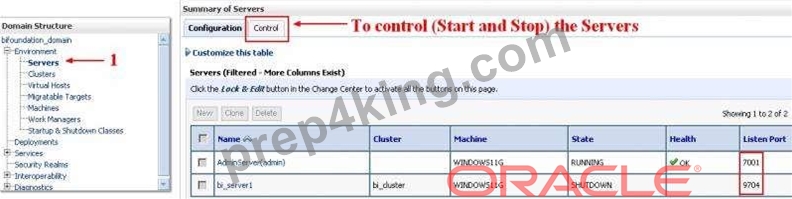
NEW QUESTION # 40
A customer frequently queries multiple dimension tables without a measure. What needs to be defined in the presentation layer?
- A. Alias
- B. Custom Display Name
- C. Logical Key
- D. Logical Column Name
- E. Implicit Fact Column
Answer: E
Explanation:
Metadata Repository Builder's Guide
http://download.oracle.com/docs/cd/E21764_01/bi.1111/e10540/toc.htm
http://download.oracle.com/docs/cd/E21764_01/bi.1111/e10540.pdf
Setting an Implicit Fact Column in the Subject Area
For each subject area in the Presentation layer, you can set an implicit fact column. The implicit fact column is added to a query when it contains columns from two or more dimension tables and no measures. The column is not visible in the results. It is used to specify a default join path between dimension tables when there are several possible alternatives or contexts.
NEW QUESTION # 41
What is the process in which there is redundancy of data to improve performance?
- A. Granularity
- B. Cardinality
- C. Redundancy
- D. Normalization
- E. Denormalization
Answer: E
Explanation:
Denormalization is the process of intentionally backing away from normalization to improve performance by suppressing join and permitting the use of star transformation technique.
Denormalization should not be the first choice for improving performance and should only be used for fine tuning of a database for a particular application.
NEW QUESTION # 42
A company's Database Administrator has divided the region table into two tables so that the region "West" is in one table and all the other regions are in another single table. What kind of partition is being used?
- A. Time-based
- B. Complex
- C. Fact-based
- D. Mixed
Answer: B
Explanation:
You have three sort of fragmentation:
Fact-based / Dimension-based fragmentation
Content-based / Value-based fragmentation
Level-based fragmentation / aggregate navigation
You can combine the techniques above to construct powerful design that are known as Complex partitioning / fragmentation. When you fragment a dimension, you are automatically in a complex fragmentation.
NEW QUESTION # 43
A customer frequently queries multiple dimension tables without a measure. What needs to be defined in the presentation layer?
- A. Alias
- B. Custom Display Name
- C. Logical Column Name
- D. Logical Key
- E. Implicit Fact Column
Answer: C
Explanation:
Explanation
You can define calculations in either of the following ways:- Before the aggregation, in the logical table source. For example:sum(col_A *( col_B))- After the aggregation, in a logical column derived from two other logicalcolumns. For example:sum(col A) * sum(col B)
NEW QUESTION # 44
Identity the three advantages of the BI Server metadata repository.
- A. Little changes in the physical layer to shiftfrom development to production environment
- B. Mapping of federated data sources to one logical object
- C. Ability to change physical sources without losing reports
- D. Three layers support the highest level of security
Answer: A,B,D
Explanation:
A: OBIEE Federated Repository Instead of moving data in to a single database, OBIEE - BI Administration can access multiple databases and create a single federated repository.OBIEE BI Answer uses this federated repository and build the ad-hoc reports and dashboards.
D: Repository Metadata Consists of 3 Layers
*The Physical Layer (Schema)
*The Business Model and Mapping Layer
*The Presentation Layer
Note: star schema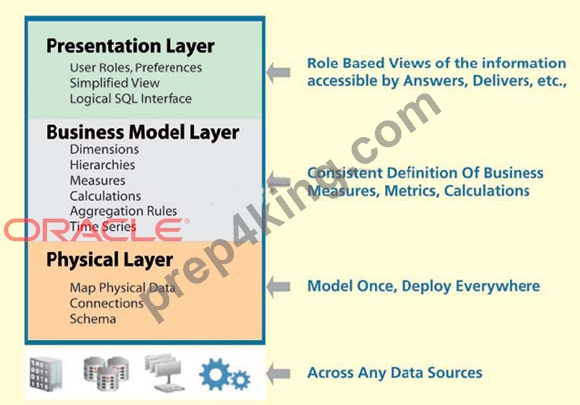
NEW QUESTION # 45
Identify the reason why Oracle OLAP provides a favorable aggregation strategy.
- A. OLAP cubes eliminate the need for a large number of aggregate tables.
- B. OLAP cubes can be queried by using SQL.
- C. OLAP cubes can be easily transported from database to database.
- D. OLAP cubes are stored outside of the database in highly optimized file structures.
Answer: B
Explanation:
All metadata for cubes and dimensions is stored in the Oracle database and revealed in the data dictionary views, so that you can query the entire business model in SQL.
Reference: Oracle OLAP User's Guide, What's New in Oracle OLAP?
NEW QUESTION # 46
Query Limits are used to manage Query environment in the repository for users and roles and can_________.
- A. Control aggregation
- B. Limit Queries by maximum run time
- C. Control runaway queries
- D. Control Write Back Capabilities
- E. Control User Authentication
Answer: B
Explanation:
Explanation/Reference:
Query Limits. You can limit queries by the number of rows received, by maximum run time, and by restricting to particular time periods. You can also allow or disallow direct database requests or the Populate privilege.
See figure below.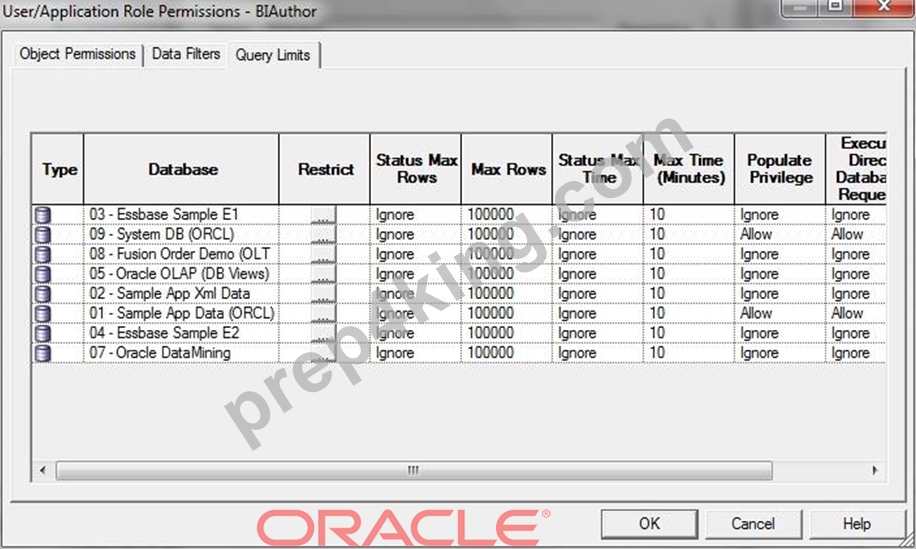
NEW QUESTION # 47
......
Oracle Exam Practice Test To Gain Brilliante Result: https://www.prep4king.com/1z1-591-exam-prep-material.html
Tested Material Used To 1Z1-591: https://drive.google.com/open?id=1zFQQD1XVrHfRWGGZbVPEU-NQnmqj9P8h
