

[May-2026] SAP Certified Associate C-S4TM-2023 Exam Practice Test Questions Dumps Bundle!
2026 Updated C-S4TM-2023 PDF for the C-S4TM-2023 Tests Free Updated Today!
SAP C-S4TM-2023 Exam Syllabus Topics:
| Topic | Details |
|---|---|
| Topic 1 |
|
| Topic 2 |
|
| Topic 3 |
|
| Topic 4 |
|
NEW QUESTION # 44
In an embedded deployment scenario, which of the following options are available to create freight units?
- A. Manually by using the sales order worklist
- B. Manually by using the transportation cockpit
- C. Manually by using the order-based transportation requirement worklist
- D. Automatically
Answer: D
NEW QUESTION # 45
Integration of SAP ERP orders and deliveries facilitates transportation planning and execution in SAP TM based on orders and deliveries created in an SAP ERP system. The orders and deliveries are represented by transportation requirements in SAP TM. Integration with SAP ERP enables you to:
There are 4 correct answers to this question.
- A. Propose and create deliveries based on dates and quantities according to transportation planning results. This takes into account transportation constraints such as resource availability and transportation durations.
- B. Perform transportation planning in SAP TM based on SAP ERP orders before delivery creation. This forecasts transportation and resource demands.
- C. Collectively plan transportation for all orders and across order types.
- D. Sales Organization
- E. Perform tendering, subcontracting, and execution in SAP TM based on SAP ERP orders before delivery creation.
Answer: A,B,C,E
NEW QUESTION # 46
How can you create a schedule departure? Note: There are 2 correct answers to this question.
- A. Copy from a freight booking
- B. Generate from a rule
- C. Maintain in default route
- D. Upload via report
Answer: B,D
Explanation:
In SAP S/4HANA Transportation Management, schedule departures define planned departure times for transportation, such as for regular routes. According to the SAP documentation, schedule departures can be created by:
* Upload via report (A): Users can upload schedule departures using a report or data import tool, allowing mass creation or updates.
* Generate from a rule (B): Schedule departures can be generated automatically based on predefined rules, such as recurring schedules for specific routes.
The other options are incorrect:
* Copy from a freight booking (C)is not a standard method for creating schedule departures, as freight bookings are execution documents for ocean or air transport.
* Maintain in default route (D)relates to route configuration but does not directly involve creating schedule departures.
Reference:
SAP S/4HANA Cloud Private Edition, Transportation Management Study Guide: Unit 7 - Master Data, Section on Schedules.
SAP Help Portal: Transportation Management - Schedule Management ().
NEW QUESTION # 47
In a side-by-side deployment between SAP S/4HANA and transportation management in SAP S/4 HANA, which interface is used to transfer business partner, product, and location Master Data?
- A. Data replication framework (DRF)
- B. Core interface (CIF)
- C. Web service (WS)
- D. Intermediate document (IDoc)
Answer: A,B
Explanation:
Transportation Management Overview and Fundamentals
NEW QUESTION # 48
You create a freight settlement document after you plan an inbound delivery with the following items: The total freight costs are USD 3000.
Which posting can be automatically performed for Product 2 if you transfer the freight settlement document with the distributed costs to SAP ERP?
Please choose the correct answer.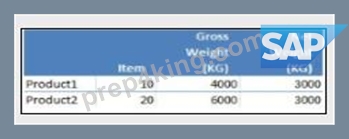
- A. USD 1800 on Material Account
- B. USD 1200 on CO-PA
- C. USD 3000 on Material Account
- D. USD 1500 on CO-PA
Answer: A
NEW QUESTION # 49
The following settings are defined for a freight order from location A to location B with two freight units:
* The distance between locations A and B in the transportation lane is 1500 km, the duration is 19 hours, and the Fix Transportation Duration flag is set.
* The average speed for the means of transport is defined as 100 km/h and the GIS quality flag is NOT set.
* Loading and unloading of each freight unit at locations A and B is defined as 1 hour.
* The vehicle resource is available weekdays from 8:00 am to 8:00 pm.
* Loading starts on Monday at 8:30 am.
When is unloading finished?
- A. Tuesday 5:30 pm
- B. Tuesday 7:30 pm
- C. Tuesday 7:30 am
- D. Tuesday 6:30 pm
Answer: C
Explanation:
To determine when unloading is finished, we need to calculate the total time required for the transportation process, considering the given settings. According to the SAP S/4HANA Transportation Management documentation, theFix Transportation Duration flagmeans the specified duration (19 hours) overrides the calculated duration based on distance and speed. Let's break down the timeline:
* Loading: Each freight unit takes 1 hour to load, and with two freight units, loading takes 2 hours (sequential, as per standard SAP TM behavior). Loading starts on Monday at 8:30 am and ends at 10:30 am.
* Transportation duration: The fixed duration is 19 hours, starting after loading (Monday 10:30 am).
Adding 19 hours:
* Monday 10:30 am + 19 hours = Tuesday 5:30 am.
* Unloading: Each freight unit takes 1 hour to unload, so two freight units require 2 hours. Unloading starts at Tuesday 5:30 am and ends atTuesday 7:30 am.
* Vehicle availability: The vehicle is available from 8:00 am to 8:00 pm weekdays, but since the transportation starts within this window and the fixed duration does not mention breaks, we assume continuous transport within the 19-hour duration.
* GIS quality flag: Since it is not set, no additional geographical adjustments affect the duration.
Thus, unloading finishes atTuesday 7:30 am.
The other options are incorrect:
* A (Tuesday 6:30 pm)andC (Tuesday 7:30 pm)assume longer durations, possibly ignoring the fixed duration or adding unnecessary breaks.
* D (Tuesday 5:30 pm)does not account for the unloading time correctly.
Reference:
SAP S/4HANA Cloud Private Edition, Transportation Management Study Guide: Unit 3 - Transportation Planning, Section on Scheduling and Duration Calculation.
SAP Help Portal: Transportation Management - Scheduling in Freight Orders ().
NEW QUESTION # 50
You have created two freight units for customer A and two freight units for customer B.
You have defined the transportation network (see attached diagram) and no incompatibilities exist. How many freight orders does the optimizer create using only route-based distance costs?
- A. 0
- B. 1
- C. 2
- D. 3
Answer: C
NEW QUESTION # 51
Which of the following attributes are used to define a business partner with role Driver? Note: There are 2 correct answers to this question.
- A. Validity period
- B. Non-working times and absences
- C. Planning profile
- D. Fixed assignment to a vehicle resource
Answer: A,B
Explanation:
In SAP S/4HANA Transportation Management, a business partner with the role Driver is defined in the master data with specific attributes. According to the SAP documentation:
* Non-working times and absences (C): These attributes specify the driver's availability, including holidays, vacations, or other non-working periods, critical for planning.
* Validity period (D): The validity period defines the time frame during which the driver is active in the system, ensuring assignments are time-relevant.
The other options are incorrect:
* Fixed assignment to a vehicle resource (A)is optional and managed in vehicle resource master data, not a mandatory driver attribute.
* Planning profile (B)is used for planning settings, not for defining driver attributes.
Reference:
SAP S/4HANA Cloud Private Edition, Transportation Management Study Guide: Unit 7 - Master Data, Section on Business Partner Roles.
SAP Help Portal: Transportation Management - Driver Master Data ().
NEW QUESTION # 52
You want to perform carrier selection for a freight order created in SAP S/4HANA Supply Chain for transportation management. Which of the following can you use as decision criteria? Note: There are 2 correct answers to this question.
- A. Costs from shipment cost document
- B. Priority from transportation lane
- C. Costs from charge management
- D. Priority from carrier selection settings
Answer: B,D
Explanation:
Transportation Planning
NEW QUESTION # 53
What are some of the parameters that you can define in the forwarding order type?
Note: There are 3 correct answers to this question.
- A. Export forwarding order type
- B. Shipping type
- C. Bill of lading type
- D. Dangerous goods profile
- E. Planning profile
Answer: A,B,C
NEW QUESTION # 54
What is stored for each business partner role?
Please choose the correct answer.
- A. Instead
- B. As a copy of an existing forwarding order
- C. From the order management overview
- D. Specific data
Answer: D
NEW QUESTION # 55
What is automatically determined based on the object being transferred from ERP when location data is created via the CIF. Please choose the correct answer.
- A. MES Access
- B. The location type
- C. Give operators
- D. Intuitive mobile
Answer: B
NEW QUESTION # 56
In an international outbound transportation scenario, you want to calculate base freight between a shipping point and destination transportation zones depending on gross weight. The modes of transport, road and rail, have a strong influence on the transportation costs. The price unit of the calculation rule of the rate table is set to one pallet (PAL). How many scales do you have to define in the rate table?
- A. 0
- B. 1
- C. 2
- D. 3
Answer: C
NEW QUESTION # 57
What settings are controlled by the freight unit type? Note: There are 3 correct answers to this question.
- A. Direct shipment options
- B. Tendering settings
- C. Change controller settings
- D. Organizational unit determination
- E. Freight unit building rule
Answer: A,D,E
Explanation:
Transportation Management Overview and Fundamentals
NEW QUESTION # 58
What is the maximum number of freight settlement documents that can be created from a freight order with two deliveries during its lifecycle, given that all the charge elements in the calculation sheet have a value greater than zero?
- A. 0
- B. 1
- C. 2
- D. No limit
Answer: D
NEW QUESTION # 59
You want to configure event based charges. To which document type can you assign an event profile?
There are 2 correct answers to this question.
- A. Freight Settlement Document
- B. Freight Booking
- C. Transportation Unit
- D. Forwarding Order
Answer: B,D
NEW QUESTION # 60
Which item category in a forwarding order item hierarchy does NOT influence planning?
- A. Product
- B. Container
- C. Passive vehicle
- D. Service
Answer: D
NEW QUESTION # 61
You want to use destination-based distance costs when planning freight orders with the VSR optimizer. What MUST you define?
- A. Costs for distance in the transportation lane
- B. A freight unit building rule that does NOT use default routes
- C. Costs for distance in the constraints and cost settings
- D. Planning strategy VSR_DEF in the optimizer settings
Answer: A
Explanation:
To use destination-based distance costs when planning freight orders with the VSR (Vehicle Scheduling and Routing) optimizer in SAP S/4HANA Transportation Management, you must definecosts for distance in the transportation lane (A). According to the SAP documentation, the transportation lane contains cost-related data, such as distance-based costs, which the VSR optimizer uses to calculate the optimal plan based on the distance between source and destination locations. This ensures that the optimizer considers the cost implications of the route.
The other options are incorrect:
* Planning strategy VSR_DEF (B)is a default strategy for the VSR optimizer but does not specifically address destination-based distance costs.
* Costs for distance in the constraints and cost settings (C)are not a standard configuration area; costs are defined in transportation lanes or freight agreements.
* A freight unit building rule that does NOT use default routes (D)affects freight unit creation, not the optimizer's cost calculations.
Reference:
SAP S/4HANA Cloud Private Edition, Transportation Management Study Guide: Unit 3 - Transportation Planning, Section on VSR Optimizer.
SAP Help Portal: Transportation Management - VSR Optimizer Configuration ().
NEW QUESTION # 62
You have fixed-price contracts with your carriers. The carriers have guaranteed availability for all of your transports. How can you streamline the subcontracting process?
- A. Use carrier selection with the Assign Best Carrier option
- B. Use carrier selection with the Automatic Tendering option
- C. Use tendering with the Peer-to-Peer Tendering - No Response Required type
- D. Use tendering with the Broadcast Tendering - First Acceptable Offer type
Answer: D
Explanation:
Transportation Planning
NEW QUESTION # 63
Which of the following characteristics describe transportation zones? Note: There are 2 correct answers to this question.
- A. Transportation zones are used to group locations.
- B. Transportation zones increase the effort needed to model the network.
- C. Transportation zones transfer their properties to their locations.
- D. Transportation zones are physical locations.
Answer: A,C
Explanation:
In SAP S/4HANA Transportation Management, transportation zones are used to organize the transportation network. According to the SAP documentation:
* Transportation zones transfer their properties to their locations (A): Zones define attributes (e.g., geographical or organizational properties) that are inherited by the locations within them, simplifying configuration.
* Transportation zones are used to group locations (D): Zones group multiple locations (e.g., warehouses, plants) to streamline planning and routing in the transportation network.
The other options are incorrect:
* Transportation zones are physical locations (B)is incorrect; zones are logical groupings, not physical sites.
* Transportation zones increase the effort needed to model the network (C)is incorrect; zones reduce modeling effort by grouping locations.
Reference:
SAP S/4HANA Cloud Private Edition, Transportation Management Study Guide: Unit 7 - Master Data, Section on Transportation Zones.
SAP Help Portal: Transportation Management - Transportation Zone Management ().
NEW QUESTION # 64
You want to print a road waybill document, a loading list, and labels for your freight orders with freight order type FOT1. You also want to send emails and XML messages to the carriers of freight orders of this type.
What is the MINIMUM number of PPF (Post-Processing Framework) action profiles that you need to define for this purpose?
- A. 0
- B. 1
- C. 2
- D. 3
Answer: C
Explanation:
Freight Order Management
NEW QUESTION # 65
When using dispute management, which activities can a carrier perform in the carrier collaboration portal? Note: there are 2 correct answers to this question.
- A. Upload files
- B. Add a detention charge
- C. Change the document currency
- D. Change the quantity of a charge line's calculation base
Answer: B,D
NEW QUESTION # 66
Which of the following can you determine using conditions in transportation charge management? Note:
There are 2 correct answers to this question.
- A. Rate table
- B. Freight agreement
- C. Carrier in the freight agreement
- D. Validity date of the rate table
Answer: A,B
Explanation:
In SAP S/4HANA Transportation Management, conditions are used to determine specific objects or settings during charge calculation based on predefined rules. According to the SAP documentation:
* Freight agreement (A): Conditions can be used to select the appropriate freight agreement based on attributes like carrier, purchasing organization, or transportation lane.
* Rate table (D): Conditions can determine the specific rate table to be used for charge calculation, based on criteria such as source/destination or service type.
The other options are incorrect:
* Carrier in the freight agreement (B)is determined during carrier selection, not through conditions in charge management.
* Validity date of the rate table (C)is defined in the rate table configuration and is not determined dynamically via conditions.
Reference:
SAP S/4HANA Cloud Private Edition, Transportation Management Study Guide: Unit 5 - Charge Calculation and Freight Settlement, Section on Conditions in Charge Management.
SAP Help Portal: Transportation Management - Conditions for Charge Calculation
NEW QUESTION # 67
How does the continuous move function influence the carrier selection process?
- A. It deducts a discount from the carrier selection planning costs for neighboring freight orders
- B. It combines two freight orders with the same carrier in one freight order
- C. It moves the dates of the freight orders to avoid idle time
- D. It narrows down the available carriers to only carriers that allow continuous moves
Answer: D
NEW QUESTION # 68
Which of the following profiles is directly assigned to an organizational unit?
- A. Charges profile
- B. Calculation profile
- C. Distribution profile
- D. Dimensional weight profile
Answer: C
Explanation:
In SAP S/4HANA Transportation Management, thedistribution profileis directly assigned to an organizational unit to define how costs are distributed across different entities, such as cost centers or internal orders, during freight settlement. According to the SAP documentation, the distribution profile is linked to the organizational unit (e.g., a purchasing organization) to specify rules for cost allocation in materials management integration scenarios. This ensures that transportation costs are correctly assigned based on organizational structure.
The other options are incorrect:
* Charges profile (A)defines the structure of charges but is not directly assigned to an organizational unit; it is used in freight agreements or calculation sheets.
* Calculation profile (B)determines how charges are calculated but is assigned to documents like freight orders, not organizational units.
* Dimensional weight profile (D)is used for calculating dimensional weight and is linked to calculation profiles, not organizational units.
Reference:
SAP S/4HANA Cloud Private Edition, Transportation Management Study Guide: Unit 5 - Charge Calculation and Freight Settlement, Section on Cost Distribution.
SAP Help Portal: Transportation Management - Cost Distribution Profiles ().
NEW QUESTION # 69
......
Fully Updated Dumps PDF - Latest C-S4TM-2023 Exam Questions and Answers: https://www.prep4king.com/C-S4TM-2023-exam-prep-material.html
100% Free C-S4TM-2023 Exam Dumps to Pass Exam Easily: https://drive.google.com/open?id=1bgyTIwPjcQNcHpT0ah-uRcsDyIwEoWaq
