

100% Reliable Microsoft P_SAPEA_2023 Exam Dumps Test Pdf Exam Material
Based on Official Syllabus Topics of Actual SAP P_SAPEA_2023 Exam
NEW QUESTION # 18
While trying to identify and map key stakeholders in Wanderlust, you, as the Chief Enterprise Architect, have been evangelizing the strategic business and IT objectives with business and IT departments across regions and taking in their views on the upcoming business transformation, Match the feedback from stakeholders (shown on the left) to the categorization and to some of the actions in the dropdown lists.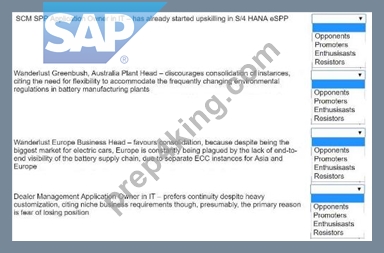
Answer:
Explanation: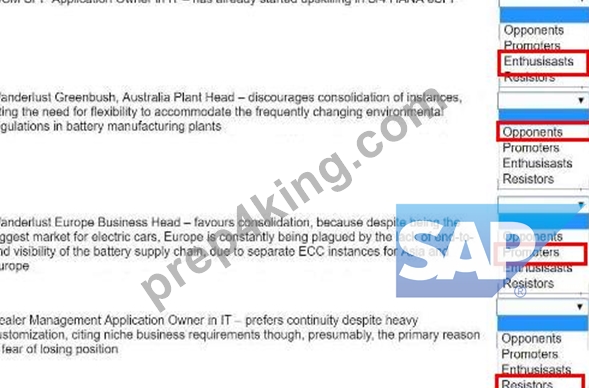
NEW QUESTION # 19
As an Enterprise Architect, you must ensure that future extensions to the Digital Core of the enterprise guarantee stable and reliable operations. The architecture guideline demands to follow the clean-core strategy. What does this demand ensure and entail?
- A. Extensions may access SAP tables directly and in a well-documented, clean way. Therefore, the code of extensions can be adapted quickly to accommodate future changes.
- B. Extensions are kept strictly separate from the SAP application, Extensions are developed in accordance with the SAP Application Extension Methodology. Side-by-side extensibility options are always preferable to on-stack extensibility options.
- C. Extensions do not break an upgrade, and upgrades do not break an extension. Such extensions can access SAP business objects only through well defined, upgrade-stable interfaces.
Answer: C
Explanation:
Explanation
The clean-core strategy is a SAP initiative to keep the core of SAP applications as clean as possible by moving customizations and extensions to the side-by-side layer. This allows SAP to more easily deliver new releases of applications without having to worry about breaking custom code.
The following are the benefits of following the clean-core strategy:
Stability: Extensions that are developed in accordance with the clean-core strategy are less likely to break when the underlying application is upgraded.
Maintainability: Extensions that are developed in the side-by-side layer are easier to maintain than extensions that are embedded in the core application.
Flexibility: The clean-core strategy allows for more flexibility in how extensions are developed.
Therefore, the clean-core strategy is a good way to ensure that future extensions to the Digital Core of the enterprise guarantee stable and reliable operations.
The clean-core strategy is a SAP initiative to keep the core of SAP S/4HANA as clean as possible by moving customizations and extensions to the side-by-side layer. This allows SAP to more easily deliver new releases of S/4HANA without having to worry about breaking custom code. The clean-core strategy ensures that extensions do not break an upgrade, and upgrades do not break an extension. This means that extensions are compatible with the latest version of SAP S/4HANA and do not require any changes or adaptations when a new release is applied. To achieve this, extensions must access SAP business objects only through well defined, upgrade-stable interfaces, such as public APIs, OData services, or events. These interfaces are documented and maintained by SAP and guarantee backward compatibility and stability across releases.
Verified References: 1: https://www.sap.com/products/rise/clean-core.html | 2:
https://blogs.sap.com/2023/02/22/s-4hana-clean-core-with-and-btp/
NEW QUESTION # 20
Tho Wanderlust CIO wants to focus loss on marketing strategy and planning, to instead prioritize marketing implement goals in mind to enhance number of leads generated:
* Run effective and highly visible campaigns (for example. on social media)
* Increase cross selling opportunities through online recommendation
AS the Chief Enterprise Architect Of Wanderlust. assisted by the SAP Enterprise Architects, you have been trying to re goals with the Business Process Modules, Segments and Activities in the Lead to Cash B2C Business Process Varia Business Architecture content repository (see graphic below).
What are relevant combinations Of business activities and goals based on the graphic below?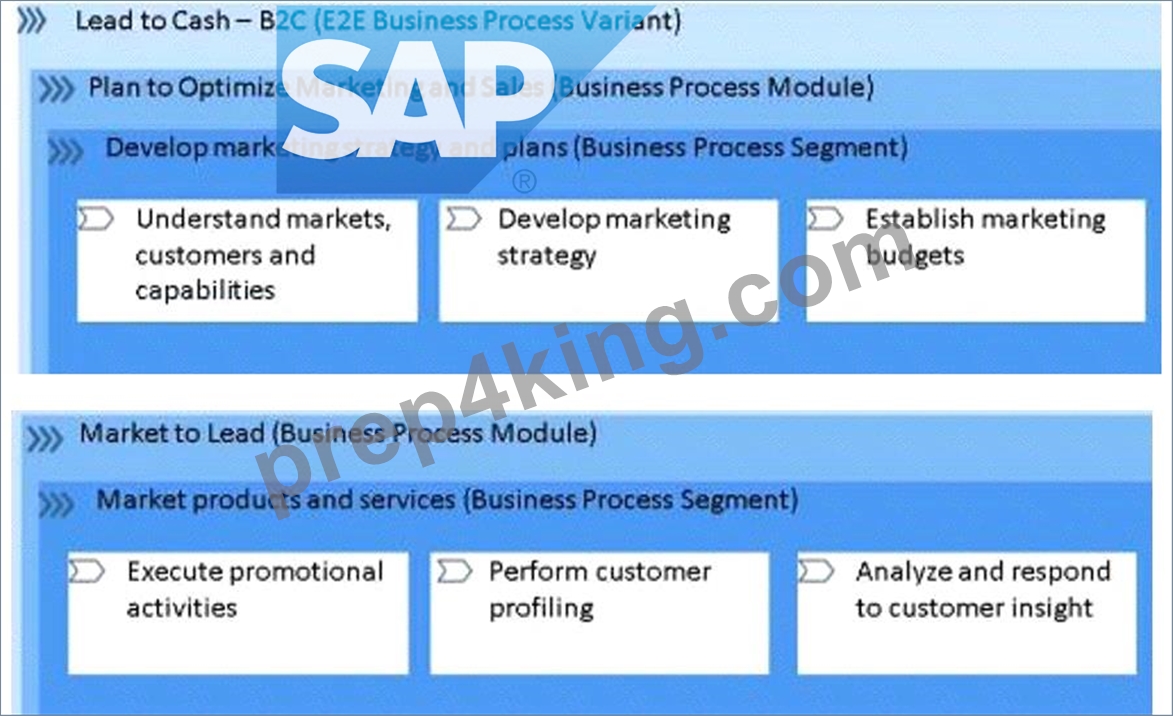
Note: There are 2 correct answers to this question.
See the Image
- A. Design and mange a customer loyalty program- increase cross selling opportunities through online recommendations.
- B. Develop market strategy -Run effective and high visibility campaigns.
- C. Implement promotional activities-Run effective and high visibility campaigns.
- D. Analyse and respond to customer insight- increase cross selling opportunities through online recommendations.
Answer: C,D
Explanation:
Explanation
Analyse and respond to customer insight is a business activity that is related to the Customer Insight segment of the Lead to Cash B2C Business Process Variant. This business activity can help Wanderlust to identify opportunities to increase cross selling through online recommendations.
Implement promotional activities is a business activity that is related to the Promotion segment of the Lead to Cash B2C Business Process Variant. This business activity can help Wanderlust to run effective and highly visible campaigns on social media.
The other two options, Develop market strategy and Design and mange a customer loyalty program, are not as relevant to the goals that Wanderlust is trying to achieve.
Develop market strategy is a business activity that is related to the Marketing Strategy segment of the Lead to Cash B2C Business Process Variant. This business activity is more focused on the overall marketing strategy of Wanderlust, rather than the specific goals of increasing cross selling or running effective campaigns.
Design and mange a customer loyalty program is a business activity that is related to the Customer Relationship Management segment of the Lead to Cash B2C Business Process Variant. This business activity is more focused on building long-term relationships with customers, rather than the specific goals of increasing cross selling or running effective campaigns.
Therefore, the best course of action is to focus on the Analyse and respond to customer insight and Implement promotional activities business activities in order to achieve Wanderlust's goals of increasing cross selling and running effective campaigns.
NEW QUESTION # 21
Having identified the appropriate sel of Business Activities, as the Chief Enterprise Architect of Wanderlust, assisted by the sap Enterprise Architects. you have been trying to relate to Lead to Cash Business Capabilities in the SAP Reference Business Architecture content repository. In light of the two key goals outlined by the Wanderlust CIO, what are the most appropriate Business Capabilities? Note: There are 3 correct answers to this question.
- A. Account Based Marketing, Lead Management
- B. Marketing Analytics, Recommendation Management
- C. Marketing Strategy Management, Brand Management
- D. Marketing Campaign Management
- E. Social Media Management
Answer: B,D,E
Explanation:
The business capabilities 'Marketing Analytics' and 'Recommendation Management' align with the goal of enhancing the number of leads through targeted campaigns and cross-selling opportunities. 'Marketing Campaign Management' is central to designing and executing effective campaigns. 'Social Media Management' is pivotal for achieving high visibility on platforms where potential customers are most active.
Reference = These capabilities should be part of Wanderlust's business architecture to support the CIO's objectives, and they are likely detailed in the SAP Reference Business Architecture content, which includes capabilities needed to execute comprehensive marketing strategies.
NEW QUESTION # 22
Which artifact from the SAP Reference Solution Architecture shows which data objects are exchanged between SAP application components in a given end-to-end scenario?
- A. SAP Data Object Diagram, which is available from SAP API Business Accelerator Hub (api.sap.com)
- B. SAP Data Flow Diagram, which is available from SAP API Business Accelerator Hub (api sap.com)
- C. SAP Data Component Diagram, which is available in SAP Signavio Process Explorer
Answer: B
Explanation:
The SAP Data Flow Diagram (DFD) is an artifact from the SAP Reference Solution Architecture that shows which data objects are exchanged between SAP application components in a given end-to-end scenario. The DFD uses a graphical representation to show the flow of data between different components of a system.
The SAP Data Object Diagram (DOD) is also an artifact from the SAP Reference Solution Architecture, but it does not show the flow of data between different components. The DOD shows the structure of data objects, including their attributes and relationships.
The SAP Data Component Diagram (DCD) is an artifact from SAP Signavio Process Explorer, which is a tool for modeling business processes. The DCD shows the different components of a system, including their relationships.
Therefore, the correct answer is option B.
Here is a table that summarizes the different artifacts and their purposes: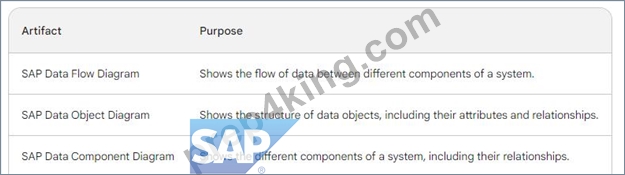
According to the SAP Reference Architecture Content: An Overview - Part 2 , the SAP Data Flow Diagram is an artifact that shows the flow of data through the SAP solution, from the source to the destination. It also shows which data objects are exchanged between the different components and services of the SAP solution, such as master data, transactional data, analytical data, or configuration data. The SAP Data Flow Diagram can help you to understand and communicate how data is created, transformed, and consumed in a SAP solution, and to identify and optimize the data integration points and dependencies.
The other options (A and C) are not correct for the artifact from the SAP Reference Solution Architecture that shows which data objects are exchanged between SAP application components in a given end-to-end scenario, because they either do not exist or do not show the data flow. For example:
Option A is not correct because there is no such artifact as SAP Data Object Diagram in the SAP Reference Solution Architecture content. The SAP API Business Accelerator Hub (api.sap.com) is a platform that provides access to SAP APIs, events, and related resources, but it does not provide any diagrams that show the data objects exchanged between SAP application components.
Option C is not correct because the SAP Data Component Diagram is not an artifact that shows the data flow, but rather an artifact that shows the main components and services that constitute the target application architecture, as well as their relationships and interactions. The SAP Data Component Diagram does not show which data objects are exchanged between the different components and services of the SAP solution. The SAP Signavio Process Explorer is a tool that helps you to model, analyze, and optimize business processes, but it does not provide any diagrams that show the data flow.
NEW QUESTION # 23
While trying to identify and map key stakeholders in Wanderlust, you, as the Chief Enterprise Architect, have been evangelizing the strategic business and IT objectives with business and IT departments across regions and taking in their views on the upcoming business transformation, Match the feedback from stakeholders (shown on the left) to the categorization and to some of the actions in the dropdown lists.
Answer:
Explanation: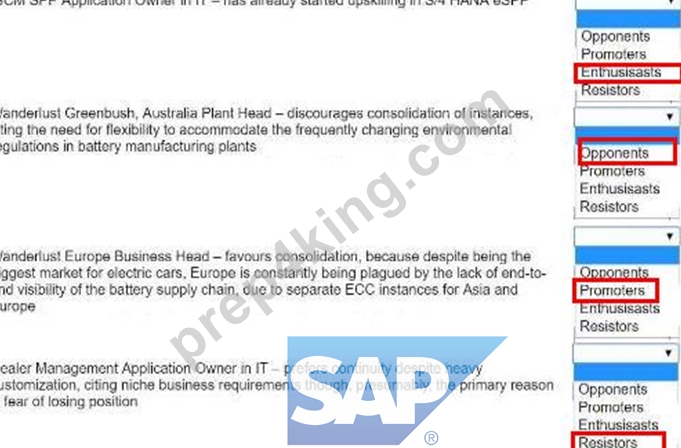
NEW QUESTION # 24
Green Elk & Company is the world's leading manufacturer of agricultural and forestry machinery. The former company slogan "Elk always runs has recently been changed to "Elk feeds the world" One of Green Elk's strategic goals is to increase its revenue in the emerging markets of China, India, and other parts of Asia by 80 % within three years. This requires a new business model that caters to significantly smaller farms with limited budgets. You are the Chief Enterprise Architect and the CIO asked you to conduct interviews with the key stakeholders of Green Elk to assess the business strategy. You are planning to interview the owner of the business unit of finished goods. Which of the following sets of questions would you ask?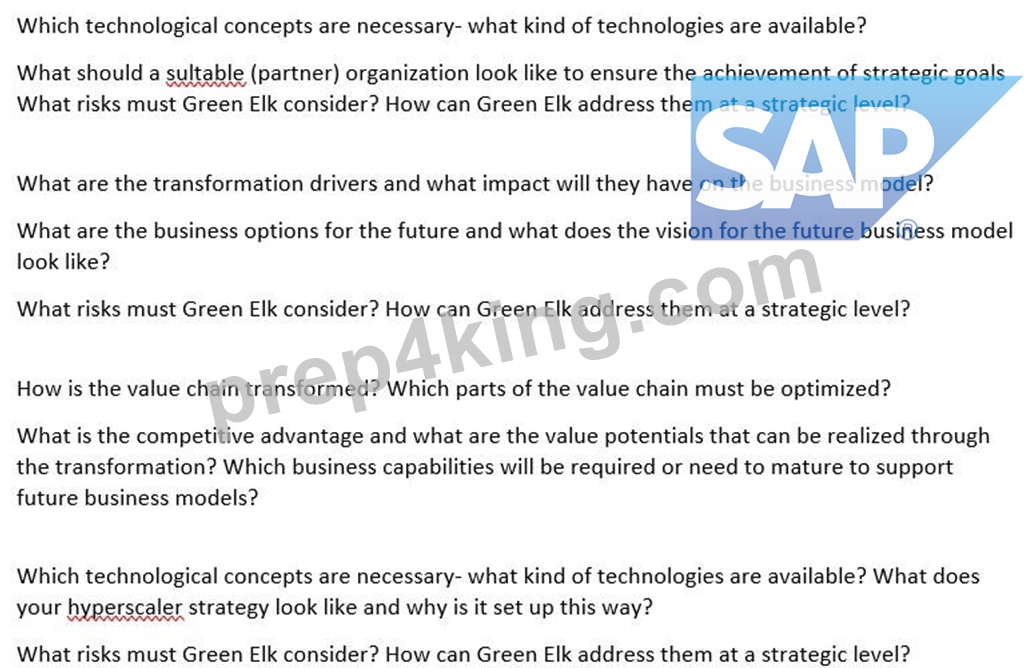
- A. How is the value chain transformed? Which parts of the value chain must be optimized?What is the competitive advantage and what are the value potentials that can be realized through the transformation? Which business capabilities will be required or need to mature to support future business models?
- B. Which technological concepts are necessary- what kind of technologies are available? What should a sultable (partner) organization look like to ensure the achievement of strategic goals What risks must Green Elk consider? How can Green Elk address them at a strategic level?
- C. What are the transformation drivers and what impact will they have on the business model?What are the business options for the future and what does the vision for the future business model look like?What risks must Green Elk consider? How can Green Elk address them at a strategic level?
- D. Which technological concepts are necessary- what kind of technologies are available? What does your hyperscaler strategy look like and why is it set up this way? What risks must Green Elk consider? How can Green Elk address them at a strategic level?
Answer: C
Explanation:
When assessing the business strategy as the Chief Enterprise Architect, the following set of questions would be pertinent to ask the owner of the business unit of finished goods:
What are the transformation drivers, and what impact will they have on the business model? Understanding the forces driving change is critical to aligning the business strategy and the enterprise architecture.
What are the business options for the future, and what does the vision for the future business model look like? This will provide insights into potential pathways for growth and innovation.
What risks must Green Elk consider, and how can Green Elk address them at a strategic level? Risk assessment and mitigation are essential components of strategic planning, particularly in the context of ambitious growth targets.
This set of questions is designed to uncover the strategic direction of the business unit and to ensure that the enterprise architecture will support the achievement of strategic goals.
= The methodology for conducting such stakeholder interviews is encompassed within the SAP Enterprise Architecture Framework and the business strategy assessment process, which includes stakeholder engagement and alignment with business objectives.
NEW QUESTION # 25
What kind of applications can you develop with SAP Business Application Studio?
- A. ABAP applications
- B. SAPUI5 (SAP Fiori) applications
- C. SAPUI5 (SAP Fiori) applications and ABAP applications
Answer: B
Explanation:
SAP Business Application Studio is a modern development environment designed to support the development of various SAP-centric applications. Among the supported application types are:
SAPUI5 (SAP Fiori) applications (C): SAP Business Application Studio provides extensive tools and templates specifically tailored for developing SAPUI5 applications, which are the backbone of the SAP Fiori user experience. This includes support for frontend development with rich user interfaces, integration with SAP services, and adherence to SAP Fiori design principles.
Options A and B are incorrect because SAP Business Application Studio does not support ABAP development directly within its environment. ABAP development traditionally requires a different set of tools and environments provided by SAP, such as the ABAP Development Tools (ADT) in Eclipse or the ABAP environment on SAP Cloud Platform.
:
SAP Business Application Studio documentation.
SAP Fiori development guidelines provided by SAP.
NEW QUESTION # 26
Demand and Supply Planning (SAP IBP) implementation has been identified as a quick win, based on feedback from a large cross section of Wanderlust stakeholders. As the Chief Enterprise Architect, you have now been asked to scope and contextualize the architecture project. Architecture principles have already been adopted. Which of the following activities should you to initiate to conclude the Statement of Architecture Work for the intended SAP IBP implementation initiative? Note: There are 3 correct answers to this question.
- A. Define the Solution Context for the architecture work.
- B. Conduct a Fit Gap Assessment to identify requirements that cannot be met
- C. Conduct a technical Proof of Concept to understand features and functionalities of SAP IBP.
- D. Outline the aspirational Solution Concept to address the stakeholders' needs and business requirements.
- E. Conduct a high-level Capability Assessment to identify areas of improvement (business and IT).
Answer: B,D,E
NEW QUESTION # 27
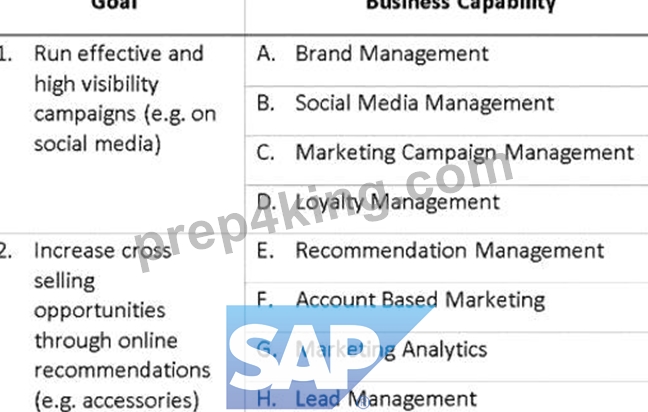
The Wanderlust CIO, along with you, the Chief Enterprise Architect, are in the process of deciding on the application that can potentially replace your existing online marketing application, and you are trying to create the artifact Business Footprint Diagram for decision support ( See table below) Which of the following combinations of goals, business capabilities, and applications would you recommend?
Note: There are 2 correct answers to this question,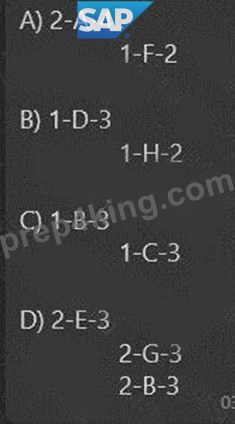
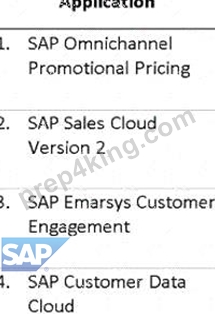
- A. 2-E-3,2-G-3,2-B-3
- B. 1-B-3,1-C-3
- C. 1-D-3,1-H-2
- D. 2-A-4,1-F-2
Answer: B,D
NEW QUESTION # 28
As the Chief Enterprise Architect of your company you have been asked by the CIO to apply agile principles instead of following the sequential phases of TOGAFS ADM. How do you respond?
- A. It is essential to fully understand the business needs and to successfully review the business architecture with critical stakeholders before going to the next phase. In the implementation phase, agile approaches can naturally provide quick wins, constant progress, and the benefit of early validation. The phased approach, during architecture definition phases, avoids double work and will lead to overall better results.
- B. The SAP EA Framework combines the sequential approach of the TOGAF® ADM with agile principles Agile principles are included and can be applied only to Application Architecture. Therefore, the SAP EA Framework is especially suitable for organizations that follow agile principles.
- C. It is reasonable to apply an agile methodology for the most urgent tasks and switch to the process as guided by the SAP EA Framework later, as long as the fundamental IT architecture is not affected Collecting "low-hanging fruit, and realizing instant value before using the SAP EA Framework, and ensuring an overall successful transformation is possible.
- D. The TOGAF® ADM already embraces agile principles within and across phases and generally follows a cyclic approach. The SAP EA Framework builds on that and is especially suitable for organizations that follow agile principles.
Answer: A
Explanation:
Topic 1, Case Study - Wanderlust
Introduction
Wanderlust GmbH, headquartered in Germany but with manufacturing facilities and sales globally, is a leading global manufacturer of conventional fuel driven cars. They are renowned for their best-in-class engineering, but not so much for aftermarket customer service. In recent years, Wanderlust has had limited success expanding into the market of electric vehicles.
Following is Wanderlust's geographical manufacturing and supply spread: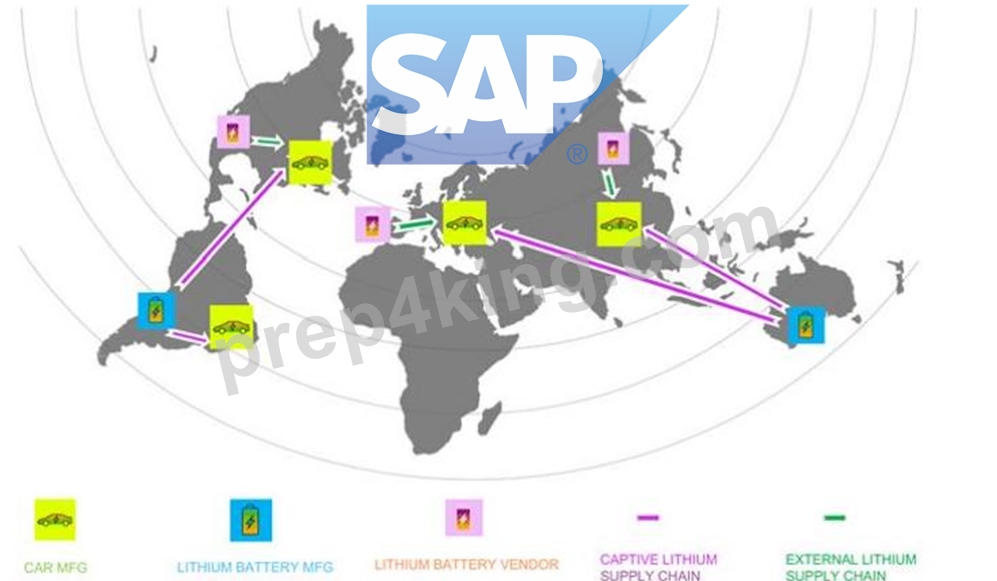
Wanderlust offers one compact electric Sedan (model ELAN) and one compact electric SUV (model ELUV), each with three variants - basic (LX), mid-range (VX) and high-end (ZX). Customers can also choose from a range of five metallic colors, two drive trains and two battery ranges.
Overall, 50 different combinations are offered for all segments and variants put together.
Extracts from CEO Interviews - Business Environment
Constraints/Issues
o Stiff water consumption regulations and enormous penalties for violation - Lithium extraction is a heavy water intensive process and mine locations are in very arid areas like the Australian outback and Atacama Desert o Significant dependence on external suppliers of Lithium batteries due to limited number of manufacturing units, long lead times and high carbon footprint in all car manufacturing facilities except Brazil.
o Long delays in spare battery availability, leading to an avalanche of unresolved battery related customer complaints for vehicles under warranty o Limited charging infrastructure, long charging cycles (as compared to refilling fuel) and slow resolution of battery related complaints.
o Dwindling in store footfall due to pandemic (for feature-based vehicle selection prior to test drive) Wanderlust offers one compact electric Sedan (model ELAN) and one compact electric SUV (model ELUV), each with three variants - basic (LX), mid-range (VX) and high-end (ZX). Customers can also choose from a range of five metallic colors, two drive trains and two battery ranges.
Overall, 50 different combinations are offered for all segments and variants put together.
Extracts from CEO Interviews - Business Environment
Constraints/Issues
o Stiff water consumption regulations and enormous penalties for violation - Lithium extraction is a heavy water intensive process and mine locations are in very arid areas like the Australian outback and Atacama Desert o Significant dependence on external suppliers of Lithium batteries due to limited number of manufacturing units, long lead times and high carbon footprint in all car manufacturing facilities except Brazil.
o Long delays in spare battery availability, leading to an avalanche of unresolved battery related customer complaints for vehicles under warranty o Limited charging infrastructure, long charging cycles (as compared to refilling fuel) and slow resolution of battery related complaints.
o Dwindling in store footfall due to pandemic (for feature-based vehicle selection prior to test drive) Extracts from CIO Interviews - IT Environment Extracts from CIO Interviews - IT Environment Strategic Priorities - IT o Ease of usage o Ease of Maintenance o Total Cost of Ownership Optimization o Time to Value Acceleration Transformation Status o Only at a conceptual stage - no planning done yet o Nascent architecture practice o Unclear on supported processes, required capabilities, applications, and transition path o Yet to identify, prioritize and sequence initiatives As-Is Architecture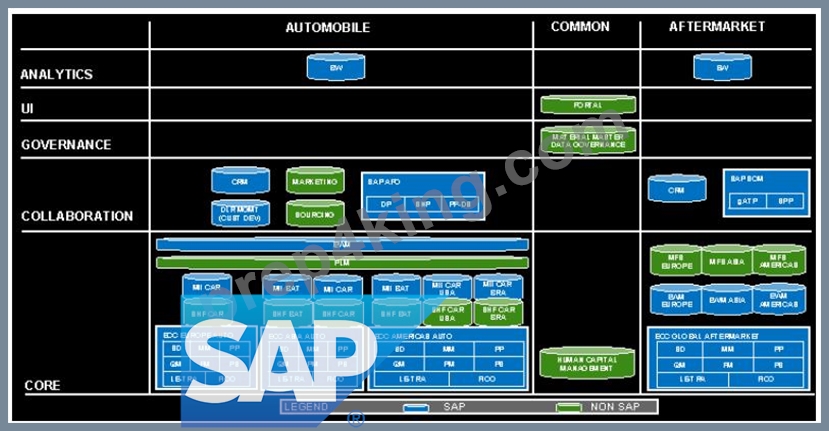
Wanderlust has a separate organization and setup for their Automobile and Aftermarket businesses o Wanderlust is reluctant to consider cloud for Core applications due to data privacy concerns, but are open for Collaboration applications o Automobile business started off in Europe and grew through acquisitions in Asia and Americas o Automobile business runs on three continental SAP ECC instances with inherited, disparate processes, which need to move to S/4HANA o Automobile business is also looking to harmonize their processes across the continents, adopt a seamless, transparent global supply chain for batteries and consolidate the continental instances into a global single instance, data regulations permitting o Automotive business uses a highly complex custom developed dealer management solution on ECC, which needs to be replaced o Automotive business uses SAP APO, which is nearing end of lifecycle and needs to be replaced by IBP (DP & SNP) & S/4HANA (PP-DS) o Automotive business uses several bespoke non-SAP applications, which are considered irreplaceable, except for the Marketing and Sourcing applications, which are expensive to maintain, seldom used and hence need to be replaced o Aftermarket business processes are largely uniform and handled through a single ECC instance which also should move to S/4HANA o Aftermarket business uses SAP SCM which is nearing end of lifecycle and needs to be replaced by S/4HANA AATP (gATP) and eSPP (SPP) Extracts from Interview with Enterprise Architect Enterprise Architecture Dimensions & Maturity o Wanderlust's Key EA Dimensions, their overall purpose and current maturity level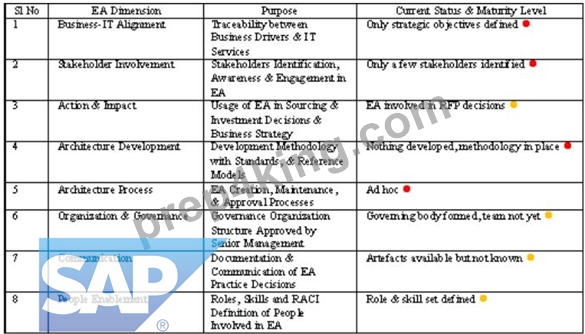
Top three priorities given the current maturity level, are as follows
o Stakeholder Involvement is the topmost priority, to create a Stakeholder Map that'll identify all key EA stakeholders within Wanderlust o Business-IT Alignment is also a top priority, to anchor every IT initiative to a Business Strategy Map, consisting of clearly defined strategic business objectives, tangible goals and measurable value drivers o Architecture Development is the next priority, beginning with development of business architectures, followed by application architectures and finally opportunities & solutions planning Enterprise Architecture Practice Structure (Current)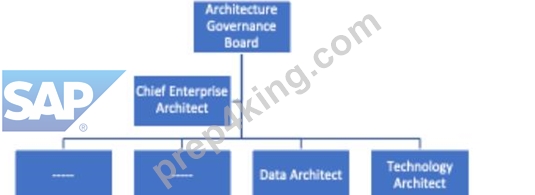
Enterprise Architecture Principles
o Wanderlust's Enterprise Architecture Principles are a collection of crisp and precise one liners pertaining to business, application, information, integration, technology and security aspects of transformation o Some of the EA Principles in the repository are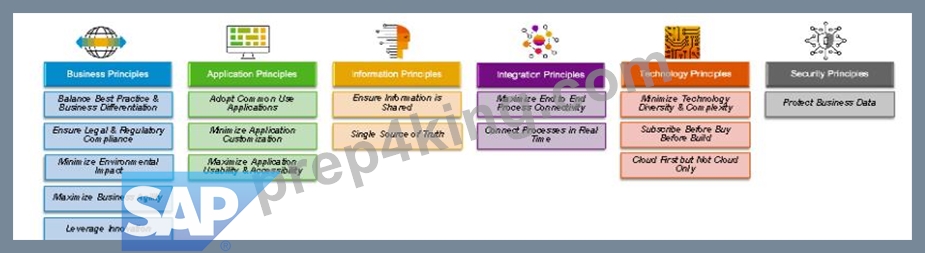
These EA Principles serve as high level directional statements and long term guard rails to the above six aspects of transformation programs & projects o They should ideally correlate (many to many) with the Strategic Objectives, defined in the Business-IT alignment EA Dimension - this is yet to be done though
NEW QUESTION # 29
Green Elk & Company is the world's leading manufacturer of agricultural and forestry machinery. The former company slogan "Elk always runs has recently been changed to "Elk feeds the world" One of Green Elk's strategic goals is to increase its revenue in the emerging markets of China, India, and other parts of Asia by 80 % within three years. This requires a new business model that caters to significantly smaller farms with limited budgets. You are the Chief Enterprise Architect and the CIO asked you to conduct interviews with the key stakeholders of Green Elk to assess the business strategy. You are planning to interview the owner of the business unit of finished goods. Which of the following sets of questions would you ask?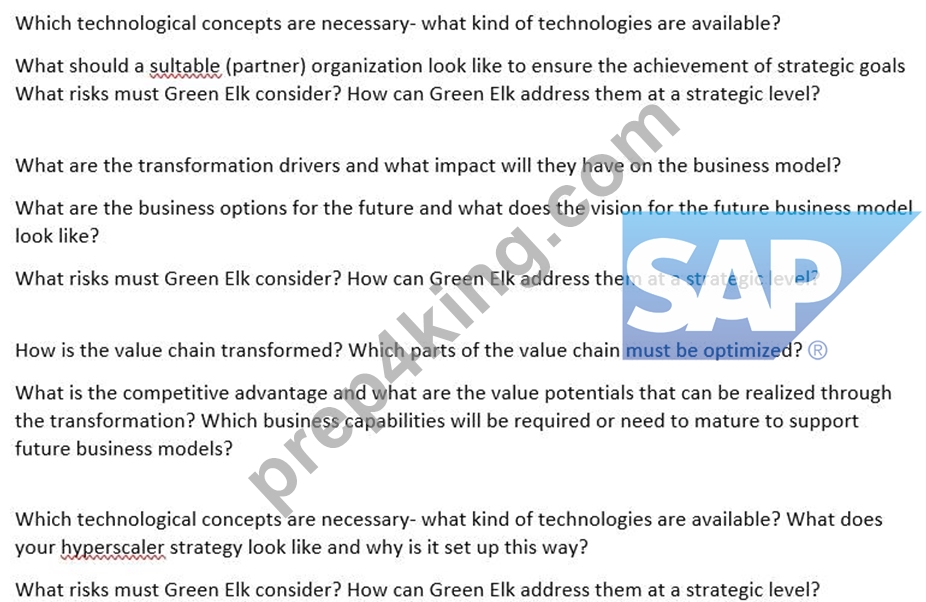
- A. How is the value chain transformed? Which parts of the value chain must be optimized?What is the competitive advantage and what are the value potentials that can be realized through the transformation?
Which business capabilities will be required or need to mature to support future business models? - B. Which technological concepts are necessary- what kind of technologies are available? What should a sultable (partner) organization look like to ensure the achievement of strategic goals What risks must Green Elk consider? How can Green Elk address them at a strategic level?
- C. What are the transformation drivers and what impact will they have on the business model?What are the business options for the future and what does the vision for the future business model look like?What risks must Green Elk consider? How can Green Elk address them at a strategic level?
- D. Which technological concepts are necessary- what kind of technologies are available? What does your hyperscaler strategy look like and why is it set up this way? What risks must Green Elk consider? How can Green Elk address them at a strategic level?
Answer: A
Explanation:
Explanation
According to the SAP Enterprise Architecture Framework, which is a methodology and toolset by the German multinational software company SAP that helps enterprise architects define and implement an architecture strategy for their organizations, the first phase of the architecture development cycle is the architecture vision, which involves defining the scope, objectives, and stakeholders of the architecture project, and creating a high-level vision of the desired outcome. The questions in option C are aligned with this phase, as they aim to understand and assess the business strategy and transformation drivers of Green Elk & Company, and to identify the value proposition, value chain, and business capabilities that are relevant for the new business model. The questions in option C are:
How is the value chain transformed? Which parts of the value chain must be optimized? This question helps to understand how the new business model affects the way Green Elk & Company creates and delivers value to its customers, and which activities or processes need to be improved or changed to support the new business model.
What is the competitive advantage and what are the value potentials that can be realized through the transformation? This question helps to understand what differentiates Green Elk & Company from its competitors, and what benefits or opportunities it can achieve by adopting the new business model.
Which business capabilities will be required or need to mature to support future business models? This question helps to identify the skills, resources, and competencies that Green Elk & Company needs to develop or enhance to enable and sustain the new business model.
The other options (A, B, D) are not correct for the set of questions to ask the owner of the business unit of finished goods, because they either skip or misrepresent some of the aspects of the architecture vision phase.
For example:
Option A is not correct because it focuses too much on the technological aspects of the architecture project, such as technological concepts, integration technology, and partner organization. These aspects are more relevant for later phases of the architecture development cycle, such as application architecture or technology architecture. The questions in option A do not address the business aspects of the architecture project, such as business goals, drivers, constraints, or value proposition.
Option B is not correct because it does not include asking about the value chain or the business capabilities, which are important aspects of the architecture vision phase. The value chain describes how Green Elk & Company creates and delivers value to its customers, and the business capabilities describe what Green Elk & Company can do or needs to do to achieve its goals. The questions in option B only focus on the transformation drivers and the future business model, which are not enough to define a comprehensive architecture vision.
Option D is not correct because it also focuses too much on the technological aspects of the architecture project, such as technological concepts and hyperscaler strategy. These aspects are not relevant for interviewing the owner of the business unit of finished goods, who is more concerned with the business aspects of the architecture project. The questions in option D do not address the value proposition or the value chain, which are essential for understanding how Green Elk & Company creates and delivers value to its customers.
For more information on the SAP Enterprise Architecture Framework and its phases, you can refer to SAP Enterprise Architecture Methodology Guide or SAP Enterprise Architecture Framework - Wikipedia.
NEW QUESTION # 30
Green Elk & Company is the world's leading manufacturer of agricultural and forestry machinery. The former company slogan "Elk always runs" has recently been changed to "Elk feeds the world". One of Green Elk's strategic goals is to increase its revenue in the emerging markets of China, India, and other parts of Asia by 80 % within three years. This requires a new business model that caters to significantly smaller farms with limited budgets. You are the Chief Enterprise Architect and the CIO asks you to assess the now business model for smaller farms with smaller budgets. By applying the Sustainable Business Model Canvas, which sequence of steps is best practice?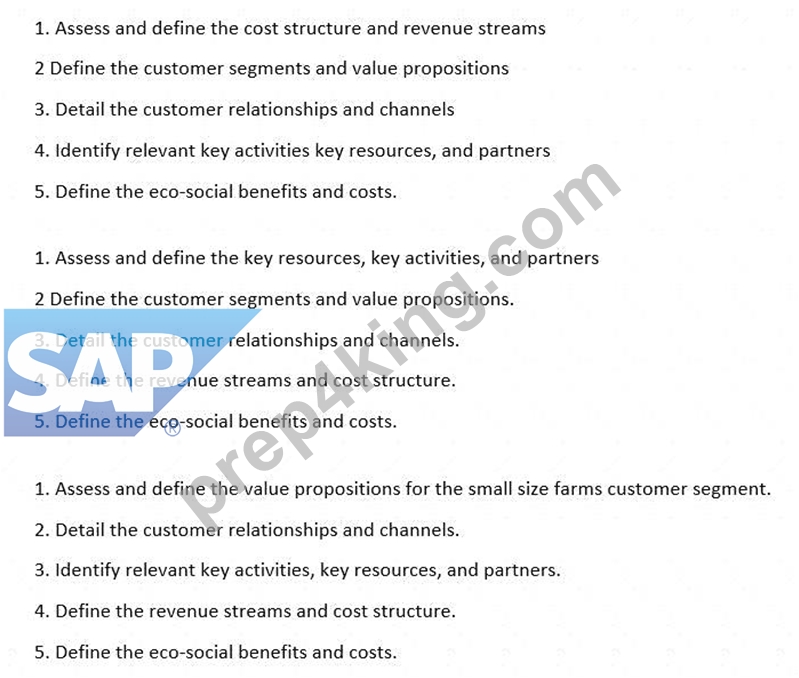
- A. 1. Assess and define the cost structure and revenue streams
2 Define the customer segments and value propositions
3. Detail the customer relationships and channels
4. Identify relevant key activities key resources, and partners
5. Define the eco-social benefits and costs. - B. 1. Assess and define the value propositions for the small size farms customer segment.
2. Detail the customer relationships and channels.
3. Identify relevant key activities, key resources, and partners.
4.Define the revenue streams and cost structure.
5. Define the eco-social benefits and costs. - C. 1. Assess and define the key resources, key activities, and partners
2 Define the customer segments and value propositions.
3. Detail the customer relationships and channels.
4. Define the revenue streams and cost structure.
5. Define the eco-social benefits and costs.
Answer: B
Explanation:
Explanation
According to the Sustainable Business Model Canvas, which is a tool that helps entrepreneurs to design and communicate their business models in a sustainable way, the recommended sequence of steps is:
Assess and define the value propositions for the small size farms customer segment. This step involves defining and describing the products or services that Green Elk & Company offers to its target customers, and how they create value for them. The value propositions should address the needs, problems, or desires of the customers, and highlight the benefits or advantages of Green Elk & Company's solutions over the alternatives.
Detail the customer relationships and channels. This step involves defining and describing how Green Elk & Company interacts with its customers, and how it reaches and delivers its products or services to them. The customer relationships should reflect the type and level of engagement that Green Elk & Company wants to establish and maintain with its customers, such as self-service, personal assistance, or community. The channels should reflect the most effective and efficient ways to communicate and distribute Green Elk & Company's value propositions to its customers, such as online platforms, physical stores, or partners.
Identify relevant key activities, key resources, and partners. This step involves identifying and describing the main activities, resources, and partners that Green Elk & Company needs to perform and leverage to create and deliver its value propositions to its customers. The key activities should reflect the most important tasks or processes that Green Elk & Company undertakes to execute its business model, such as production, marketing, or sales. The key resources should reflect the most essential assets or inputs that Green Elk & Company requires to execute its business model, such as human, physical, financial, or intellectual resources. The key partners should reflect the most strategic relationships or collaborations that Green Elk & Company establishes with other entities to execute its business model, such as suppliers, distributors, or competitors.
Define the revenue streams and cost structure. This step involves defining and describing how Green Elk & Company generates income from its customers, and how much it spends to execute its business model. The revenue streams should reflect the sources and mechanisms of income that Green Elk & Company obtains from selling its products or services to its customers, such as sales, subscriptions, or fees. The cost structure should reflect the types and amounts of expenses that Green Elk & Company incurs to execute its business model, such as fixed costs, variable costs, or economies of scale.
Define the eco-social benefits and costs. This step involves defining and describing how Green Elk & Company contributes to or affects the environment and society through its business model. The eco-social benefits should reflect the positive impacts or externalities that Green Elk & Company creates for the environment and society through its products or services, such as reducing emissions, improving health, or enhancing education. The eco-social costs should reflect the negative impacts or externalities that Green Elk & Company causes for the environment and society through its products or services, such as increasing waste, depleting resources, or harming biodiversity.
The other options (A and B) are not correct for the sequence of steps to apply the Sustainable Business Model Canvas, because they either skip or misrepresent some of the steps in this tool. For example:
Option A is not correct because it does not include assessing and defining the value propositions for the small size farms customer segment, which is a crucial step to understand and communicate how Green Elk & Company creates value for its customers. It also suggests defining the cost structure and revenue streams before defining the customer segments and value propositions, which is not a logical order since the latter determine the former.
Option B is not correct because it does not include identifying relevant key activities, key resources, and partners, which are important aspects of executing a business model. It also suggests retrieving the documentation for the solutions that need to be integrated instead of assessing and defining the value propositions for the small size farms customer segment, which is not relevant for designing a new business model.
For more information on the Sustainable Business Model Canvas and its steps, you can refer to The Sustainable Business Canvas or Sustainable Business Model Canvas: A Review And Framework Development.
NEW QUESTION # 31
What kind of applications can you develop with SAP Business Application Studio?
- A. ABAP applications
- B. SAPUI5 (SAP Fiori) applications and ABAP applications
- C. SAPUI5 (SAP Fiori) applications
Answer: B
Explanation:
Explanation
SAP Business Application Studio is a cloud-based development environment that can be used to develop SAPUI5 (SAP Fiori) applications and ABAP applications. It provides a wide range of features and tools that can help developers to create high-quality applications quickly and easily.
SAPUI5 applications are web-based applications that are built using the SAPUI5 framework. They are typically used to provide users with a modern and user-friendly interface to SAP applications.
ABAP applications are traditional SAP applications that are written in the ABAP programming language.
They are typically used to implement business logic and to interact with SAP data.
SAP Business Application Studio also provides support for other types of applications, such as Node.js applications and Python applications. However, it is most commonly used to develop SAPUI5 and ABAP applications.
Here are some of the features and tools that are available in SAP Business Application Studio:
A code editor with syntax highlighting and code completion.
A debugger that allows developers to step through code and debug errors.
A test runner that allows developers to run unit tests and integration tests.
A deployment manager that allows developers to deploy applications to SAP Cloud Platform.
A library of pre-built components that can be used to speed up development.
SAP Business Application Studio is a powerful development environment that can be used to create a wide range of applications. It is a good choice for developers who want to create SAPUI5 and ABAP applications.
NEW QUESTION # 32
Demand and Supply Planning (SAP IBP) implementation has been identified as a quick win, based on feedback from a large cross section of Wanderlust stakeholders. As the Chief Enterprise Architect, you have now been asked to scope and contextualize the architecture project. Architecture principles have already been adopted. Which of the following activities should you to initiate to conclude the Statement of Architecture Work for the intended SAP IBP implementation initiative? Note: There are 3 correct answers to this question.
- A. Conduct a high-level Capability Assessment to identify areas of improvement (business and IT).
- B. Conduct a Fit Gap Assessment to identify requirements that cannot be met
- C. Conduct a technical Proof of Concept to understand features and functionalities of SAP IBP.
- D. Define the Solution Context for the architecture work.
- E. Outline the aspirational Solution Concept to address the stakeholders' needs and business requirements.
Answer: B,D,E
Explanation:
The Statement of Architecture Work should encompass a Fit Gap Assessment to understand what requirements are currently not met by existing capabilities, the definition of the Solution Context to set the boundaries and scope of the architecture project, and the outline of the aspirational Solution Concept that encapsulates the stakeholders' needs and business requirements. These steps are vital in the preparatory phase to ensure that the architecture work is well-defined and targeted to deliver the anticipated outcomes.
= These activities are part of standard enterprise architecture practices and are necessary to develop a comprehensive and actionable Statement of Architecture Work that guides the SAP IBP implementation initiative.
NEW QUESTION # 33
What are important factors of the SAP BTP. Cloud Foundry environment during runtime that you need to consider?
- A. Programming language and buildpacks
- B. CPU capacity and memory size of the application
- C. Number of users and API calls
Answer: B
Explanation:
In the SAP BTP Cloud Foundry environment, several factors are critical during runtime to ensure optimal application performance and scalability. The correct answer, A, highlights two fundamental aspects:
Programming language: This determines the specific buildpack to be used, as Cloud Foundry supports multiple programming languages through different buildpacks which provide framework and runtime support for applications.
Buildpacks: These are key components in the Cloud Foundry architecture that provide runtime and framework support necessary to build and deploy applications in various programming languages effectively.
These elements are crucial as they directly impact how applications are built, deployed, and run within the Cloud Foundry environment, influencing performance, compatibility, and scalability.
Reference:
SAP BTP Cloud Foundry documentation.
Buildpacks and programming language support in SAP BTP.
NEW QUESTION # 34
Green Elk & Company is the world's leading manufacturer of agricultural and forestry machinery. The former company slogan "Elk always runs" has recently been changed to "Elk feeds the world" One of Green Elk's strategic goals is to increase its revenue in the emerging markets of China, India and other parts of Asia by 80 % within three years. This requires a new business model that caters to significantly smaller farms with limited budgets The CIO asks you, the Chief Enterprise Architect, to present an architecture vision to address the aforementioned business challenge. According to the SAP Enterprise Architecture Framework, what is the best approach?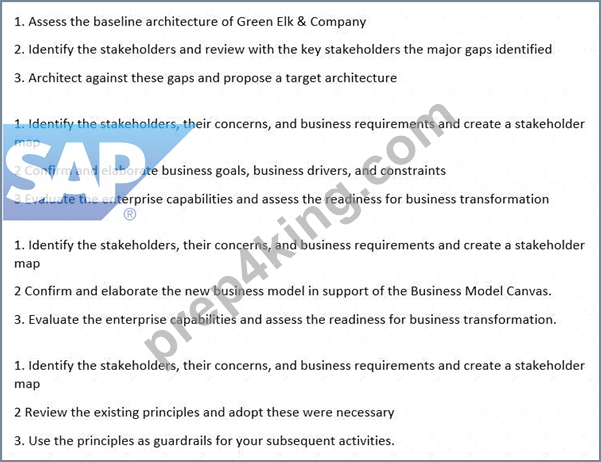
- A. 1. Identify the stakeholders, their concerns, and business requirements and create a stakeholder map.2 Review the existing principles and adopt these were necessary3. Use the principles as guardrails for your subsequent activities.
- B. 1. Identify the stakeholders, their concerns, and business requirements and create a stakeholder map/2 Confirm and elaborate business goals, business drivers, and constraints/3 Evaluate the enterprise capabilities and assess the readiness for business transformation
- C. 1. Identify the stakeholders, their concerns, and business requirements and create a stakeholder map/2 Confirm and elaborate the new business model in support of the Business Model Canvas./3. Evaluate the enterprise capabilities and assess the readiness for business transformation.
- D. 1. Assess the baseline architecture of Green Elk & Company/2. Identify the stakeholders and review with the key stakeholders the major gaps identified/3. Architect against these gaps and propose a target architecture.
Answer: C
Explanation:
Explanation
According to the SAP Enterprise Architecture Framework, which is based on the TOGAF ADM, the architecture vision is the first phase of the architecture development cycle. The purpose of this phase is to define the scope, objectives, and stakeholders of the architecture project, and to create a high-level vision of the desired outcome. The steps involved in this phase are:
Identify the stakeholders, their concerns, and business requirements and create a stakeholder map. This step involves identifying and analyzing the key stakeholders of the architecture project, such as business owners, users, customers, partners, vendors, regulators, etc. The stakeholder map is a document that shows the relationships and interests of the stakeholders, as well as their expectations and concerns regarding the architecture project.
Confirm and elaborate the new business model in support of the Business Model Canvas. This step involves confirming and refining the business goals, drivers, and constraints that motivate the architecture project, and defining the new business model that will enable the achievement of those goals. The Business Model Canvas is a tool that helps to describe, design, and analyze the new business model in a structured and visual way. It consists of nine building blocks that cover the key aspects of the business model, such as value proposition, customer segments, revenue streams, cost structure, etc.
Evaluate the enterprise capabilities and assess the readiness for business transformation. This step involves evaluating the current state of the enterprise in terms of its capabilities, resources, processes, systems, and culture, and assessing how ready it is for undergoing a business transformation. This step also involves identifying the gaps and risks that need to be addressed or mitigated in order to achieve the desired future state.
The other options (A, B, D) are not correct for the architecture vision according to the SAP Enterprise Architecture Framework, because they either skip or misrepresent some of the steps in this phase. For example:
Option A is not correct because it does not include creating a stakeholder map or confirming and elaborating the new business model in support of the Business Model Canvas, which are essential steps to define and communicate the scope and objectives of the architecture project.
Option B is not correct because it does not include creating a stakeholder map or defining a new business model in support of the Business Model Canvas, which are essential steps to understand and align with the needs and expectations of the stakeholders.
Option D is not correct because it does not include confirming and elaborating the new business model in support of the Business Model Canvas or evaluating the enterprise capabilities and assessing the readiness for business transformation, which are essential steps to define and validate the desired outcome and identify the gaps and risks.
For more information on the SAP Enterprise Architecture Framework and its phases, you can refer to SAP Enterprise Architecture | SAP Help Portal or SAP Certified Professional - SAP Enterprise Architect.
NEW QUESTION # 35
......
SAP P_SAPEA_2023 Exam Syllabus Topics:
| Topic | Details |
|---|---|
| Topic 1 |
|
| Topic 2 |
|
| Topic 3 |
|
| Topic 4 |
|
Free P_SAPEA_2023 Dumps are Available for Instant Access: https://www.prep4king.com/P_SAPEA_2023-exam-prep-material.html
View All P_SAPEA_2023 Actual Exam Questions Answers and Explanations for Free: https://drive.google.com/open?id=1eY3mUJqnz2p8PL7i-m6g2dDsoA5rK30c
